

News
News Center
Science and Technology Daily | Stem Cell Technology: Still Need to Fasten the "Safety Belt" of Standards on the Fast Track
2023-11-21
Currently, stem cells Technology has become a hot topic in the biopharmaceutical industry, emerging as one of the research areas with the greatest potential for transformation. What roles do stem cells play? And how can we promote the standardization and regularization of stem cell research and applications in China?
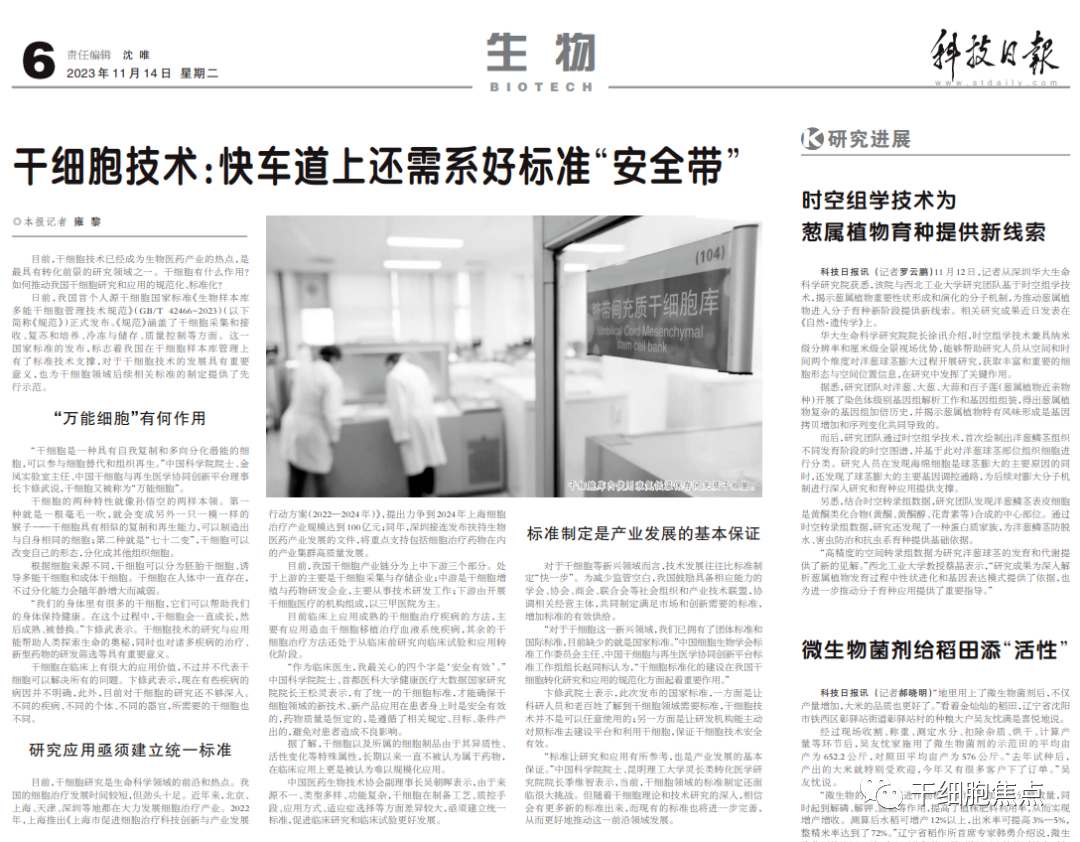
Recently, China officially released its first national standard for human-derived stem cells: the "Technical Specification for Management of Pluripotent Stem Cells in Biobanks" (GB/T 42466-2023), hereinafter referred to as the "Specification." The Specification covers key aspects such as stem cell collection and receipt, cryopreservation and culture, freezing and storage, as well as quality control.
The release of this national standard marks a significant milestone, providing standardized technical support for stem cell sample bank management in China. It holds great importance for the advancement of stem cell technology and also sets a pioneering example for the development of future related standards in the stem cell field.
"What is the role of "pluripotent cells"?"
"Stem cells are cells with the remarkable ability to self-replicate and differentiate into multiple cell types, making them crucial for cell replacement and tissue regeneration," says Bian Xiuwu, an academician of the Chinese Academy of Sciences, director of the JinFeng Laboratory, and chairman of the China Stem Cell and Regenerative Medicine Collaborative Innovation Platform. He adds that stem cells are also referred to as " Versatile cells ”。
The two unique characteristics of stem cells are like Sun Wukong’s two magical strands of hair. The first is that with just a blow, a single strand can transform into an exact replica of the original monkey—stem cells possess remarkable self-replication and regenerative abilities, allowing them to generate identical copies of themselves. The second is "72 Transformations," meaning stem cells can change their shape and differentiate into various types of tissue-specific cells.
Stem cells can be classified into embryonic stem cells, induced pluripotent stem cells, and adult stem cells, depending on their cellular origin. Stem cells are naturally present throughout the human body, though their ability to differentiate tends to decline as we age.
"Our bodies contain numerous stem cells, which play a crucial role in helping us stay healthy. During this process, stem cells continuously grow, mature, and eventually get replaced," said Bian Xiuwu. Research and application of stem cell technology not only enable humans to unlock the mysteries of life but also hold significant potential for treating various diseases and developing and screening new pharmaceuticals.
Stem cells have significant clinical potential, but that doesn’t mean they can solve every problem. Bian Xiuwu notes that the causes of some diseases remain unclear, and current research on stem cells is still not thorough enough. Moreover, the type of stem cells needed varies depending on the specific disease, individual, and organ involved.
Research applications urgently require the establishment of unified standards.
Currently, stem cell research is at the forefront and a hot topic in the field of life sciences. Although China's cell therapy sector has a relatively short history, it is gaining significant momentum. In recent years, cities like Beijing, Shanghai, Tianjin, and Shenzhen have been aggressively advancing their cell therapy industries.
In 2022, Shanghai launched the "Shanghai Action Plan for Promoting Innovation and Industrial Development in Cell Therapy (2022–2024)," aiming to propel the city’s cell therapy industry to reach a market scale of 10 billion yuan by 2024. Later that same year, Shenzhen rolled out a series of documents aimed at boosting the biopharmaceutical industry, with a strong focus on supporting the high-quality development of industrial clusters—including those centered around cell therapy drugs.
Currently, China's stem cell industry chain is divided into three segments: upstream, midstream, and downstream. At the upstream level, the main players are stem cell collection and storage companies. The midstream segment comprises stem cell proliferation and drug development firms, primarily focused on research and technological innovation. Meanwhile, the downstream sector consists of institutions offering stem cell-based medical treatments, with top-tier Grade-III hospitals forming the backbone of this segment.
Currently, the clinically established methods for stem cell therapy to treat diseases mainly involve the application of Hematopoietic stem cell transplantation therapy Hematological disorders remain, while other stem cell therapies are still transitioning from preclinical research toward clinical trials and eventual application.
"As a clinician, the two words that matter most to me are 'safe and effective'," says Wang Songling, an academician of the Chinese Academy of Sciences and director of the National Institute for Health and Medical Big Data at Capital Medical University. He emphasizes that only with unified stem cell standards can we ensure that new technologies and products in the stem cell field are both safe and effective when applied to patients—guaranteeing consistent drug quality, adherence to relevant regulations, clear objectives, and well-defined conditions, thereby preventing any adverse effects on patients.
It is understood that stem cells and their associated cell products have long been regarded as not belonging to the category of drugs due to their unique characteristics, such as heterogeneity and variability in activity. Moreover, they are considered particularly challenging to scale up for clinical applications.
Wu Chaohui, Vice Chairman of the China Association for Medical Biotechnology, stated that due to their diverse origins, varied types, and complex functions, stem cells exhibit significant differences in preparation processes, quality control methods, application approaches, and indication selection. Therefore, there is an urgent need to establish unified standards to better facilitate the advancement of clinical research and trials.
Standard-setting is a fundamental guarantee for industry development.
For emerging fields like stem cells, technological advancements often outpace the development of standardized guidelines. To address regulatory gaps, China encourages social organizations—such as academies, associations, chambers of commerce, and federations—as well as industry technology alliances that possess the necessary expertise to coordinate relevant market players and collaboratively develop standards that meet both market demands and innovation needs, thereby enhancing the effective supply of these standards.
"Regarding the emerging field of stem cells, we already have both group and international standards—but what’s currently lacking is a national standard," says Zhao Tongbiao, Director of the Standards Committee at the Chinese Society for Cell Biology and Head of the Standards Working Group for the China Stem Cell and Regenerative Medicine Collaborative Innovation Platform. "The establishment of stem cell standardization plays a crucial role in promoting the standardized translation research and application of stem cells in China."
Academician Bian Xiuwu stated that the newly released national standard serves two key purposes: first, it helps researchers and the general public understand the need for standards in the stem cell field, emphasizing that stem cell technology cannot be used arbitrarily. Second, it empowers research and development institutions to proactively align their platform-building efforts—and their use of stem cells—against these standards, ensuring the safety and efficacy of stem cell technologies.
“Standards provide crucial reference points for both research and application, serving as a fundamental guarantee for industry development,” said Ji Weizhi, an academician of the Chinese Academy of Sciences and director of the Primate Translational Medicine Research Institute at Kunming University of Science and Technology. He added that currently, developing standards in the stem cell field still faces significant challenges. However, as research into stem cell theories and technologies continues to advance, he believes more innovative standards will emerge, while existing ones will be refined further—ultimately helping to propel this cutting-edge field forward even more effectively.
Reprint Notice: This article is reprinted from Science and Technology Daily. If there are any issues, please contact us for removal.
Related News

Here is the title—h1 placeholder text


Copyright © Jiuzhitang Maker (Beijing) Cell Technology Co., Ltd.
Powered by: 300.cn SEO | Privacy Policy