

News
News Center
Big news! Shenzhen's Nanshan District issues a document supporting medical and research institutions within the free trade zone to conduct research and facilitate the translational applications of cutting-edge technologies such as stem cells, immune cells, and gene therapy.
来源:Shenzhen Nanshan District People's Government Official Website
2021-06-15
On June 8, 2021, Nanshan District of Shenzhen officially released the "Notice from the Office of the People's Government of Nanshan District, Shenzhen, on Issuing the Implementation Plan for Promoting the Leading Development of the Biopharmaceutical Industry (2021-2025)" on its official website.
The implementation plan clearly states: Supporting the growth of the precision medicine industry. Strengthening technological development in the field of genetic testing and pioneering clinical trials with stem cells. Support enterprises in developing gene-testing technologies and promoting their application in areas such as disease screening and COVID-19 nucleic acid testing. Additionally, support the establishment of a national-local joint engineering laboratory dedicated to personalized cell therapy technology. Promote the standardization of technical and management protocols in the cell industry. Support medical and research institutions within the free trade zone to conduct research and facilitate the translation of cutting-edge technologies such as stem cells, immune cells, and gene therapies into practical applications. (Responsible Units: District Health and Wellness Bureau, District Science and Technology Innovation Bureau, District Industry and Information Technology Bureau)
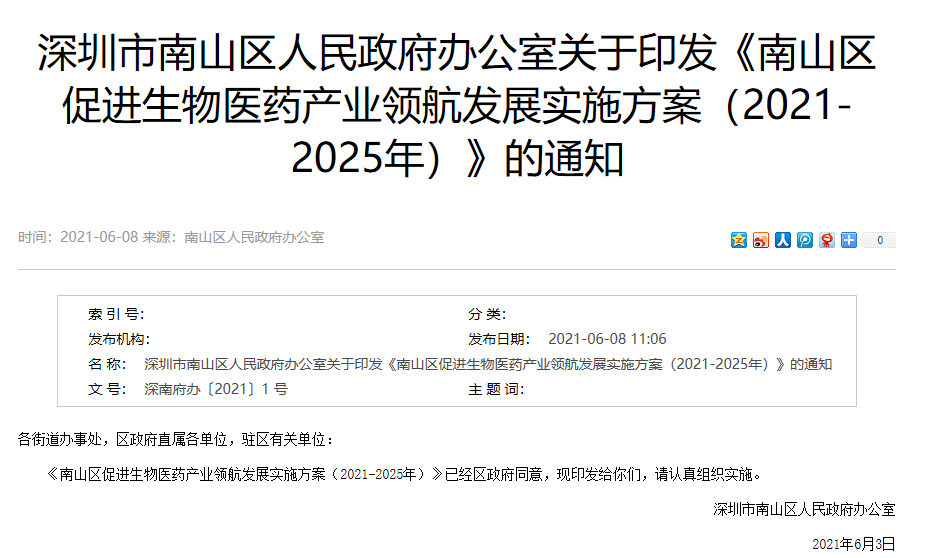
The full text of the document and the policy interpretation are as follows:
Nanshan District Implementation Plan for Leading the Development of the Biopharmaceutical Industry (2021–2025)
To thoroughly implement the guiding principles outlined in documents such as the "Opinions of the CPC Central Committee and the State Council on Supporting Shenzhen's Development as a Pilot Demonstration Zone for Socialism with Chinese Characteristics," the "Implementation Plan for the Comprehensive Reform Pilot Program to Build Shenzhen into a Pilot Demonstration Zone for Socialism with Chinese Characteristics (2020–2025)," and the "Guiding Opinions of Shenzhen on Promoting the Agglomeration and Development of the Biopharmaceutical Industry," this Implementation Plan has been specially formulated to strengthen the use of digital technologies in driving industrial transformation and upgrading, thereby propelling the leading development of the biopharmaceutical industry in Nanshan District.
I. General Requirements
(1) Guiding Principles
Guided by Xi Jinping Thought on Socialism with Chinese Characteristics for a New Era, we will fully implement the spirit of the 19th National Congress of the Communist Party of China and the Second, Third, Fourth, and Fifth Plenary Sessions of the 19th Central Committee. We will prioritize scientific and technological self-reliance and strength as a strategic cornerstone for industrial transformation, continuously strengthen the development of an industry-wide shared-service ecosystem, accelerate breakthroughs in new products and technologies, help enterprises grow stronger and larger, expedite the planning and construction of specialized industrial parks, and foster the branding, high-end positioning, and cluster development of the biopharmaceutical industry in Nanshan District.
(II) Fundamental Principles
Stick to independent innovation. Strengthen original "0 to 1" innovations, focusing on cutting-edge basic research, accelerate cross-sector technology integration, and foster the convergence of key, common technologies—such as artificial intelligence, pharmaceutical big data, and cloud computing—with the biopharmaceutical industry.
Enhance shared services. Develop a technology resource-sharing service system, leveraging public technology platforms as the key driver to establish core service platforms—including those focused on basic research, applied basic research, and biopharmaceutical contract R&D services. Continuously promote the open sharing of various resource elements, comprehensively improving the level of shared services within the biopharmaceutical industry.
Focus on key areas. By addressing the current and long-term, high-priority needs of the biopharmaceutical industry—particularly in critical sectors—we will optimize integrated innovation, drive the advancement of high-end medical devices, accelerate the development of breakthrough innovative drugs, support the growth of the precision medicine sector, and ultimately position the biopharmaceutical industry as a global leader.
Emphasize intensive development. Adhering to the concept of intensive development, we will fully leverage NanShan District's existing spatial resources, capitalizing on our two core strengths: technological innovation and talent aggregation. This will enable us to establish an integrated support and service system within the park—encompassing platform services, financial services, talent support, intellectual property protection, customs-based trade and technology services, and brand promotion—ultimately creating a cutting-edge modern biopharmaceutical industry cluster.
(III) Development Goals
Building a robust biomedical industry service ecosystem in Nanshan District, attracting top-tier talent and innovative teams, nurturing a group of dynamic, high-potential SMEs driven by innovation, fostering the concentration of globally influential industry leaders, and developing specialized, niche-focused industrial parks—aiming to establish the district as a pioneering domestic hub and a world-class innovation powerhouse.
— By 2022, the biopharmaceutical industry’s output reached 40 billion yuan, with 30 new drug candidates receiving clinical trial approvals and 10 drugs securing marketing authorization. Additionally, more than 400 Class II and Class III medical device registration certificates were issued.
— By 2025, the biopharmaceutical industry is expected to reach an output value of 60 billion yuan, with 60 new drug candidates receiving clinical trial approvals and 20 drugs securing marketing authorization. Additionally, more than 1,000 Class II and Class III medical device registration certificates will be issued, and 10 new biopharmaceutical companies will be listed on the market.
2. Building a Platform for Shared Technological Innovation
1. Build platforms for both basic research and application-oriented basic research. Leveraging the innovative and intellectual resource advantages of Xili Lake International Science and Education City, support universities and research institutions in establishing key laboratories in the field of life sciences. Additionally, advance the joint construction by the province and ministry of the National Key Laboratory of Tumor Chemical Genomics, as well as the Key Laboratory of Bioequivalence Studies for Generic Drug Evaluation under the National Medical Products Administration, strengthening efforts to enhance original innovation capabilities. (Responsible Units: District Bureau of Science, Technology and Innovation; Nanshan Branch of Municipal Market Supervision Administration)
2. Develop a contract research and development (CRO) service platform for biopharmaceuticals. Leveraging the Marketing Authorization Holder (MAH) system for drugs and the Medical Device Registration Holder system, we will strategically establish a group of internationally advanced R&D and production service platforms equipped with state-of-the-art facilities and cutting-edge technology. Actively collaborating with institutions such as Shenzhen Institute for Drug Control and Shenzhen Tsinghua University Research Institute, we will foster and attract platforms and companies that offer outsourced R&D and manufacturing services to enterprises, thereby accelerating product development timelines and enhancing the industry’s global competitiveness. Additionally, we will support the establishment of a New Drug Safety Evaluation Research Center to elevate the quality and efficiency of drug safety assessment services. (Responsible Units: Nanshan Bureau of District Science, Technology & Innovation; Nanshan Bureau of District Health & Wellness; Nanshan Regulatory Bureau of Municipal Market Supervision Administration)
3. Enhance the inspection, testing, and registration review platforms. Support Shenzhen Institute of Pharmaceutical Inspection in upgrading its capabilities to provide testing services for pharmaceuticals and medical devices. Accelerate the establishment of the Shenzhen Medical Device Review and Certification Agency under the Guangdong Provincial Food and Drug Administration’s Review and Certification Center, improving the quality of technical reviews and on-site inspections for medical device registration, and speeding up the approval process for medical device registrations. (Responsible Units: District Bureau of Science, Technology and Innovation; District Bureau of Development and Reform; District Bureau of Health and Wellness; Nanshan Branch of Municipal Market Supervision Administration)
4. Establish a Clinical Application and Medical Translation Platform. Leveraging the strengths of enterprises, universities, and research institutions, collaborate with medical facilities to create a translational medicine research platform aimed at advancing foundational translational medicine studies. Additionally, explore the development of a performance evaluation system for public hospitals within the region, incentivizing healthcare professionals to engage in clinical research and technology transfer, thereby accelerating the commercialization of medical innovations. (Responsible Units: District Health Commission, District Science and Technology Innovation Bureau)
5. Establish a rapid customs clearance platform for cross-border biological reagents and consumables. In the Qianhai-Shekou Free Trade Pilot Zone, explore and implement innovative regulatory models for the import and export of biological reagents, streamline the distribution process, and provide comprehensive services—including pre-approval, foreign trade customs clearance, customs declaration and inspection, as well as domestic and international logistics and warehousing/distribution—to enhance service quality and efficiency. This initiative will create a dedicated green channel for professional biological reagent imports and exports, supporting enterprises in their production and R&D activities. (Responsible Units: District Bureau of Industry and Information Technology, District Bureau of Health and Wellness, District Bureau of Science, Technology, and Innovation)
3. Building a Science and Technology Innovation Service System
6. Establish a Biopharmaceutical Resource Sharing Alliance. Integrate platform resource information from the region’s biopharmaceutical industry, proactively align with the needs of biopharmaceutical companies, and provide enterprises with "one-stop" end-to-end services covering product R&D, technical consulting, safety assessments, clinical trials, inspection and testing, product registration, and quality system certification—ultimately enhancing the level of professional service delivery. Leveraging the advantages of the national-level Medical Device Trade Measures Research and Evaluation Base, offer companies valuable information services such as overseas compliance guidance and insights into technical trade barriers, helping businesses participate in shaping international technical regulations. Additionally, actively engage in gathering, organizing, and analyzing scientific and technological intelligence, providing tailored information services to companies, universities, and research institutions. (Responsible Units: District Bureau of Science, Technology and Innovation; District Bureau of Industry and Information Technology)
7. Strengthen intellectual property rights operation and protection. Support the construction of the China (Shenzhen) Intellectual Property Protection Center, providing services such as pre-examination of patent applications and pre-confirmation of patent rights to enterprises, universities, and research institutions. Leveraging the Shenzhen branch of the National Overseas Intellectual Property Dispute Response Guidance Center, assist companies, universities, and research organizations in proactively addressing international IP disputes, thereby enhancing their ability to manage overseas risks and bolstering their global competitiveness. (Responsible Unit: District Science and Technology Innovation Bureau)
8. Strengthen financial support for businesses. Fully leverage the role of Nanshan District’s Industry Development Investment Guidance Fund, explore the establishment of a sub-fund dedicated to the biopharmaceutical industry, and invest in innovative projects to help them get off the ground. Encourage financial institutions to offer diversified financing services—such as financial leasing, pledge-based guarantees, and intellectual property-backed loans—to support the growth of SMEs. Additionally, introduce subsidies for biopharmaceutical technology insurance, providing financial assistance to local biopharmaceutical companies covering the costs of purchasing clinical trial liability insurance for their drugs. (Responsible Units: District Bureau of Industry and Information Technology, District State-owned Assets Supervision and Administration Bureau, District Bureau of Science, Technology and Innovation, District Bureau of Finance)
9. Organize brand-specific professional events. Leveraging flagship competitions such as the China Innovation and Entrepreneurship Competition and the Nanshan "Entrepreneurial Star" Contest, strengthen industry and specialized competitions in the biopharmaceutical sector, while identifying high-quality startups and innovative projects. Regularly host industry-sharing and matchmaking conferences, financing roadshows, and specialized forums tailored to the biopharmaceutical sector. Encourage companies to actively participate in international professional conferences and trade shows, further enhancing Nanshan's influence across multiple dimensions. (Responsible Units: District Bureau of Science, Technology & Innovation; District Bureau of Industry and Information Technology)
10. Proactively plan and establish investment in healthcare institutions in Hong Kong and Macao. Actively engage with healthcare providers from Hong Kong and Macao, aiming to set up internationally recognized, high-quality medical facilities in Nanshan District—either through wholly-owned, joint-venture, or collaborative models involving these regions. Explore the possibility of utilizing pharmaceuticals and medical devices already approved for sale in Hong Kong and Macao but not yet available on the mainland, thereby addressing the growing health needs of the population and fostering a vibrant, innovation-driven Healthy Nanshan initiative. (Responsible Units: District Health Commission, District Bureau of Industry and Information Technology)
4. Tackle Key Technologies in Core Areas
11. Digital technologies are driving the deep integration of BT and IT. They support the convergence and development of cutting-edge technologies such as artificial intelligence, big data, and 5G in the biopharmaceutical sector, fostering new business models and innovative products. We will accelerate the development of smart medical devices like intelligent medical imaging equipment and surgical robots, while advancing the application of AI in areas such as disease diagnosis, drug discovery, and large-scale data processing. Additionally, we’ll actively promote remote healthcare applications powered by 5G technology—including teleconsultations, remote surgery, and remote epidemiological investigations—to unlock new drivers of economic growth. (Responsible Units: District Health Commission, District Science and Technology Innovation Bureau, District Industry and Information Technology Bureau, District Government Service Data Administration)
12. Promote the high-end development of medical devices. Encourage leading companies in the industry to collaborate with cutting-edge domestic and international teams on tackling key challenges related to medical equipment and critical components, thereby strengthening the industry's ability to lead at the high end. In the medical imaging sector, support research and development of advanced imaging technologies such as PET-CT, PET-MRI, and color ultrasound diagnostic systems. In the high-value consumables area, prioritize the development of implantable and interventional devices like fully biodegradable vascular stents, as well as innovative medical consumables such as bio-regenerative materials. Meanwhile, in the in vitro diagnostics field, enhance R&D efforts focused on both diagnostic equipment and associated reagents. (Responsible Units: District Science and Technology Innovation Bureau, District Industry and Information Technology Bureau, District Health Commission)
13. Strategic Planning for the Development of Major Innovative Drugs. Support pharmaceutical companies in advancing innovative drug research and development, with a strong focus on creating novel chemical drugs targeting cutting-edge therapeutic targets and mechanisms for major diseases. Additionally, encourage generic drug manufacturers to conduct rigorous evaluations ensuring their products meet the same quality and efficacy standards as originator drugs. Furthermore, back biopharmaceutical firms in developing next-generation vaccines, with a particular emphasis on accelerating the research and production of COVID-19 vaccines. (Responsible Units: District Bureau of Science and Technology Innovation, District Bureau of Health and Wellness, Nanshan Administration of Shenzhen Municipal Market Supervision Bureau)
14. Supporting the Growth of the Precision Medicine Industry: Strengthen technological development in the field of genetic testing and take the lead in pioneering clinical trials involving stem cells. Encourage enterprises to advance genetic testing technologies, promoting their application in areas such as disease screening and COVID-19 nucleic acid testing. Support the establishment of a National-Local Joint Engineering Laboratory focused on personalized cell therapy technologies, and drive the standardization of technical and management protocols within the cell industry. Additionally, facilitate research and translational applications of cutting-edge technologies like stem cell, immune cell, and gene therapies at medical and research institutions located within the free trade zone. (Responsible Units: District Health Commission, District Science and Technology Innovation Bureau, District Industry and Information Technology Bureau)
5. Develop Intensive and Efficient Industrial Parks
15. Introduce flagship benchmark enterprises in specialized sectors. Actively connect with and attract internationally leading companies in the biopharmaceutical sector, aiming to establish their headquarters or R&D centers in Nanshan District. Encourage leading enterprises to proactively draw in upstream and downstream firms within the industry chain for collaborative growth. Support these industry leaders in partnering with major internet giants to expand online sales channels, enhancing their capacity to deliver high-quality products globally and fostering comprehensive development of the biopharmaceutical industry chain. (Responsible Units: District Bureau of Industry and Information Technology, District Bureau of Science, Technology and Innovation)
16. Foster and strengthen high-growth SMEs. Increase support for fast-growing, early-stage enterprises by providing specialized incubation services to startups that possess technology, demonstrate strong potential, yet face funding challenges. Additionally, establish a tailored service system for "Little Giant" companies—leaders in their niche sectors—to enhance product quality, drive quality transformation, and help these firms expand into both domestic and international markets. (Responsible Units: District Enterprise Service Center, District Bureau of Industry and Information Technology, District Bureau of Science and Technology Innovation)
17. Enhance the park's professional service capabilities. The High-Tech North Life & Health Industrial Park will focus on attracting a group of public platforms specializing in pharmaceutical R&D, genetic testing, and cell therapy, thereby boosting its expertise in pharmaceuticals and precision medicine services. Meanwhile, Shenzhen International Innovation Valley and Nanshan Smart Park will prioritize the introduction of public service platforms in areas such as medical imaging, high-value consumables, and in-vitro diagnostics, strengthening their capacity to deliver cutting-edge medical device solutions. Additionally, efforts will be stepped up to reinforce ecological and environmental infrastructure within industrial parks, refine the park’s environmental risk management system, and elevate its overall pollution control capabilities. (Responsible Units: District Bureau of Science, Technology and Innovation; District Bureau of Industry and Information Technology; Shenzhen Municipal Ecology and Environment Bureau, Nanshan Administration)
18. Develop specialized incubators. Strategically establish new bio-incubators targeting small and micro enterprises, providing innovative companies with access to shared experimental equipment essential for R&D, testing, pilot-scale production, and scale-up processes. Additionally, these incubators will offer specialized industrial spaces such as GMP-compliant laboratories and ultra-cleanroom facilities, creating new opportunities for businesses to drive innovation and advance their research and development efforts. (Responsible Units: District Bureau of Science, Technology & Innovation; District Bureau of Development and Reform; District Bureau of Urban Renewal and Land Consolidation)
19. Establish a standardized production base tailored for large and medium-sized enterprises. We will uphold the coordinated development of innovation-driven R&D and high-end manufacturing, with a particular focus on building specialized, standardized production facilities centered around the medical device sector. These facilities will provide large and medium-sized companies with the essential space needed for common production processes. Additionally, we will prioritize the implementation of a land supply model that combines leasing with eventual transfer options ("lease-to-own" or "lease-and-transfer"), helping to reduce land costs for industrial projects. This approach also supports and encourages businesses to upgrade and expand their existing factory facilities, unlocking new growth opportunities. (Responsible Units: District Bureau of Science, Technology & Innovation; District Bureau of Development & Reform; District Bureau of Industry, Information Technology & Communications; District Bureau of Urban Renewal and Land Consolidation)
21. Strengthen organizational leadership. Establish a Leading Development Task Force for the Biomedical Industry in Nanshan District, with the District Mayor serving as the Chairperson and the district leader overseeing the District Bureau of Science and Technology Innovation as the Vice-Chairperson. Relevant departments will serve as member units. The task force will oversee the overall planning and strategic positioning of the biomedical industry, as well as organize, coordinate, and advance the implementation of major project initiatives. All member units will work closely together to ensure that all tasks are effectively carried out. The task force office will be located within the District Bureau of Science and Technology Innovation.
6. Supporting Measures
21. Strengthen organizational leadership. Establish a Leading Development Task Force for the Biomedical Industry in Nanshan District, with the District Mayor serving as the组长 (Chairperson) and the district leader overseeing the District Bureau of Science and Technology Innovation as the 副组长 (Vice-Chairperson). Relevant departments will serve as member units. The task force will oversee the overall planning and strategic positioning of the biomedical industry, as well as organize, coordinate, and advance the implementation of major project initiatives. All member units will work closely together to ensure that all tasks are effectively carried out. The task force office will be located within the District Bureau of Science and Technology Innovation.
22. Strengthen financial support: Increase fiscal support for the biopharmaceutical industry, innovate approaches to using public funds, and enhance the efficiency of capital allocation. Fully leverage the role of social capital by attracting diverse biopharmaceutical investment funds and institutions, thereby strengthening and refining the investment and financing ecosystem for the biopharmaceutical sector in Nanshan District.
23. Expand spatial planning and layout. Effectively secure space for industrial development by increasing the supply of land and facilities dedicated to industry, with priority given to ensuring the successful implementation of major projects. Strengthen integrated management of industrial spaces, leveraging innovative industrial properties, maker spaces, incubators, accelerators, industrial parks, and other resources to provide comprehensive, full-lifecycle spatial support for R&D institutions, public service platforms, and businesses.
24. Optimize talent support. Deeply implement the Nanshan District "Leading Talent" Program to attract and cultivate a group of internationally renowned science and technology professionals, along with high-caliber innovation teams. Focus on recruiting and nurturing industry-specific technical talent, while prioritizing solutions to challenges such as housing and education for their children. Establish and refine a robust mechanism that ensures technology and skills—among other key factors—are fairly rewarded, thereby boosting the enthusiasm and creativity of professional technical experts.
Policy Interpretation of the "Nanshan District Implementation Plan for Leading Development of the Biopharmaceutical Industry (2021–2025)"
Date: 2021-06-08
Source: Nanshan District People's Government Office
I. Background and Rationale
In August 2019, the "Opinions of the CPC Central Committee and the State Council on Supporting Shenzhen in Building a Pilot Demonstration Zone for Socialism with Chinese Characteristics" were released, emphasizing the need to take the lead in establishing a modernized economic system characterized by high-quality development. On October 14, 2020, General Secretary Xi Jinping, speaking at the celebration marking the 40th anniversary of the Shenzhen Special Economic Zone, stressed the importance of steadfastly implementing the new development philosophy, pursuing an innovation-driven growth strategy, and proactively planning for strategic emerging industries—integrating innovation chains around industrial chains and aligning industrial chains with innovation initiatives. To seize the strategic opportunities presented by the "Dual Zones" initiative, on January 22, the General Office of the Shenzhen Municipal People's Government issued the "Guiding Opinions on Promoting the Agglomeration Development of the Biomedical Industry in Shenzhen," along with the "Implementation Plan for the Agglomeration Development of Shenzhen’s Biomedical Industry (2020–2025)," the "Action Plan for the Development of Shenzhen’s Biomedical Industry (2020–2025)," and the "Several Measures to Promote the Agglomeration Development of Shenzhen’s Biomedical Industry"—collectively known as the "1+3" series of documents. These documents clearly outline the goal of staying ahead of cutting-edge biomedical technology trends while fostering industry chain integration, enhancing value chain competitiveness, and optimizing market linkages. Building upon the city’s "1+3" series of documents and tailored to the unique conditions of Nanshan District, the "Several Measures to Promote the Leading Development of Shenzhen’s Biomedical Industry in Nanshan District" have been introduced.
II. Objectives and Tasks
Focusing primarily on innovative drug development and the creation of cutting-edge medical devices, and leveraging key initiatives such as building a major public technology service platform, fostering science-and-tech finance, supporting high-level talent in innovation and entrepreneurship, and organizing significant innovation events—these efforts will accelerate the concentration and growth of critical resources, including capital, technology, flagship projects, high-growth enterprises, and top-tier talent. Ultimately, this strategy aims to establish Nanshan as a pioneering innovation hub for the biopharmaceutical industry in the Greater Bay Area, driving the sector toward leadership and sustained growth.
III. Main Content
This measure consists of 16 articles, with the main contents as follows:
(1) Support the construction of major innovation platforms by providing annual funding of up to 20 million yuan for collaborative public service platforms that address common needs in R&D and technology transfer within the biopharmaceutical industry—specifically in areas such as clinical translation, biopharmaceutical safety evaluation, CRO services, and CDMO operations. Additionally, a one-time subsidy covering 50% of the site renovation costs will be provided, along with rent subsidies lasting up to five years, with a cumulative cap of 8 million yuan.
(II) Enhance new drug innovation capabilities and encourage companies to engage in pharmaceutical R&D. For biopharmaceutical innovative products developed independently, phased funding will be provided according to the different R&D stages completed after the company registers in Nanshan District, with a maximum annual subsidy of up to RMB 20 million per company.
(III) Encourage bioequivalence evaluations of generic drugs, and provide incentives to companies whose first generic drug nationwide passes such an evaluation in the previous year, with a maximum reward of up to 1 million yuan per company annually.
(4) Encourage medical device research and development by providing incentives for companies that obtained Class II or Class III medical device product registration certificates in the previous year, with a maximum reward of up to 3 million yuan per enterprise annually.
(5) Foster high-growth enterprises by providing a subsidy of 30% of their actual rent costs, with annual subsidies capped at RMB 2 million each and limited to a maximum of three consecutive years.
(6) Strengthen efforts to attract high-quality enterprises by providing financial support to pharmaceutical product marketing authorization holders and medical device product registration holders that newly relocate to Nanshan. The maximum annual subsidy for each applicant entity will be up to RMB 10 million for marketing authorization holders and RMB 1.5 million for medical device registration holders.
(7) Support high-level talent in innovation and entrepreneurship by providing financial assistance—up to 20 million yuan—to enterprises founded by such talents, covering areas like site establishment, rent subsidies, and industrialization efforts.
(8) Strengthen support for science and technology finance: For biopharmaceutical companies that complete loan registration on the Nanshan Science and Technology Finance Online Platform, secure a loan, and make timely repayments, a subsidy will be provided equivalent to 70% of the interest amount up to the specified cap, with a maximum annual subsidy of RMB 1 million per company.
(9) Subsidize waste treatment costs by providing proportional support for expenses incurred by companies in handling hazardous wastes such as pharmaceutical waste, with a maximum subsidy of 300,000 yuan per company annually.
(10) Support the organization of major science and technology innovation events by providing funding for significant initiatives in the biopharmaceutical sector, as approved by relevant departments of national, provincial, and municipal governments. Funding will be capped at up to 2 million yuan per event.
IV. Scope of Involvement
This measure applies to enterprises, institutions, social organizations, and privately-run non-enterprise entities registered in Nanshan District and holding independent legal status, engaged in research and development, manufacturing, and services related to pharmaceuticals, medical devices, and other relevant fields. In the pharmaceutical sector, priority support is given to chemical drugs, biologics, traditional Chinese medicine, and more. In the medical device field, key areas of support include medical imaging equipment, high-value consumables, implantable/interventional devices, and in vitro diagnostic products.
V. Important Notes
All support projects covered by this measure must be applied for through the Nanshan District Industry Development Comprehensive Service Platform (http://sfms.szns.gov.cn), except for special cases. Each applicant organization should carefully review the "Nanshan District Independent Innovation Industry Development Special Fund Management Measures," this measure, and the operational guidelines for individual support programs before submitting their application as outlined in the respective notification. For technical issues such as being unable to log into the system or encountering difficulties uploading/downloading documents, please contact the technical support hotline at 400-161-6289 for assistance. For questions related to policy guidelines, please reach out to the relevant management department listed on the Nanshan District Industry Development Comprehensive Service Platform for the specific project.
Additionally, to help applicant organizations thoroughly understand and effectively implement the contents of this measure, our bureau will organize policy briefings at an appropriate time. Please stay tuned and actively participate.
6. Explanation of Key Terms
CRO stands for Contract Research Organization, an organization specializing in pharmaceutical research and development. CRO companies are responsible for carrying out all or part of the activities involved in the drug development process. Their primary goal is to conduct full or partial scientific or medical research on behalf of pharmaceutical companies. They offer a range of specialized technical services, including preclinical research such as new drug discovery, R&D, and development, as well as clinical data management and support for new drug registration applications—often earning compensation either through commercial arrangements or based on the contractual relationship between the client and the service provider.
CDMO stands for Contract Development and Manufacturing Organization, an entity that primarily provides customized R&D and manufacturing services to multinational pharmaceutical companies and biotechnology firms. These services include process development and preparation of innovative drugs—particularly in the pharmaceutical sector—as well as process optimization, scale-up production, regulatory submissions, validation batch production, and commercial-scale manufacturing.
Related News

Here is the title—h1 placeholder text


Copyright © Jiuzhitang Maker (Beijing) Cell Technology Co., Ltd.
Powered by: 300.cn SEO | Privacy Policy