

News
News Center
[State Council] Will prioritize supporting regulatory science research in areas such as cell-based therapies, accelerating the development and launch of new products.
来源:Website of the Central People's Government of the People's Republic of China
2021-05-27
In recent years, China's pharmaceutical industry has experienced rapid growth, yet drug safety remains the issue that consistently draws the public's greatest concern. To comprehensively strengthen pharmaceutical regulatory capacity-building and better safeguard and promote the health of the people, the General Office of the State Council has issued "Opinions of the General Office of the State Council on Comprehensively Strengthening the Building of Drug Regulatory Capabilities."
The opinion clearly states: prioritize support for regulatory science research in areas such as traditional Chinese medicine, biologics (including vaccines), gene therapies, cell-based therapies, AI-powered medical devices, new materials for medical devices, and novel cosmetic ingredients, thereby accelerating the development and market launch of innovative products.
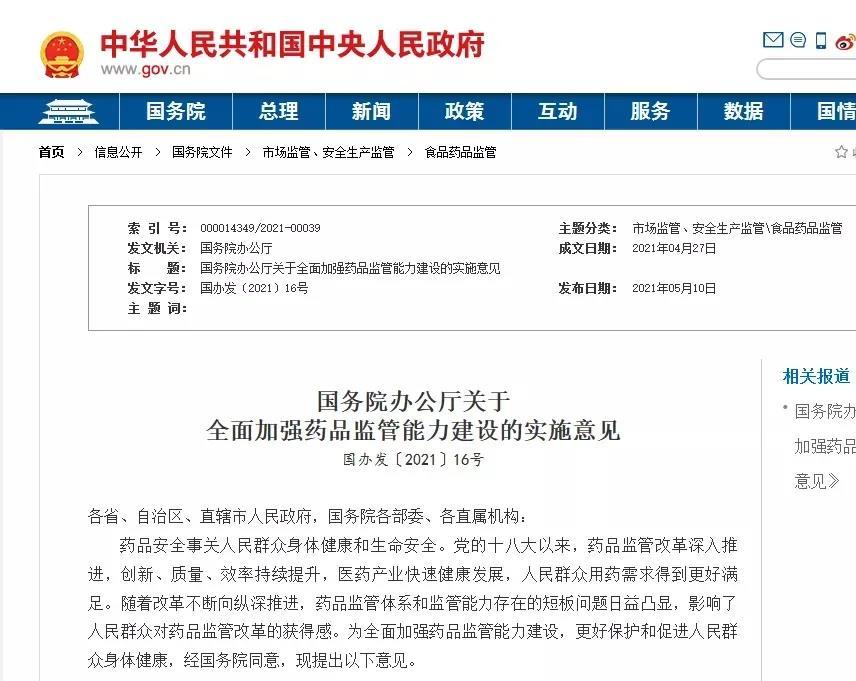
The full text is as follows.
The General Office of the State Council regarding
Opinions on Comprehensively Strengthening the Building of Drug Regulatory Capacity
Guobanfa [2021] No. 16
People's Governments of provinces, autonomous regions, and municipalities directly under the central government; and all ministries, commissions, and institutions directly affiliated with the State Council:
Drug safety is directly linked to the health and lives of the people. Since the 18th National Congress of the Communist Party of China, significant progress has been made in deepening pharmaceutical regulatory reforms, leading to continuous improvements in innovation, quality, and efficiency. As a result, the pharmaceutical industry has experienced rapid, healthy growth, better meeting the public's growing needs for safe and effective medicines. However, as these reforms continue to advance, existing gaps in the drug regulatory system and oversight capabilities have become increasingly apparent, diminishing the public's sense of satisfaction with the reform process. To comprehensively strengthen drug regulatory capacity-building and further safeguard and promote the health of the people, the following recommendations are now proposed, with approval from the State Council.
I. General Requirements
Guided by Xi Jinping Thought on Socialism with Chinese Characteristics for a New Era, we will fully implement the spirit of the 19th National Congress of the Communist Party of China and the Second, Third, Fourth, and Fifth Plenary Sessions of the 19th Central Committee. We will firmly strengthen the "Four Consciousnesses," uphold the "Four Confidences," and ensure "Two Upholds," diligently carrying out the decisions and deployments of the CPC Central Committee and the State Council. Upholding the principle that "people and life come first," we will rigorously enforce the "Four Strictest" requirements, focusing on strengthening foundations, addressing shortcomings, breaking bottlenecks, and driving continuous improvement. By aligning with internationally accepted standards, we will deepen reforms of the review and approval system, relentlessly advance regulatory innovation, and bolster our regulatory workforce. In line with the demands of high-quality development, we will accelerate the establishment of a scientific, efficient, and authoritative drug regulatory framework—ensuring robust safeguards for drug safety while continuously elevating the scientific, legal, international, and modernized dimensions of our regulatory efforts. This will pave the way for China to transition from a major pharmaceutical producer to a global leader in pharmaceutical innovation, better meeting the public's growing need for safe and effective medicines.
II. Key Tasks
(1) Improve the legal and regulatory framework Fully implement the *Drug Administration Law of the People’s Republic of China*, the *Traditional Chinese Medicine Law of the People’s Republic of China*, the *Vaccine Administration Law of the People’s Republic of China*, as well as the *Medical Device Supervision and Administration Regulations* and the *Cosmetics Supervision and Administration Regulations*, while accelerating the formulation and revision of supporting regulations and rules. Promptly review, refine, and update regulatory documents, steadily advance the development and revision of technical guidelines, and build a more comprehensive and robust legal and regulatory framework for pharmaceutical oversight.
(II) Enhancing standard management capabilities Accelerate the refinement of a standardized working mechanism led by the government, driven by enterprises, and supported by societal participation. Continue implementing the National Action Plan for Enhancing Pharmaceutical Standards. Strengthen the development of the pharmaceutical standards framework, improve standard management systems and policies, and enhance meticulous oversight throughout the entire process of standard formulation and revision. Further refine the medical device standards system, establish a robust cosmetics standards framework, and ensure seamless coordination among national, industry, association, and enterprise-level standards. Actively engage in international standard harmonization efforts to boost alignment with global benchmarks. Additionally, bolster the digital infrastructure for standards and elevate the quality of public services related to standards.
(III) Enhancing technical review capabilities Focusing on the strategic needs of the nation’s regional coordinated development, we will integrate existing regulatory resources, optimize the structure of review and inspection agencies for traditional Chinese medicine and biological products (such as vaccines), and strengthen technical expertise. We will also refine the collaborative mechanisms linking emergency response with the review and approval of innovative drugs and medical devices, encouraging the adoption of cutting-edge technologies and fostering the development of new products. Furthermore, we will fully leverage the role of the Expert Advisory Committee in guiding review decisions, ensuring transparency by publicly disclosing expert opinions, review outcomes, and detailed review reports in accordance with the law. Additionally, we will enhance communication channels and methods, increase the frequency of interactive meetings for innovative drugs and medical devices, and provide more robust technical guidance and support to applicants. Finally, we will improve the system for importing urgently needed, already-marketed overseas medicines into the country. At the same time, we will establish a national collaborative research mechanism for drug toxicology, reinforcing efforts to identify and control harmful substances in pharmaceuticals.
(4) Optimizing the Chinese Medicine Review Mechanism Following the principles of traditional Chinese medicine (TCM) development, we will establish a unique TCM review and evaluation system that integrates TCM theories, clinical experience, and rigorous clinical trials. We will place greater emphasis on evidence-based medicine and explore initiatives to conduct real-world evidence studies for pharmaceutical products. Additionally, we will optimize the registration classification of proprietary Chinese medicines, strengthen regulatory oversight of innovative drugs, improved new drugs, classic ancient formula-based compound preparations, and drugs with identical names and formulations. Finally, we will refine the system of technical guidance principles, enhance quality control throughout the entire process, and foster the sustainable inheritance, innovation, and advancement of TCM.
(5) Improve the inspection and enforcement system To implement the relevant directives on building a professional and specialized team of pharmaceutical inspectors, we must accelerate the development of an inspector system that effectively meets the regulatory needs at all levels. In response to critical issues uncovered during COVID-19 prevention and control efforts, as well as in handling major cases, provinces (autonomous regions, and municipalities directly under the central government) should leverage existing resources to strengthen the infrastructure of pharmaceutical inspection agencies, expand their inspector teams, and extend regulatory oversight to broader areas. We will also innovate inspection approaches and methods, enhancing the urgency and effectiveness of inspections. Additionally, we’ll reinforce overseas inspections to ensure stringent quality control over imported pharmaceutical products. A unified deployment mechanism for inspection personnel will be established: National pharmaceutical inspection agencies will centrally coordinate and assign inspectors from various levels according to the demands of critical regulatory tasks, while provincial drug regulatory authorities will manage and allocate inspectors within their jurisdictions based on specific inspection and enforcement needs. Furthermore, personnel engaged in pharmaceutical testing and related activities at the city and county levels are encouraged to obtain pharmaceutical inspector qualifications, enabling them to actively participate in inspection and regulatory work.
(6) Improve the inspection and case-handling mechanism Strengthen the building of the drug inspection team, enhance collaboration between inspection and regulatory activities, and improve enforcement coordination. Additionally, refine the provincial-level mechanisms for market and drug regulation oversight. Promote the implementation of standardized requirements for pharmaceutical regulatory capacity at city and county levels—specifically, ensure that municipal and county-level market regulators bolster their drug enforcement capabilities within integrated law enforcement teams, guaranteeing they have access to qualified professionals, adequate funding, and necessary equipment aligned with their regulatory responsibilities. Finally, all levels of drug regulatory authorities should work closely with public security agencies to establish a robust mechanism for coordinating administrative and criminal enforcement. This includes promptly sharing information on major cases and swiftly referring suspected drug-related criminal cases, leaving no room for illegal activities—especially those involving vaccines—and ensuring decisive action against such offenses.
(7) Strengthen coordination among regulatory authorities To implement the division of regulatory responsibilities, strengthen cross-regional and cross-level collaborative guidance on pharmaceutical oversight, and enhance coordination among departments at the national, provincial, municipal, and county levels responsible for drug regulation throughout the entire lifecycle of pharmaceutical products. Additionally, bolster provincial drug regulatory authorities' supervision and guidance over drug oversight activities conducted by city- and county-level market regulators, while establishing robust mechanisms for information sharing, joint investigations, and personnel deployment. Finally, refine the provincial, municipal, and county-level systems for jointly discussing and addressing drug safety risks, ensuring a unified, nationwide approach to pharmaceutical regulation.
(8) Enhancing inspection and testing capabilities Focusing on the cutting edge of international technology, we will leverage the China National Institute for Food and Drug Control as the leading institution, rely on the key laboratories of the National Medical Products Administration as the backbone, and draw on provincial-level testing and inspection agencies as a solid foundation, to establish a comprehensive, scientifically robust, and authoritative system for testing and inspecting pharmaceuticals, medical devices, and cosmetics. We will accelerate the establishment of the National Key Laboratory for Evaluation and Testing of Innovative Vaccines and Biotechnology Products, integrating it into the national laboratory network. Additionally, we will continue strengthening the infrastructure of medical device testing and inspection facilities, while expediting the development of laboratories dedicated to detecting prohibited and restricted substances in cosmetics and conducting safety assessments—thus addressing critical gaps in our testing and inspection capabilities. Provincial-level testing and inspection agencies are encouraged to provide enhanced technical guidance and support to their municipal and county-level counterparts, helping them achieve and maintain high-quality standards through targeted capacity-building initiatives.
(9) Enhancing the batch release capacity for biological products (vaccines) Strengthen and enhance the batch release capabilities of biological products (vaccines) at the China National Institute for Food and Drug Control, while simultaneously advancing capacity-building efforts for provincial-level drug testing and inspection institutions. In accordance with laws and regulations, qualified provincial-level drug testing and inspection agencies will be designated as national batch release facilities for biological products (vaccines).
(10) Building a National Pharmacovigilance System Strengthen the construction of the adverse reaction (event) monitoring system for drugs, medical devices, and cosmetics, as well as enhance the capacity-building of drug adverse reaction monitoring institutions at provincial, municipal, and county levels. Develop Good Pharmacovigilance Practice Standards, improve information systems, promote robust information sharing, and advance the integrated data linkage between these systems and the suspected adverse event monitoring system used by disease control agencies in vaccine-related contexts.
(11) Enhancing cosmetic risk monitoring capabilities Integrate risk information from various sources, including cosmetic product technical reviews and approvals, supervised sampling inspections, on-site audits, adverse reaction monitoring, complaint reporting, public opinion tracking, and enforcement investigations. Build a unified and comprehensive risk-monitoring system, fostering a coordinated and collaborative working mechanism. Additionally, advance capacity-building initiatives in areas such as the high-throughput screening platform for cosmetic safety risk substances, rapid testing technologies, and online monitoring systems, gradually enabling timely detection, precise analysis, scientific early warning, and effective management of cosmetic safety risks.
(12) Improve the emergency management system Perfecting emergency response plans for drug safety incidents at all levels of people's governments and strengthening the emergency management mechanism. Enhancing unified command and coordination across departments—including inspection and testing, system audits, review and approval processes, and monitoring and evaluation—during sudden, severe, and extraordinary public health events. Strengthening the construction of the National Medical Products Administration’s Safety Emergency Drill Center, conducting regular drug safety emergency drills, and improving the emergency response capabilities of drug regulatory agencies at all levels. Establishing an emergency mechanism for the rapid deployment of national reference material and raw sample resources, effectively maintaining critical emergency testing equipment and facilities, and bolstering research and development in key emergency technologies.
(Thirteen) Enhance the information-based traceability system Establish unified information-based drug traceability standards, implement pharmaceutical coding management, and ensure that marketing authorization holders fulfill their traceability responsibilities. Build a nationwide collaborative platform for drug traceability, integrating tracking data across the entire lifecycle of drugs—from manufacturing and distribution to clinical use—and starting with critical products like vaccines, blood products, and specialty medications, gradually enabling full visibility into each drug’s origin and destination. Gradually roll out unique identification systems for medical devices, strengthening integration with healthcare administration and health insurance management systems. Leverage traceability data to enhance risk management, product recalls, emergency response efforts, and other key areas, ultimately elevating the precision and effectiveness of regulatory oversight.
(Fourteen) Promote digital management across the entire lifecycle Strengthen the application of big data in the regulation of pharmaceuticals, medical devices, and cosmetics, enhancing capabilities such as comprehensive data collection spanning the entire lifecycle—from laboratories to end-users; seamless data integration and connectivity; advanced risk assessment; and efficient information sharing. Additionally, bolster the development and utilization of product-specific dossiers for drugs, medical devices, and cosmetics, while intensifying efforts to leverage data across government agencies, industry organizations, enterprises, and third-party platforms. Furthermore, explore and pioneer key, cross-cutting technologies and applications rooted in big data, driving forward the digital transformation and modernization of both regulatory frameworks and the broader industry.
(Fifteen) Enhancing the Service Level of "Internet + Pharmaceutical Regulation" Applications Promote the integrated application of the industrial internet in regulatory areas such as vaccines, blood products, and specialty pharmaceuticals. Establish and improve an electronic, standardized technical documentation system for drug registration, as well as an information-based electronic submission system for medical device registration, driving the digitalization and networking of review, approval, and license management processes. Accelerate the development of mobile internet applications in the cosmetics regulatory field to enhance operational efficiency and service quality. Foster seamless interconnectivity and resource sharing among regulatory systems at all levels and across various agencies, gradually enabling "one-stop online services" and "cross-provincial services." Adhere to the principle of managing the internet through the internet itself, advancing the construction of network monitoring systems, strengthening oversight and inspection of online sales activities, reinforcing the management of third-party online platforms, and bolstering the capacity to effectively regulate the quality of online transactions involving drugs, medical devices, and cosmetics.
(Sixteen) Implementing China's Pharmaceutical Regulatory Science Action Plan Staying at the forefront of global pharmaceutical regulatory science, we will strengthen research on regulatory policies and establish pharmaceutical regulatory science research centers in collaboration with universities, research institutions, and other key partners. This will accelerate the development and implementation of innovative tools, standards, and methodologies for regulation. Additionally, pharmaceutical regulatory science research will be integrated into relevant national science and technology programs. Focus on supporting regulatory science research in areas such as traditional Chinese medicine, biologics (including vaccines), gene therapies, cell-based therapies, AI-powered medical devices, new materials for medical devices, and innovative cosmetic ingredients—accelerating the development and market launch of cutting-edge products.
(17) Enhancing the Quality of the Regulatory Team Strengthen professional regulatory requirements by rigorously controlling the entry process for regulatory teams and optimizing their age and professional composition. Intensify efforts to cultivate talent, with a focus on systematically developing high-level reviewers and inspectors, while also bolstering the training of internationally-minded, top-tier professionals. This will enable a "dual improvement" in both the quantity and quality of core regulatory personnel. Each province (autonomous region, or municipality directly under the central government) should tailor its provincial-level training programs for professionalized drug inspectors to align with local pharmaceutical industry development needs and specific regulatory tasks. Additionally, enhance training and hands-on practice for drug regulators at provincial, municipal, and county levels, continuously improving their investigative capabilities and narrowing disparities in regulatory capacity across different regions. Furthermore, reinforce the development of national drug regulatory training facilities, creating an integrated education, training, and simulation system that combines research, training, and practical exercises. Leverage cutting-edge information technologies to establish and promote cloud-based platforms, thereby enhancing the accessibility and reach of educational and training initiatives nationwide.
(18) Enhancing the Internationalization of Regulatory Standards To meet the demands of globalizing pharmaceutical regulation, we must deepen our involvement in international regulatory coordination mechanisms and actively participate in shaping global standards. Strengthen collaborative exchanges and cooperation on pharmaceutical regulation with key trading countries and regions, as well as with priority nations and areas along the Belt and Road Initiative. By focusing on flagship products and critical sectors, we can drive mutual recognition of regulatory frameworks. Drawing on international best practices, we will enhance the national pharmaceutical regulatory quality management system, encourage local authorities to upgrade their regulatory capabilities and standards, and spearhead efforts to bring pharmaceutical oversight in regions such as Beijing-Tianjin-Hebei, the Guangdong-Hong Kong-Macao Greater Bay Area, and the Yangtze River Delta up to world-class, cutting-edge levels.
III. Supporting Measures
(Nineteen) Strengthen organizational leadership All regions must earnestly fulfill their political responsibilities for pharmaceutical safety, especially vaccine safety, upholding the principle of shared accountability between the Party and the government—and ensuring that everyone takes ownership and fully meets their duties in safeguarding public health. Provincial-level people's governments should establish coordinated mechanisms for pharmaceutical safety, strengthening leadership over drug regulatory efforts. Meanwhile, local governments at all levels must implement territorial management responsibilities for pharmaceutical safety, refine the accountability system, enhance the performance evaluation framework, and assume legal responsibility for pharmaceutical safety within their respective areas.
(Twenty) Improve the governance mechanism Strengthen the principal responsibility of pharmaceutical companies for drug safety, and leverage the self-regulatory role of industry associations. Enhance coordination and collaboration among departments involved in pharmaceutical management, while also improving data integration and application between drug regulation and healthcare/medical insurance management systems. This will facilitate information sharing and foster a unified approach to drug safety governance. Additionally, implement credit-based regulatory measures for drug safety, establishing, in accordance with laws and regulations, clear criteria for identifying entities with serious violations and breaches of trust, along with mechanisms for public disclosure and information sharing. Finally, enforce joint credit-based penalties to ensure accountability and compliance.
(21) Strengthen policy support Innovatively refine funding policies tailored to the unique demands of pharmaceutical regulatory work, ensuring rational allocation of regulatory budgets. Establish a dynamic adjustment mechanism for fees charged to companies undergoing review and approval processes. Integrate technical support services—such as review, inspection, testing, monitoring & evaluation, and standard management—into the scope of government-purchased services, optimizing budget expenditure structures and enhancing the effectiveness of these services. Additionally, provide targeted transfer payments to bolster local pharmaceutical regulatory efforts.
(22) Optimizing HR Management Scientifically determine the staffing levels for technical institutions responsible for functions such as review and approval, inspection, testing, monitoring & evaluation, and standard management. Establish a Chief Scientist position and recruit senior professionals with international regulatory experience and a deep understanding of China's industry realities. Innovatively refine human resource policies by strengthening support in areas like open recruitment, job design, title evaluation and appointment, and salary & benefit guarantees, thereby breaking through bottlenecks that hinder talent development. Additionally, rationally set the total performance-based pay for relevant technical support organizations, ensuring that high-risk regulatory roles—such as those involving on-site factory oversight—are prioritized in performance pay distribution, thus better reflecting the technical expertise and contributions of staff members.
(23) Encourage responsibility and action Strengthen the ideological and political development of the drug regulatory team, educating and guiding officials to genuinely enhance their enthusiasm, initiative, and creativity in tackling challenges and driving progress, while faithfully fulfilling their political responsibilities in drug oversight. Establish a clear orientation for personnel selection, balancing strict management with care, emphasizing both motivation and accountability, and encouraging officials to boldly pursue innovation and take proactive action. Enhance humanistic care by diligently addressing the concerns of regulatory staff—both in their professional roles and personal lives—so they can focus fully on their duties. Optimize career development pathways for talent, refine talent evaluation and incentive mechanisms, and invigorate the team’s energy and creativity. Recognize and reward outstanding units and individuals in accordance with national regulations, fostering a positive culture characterized by unity, determination, and a forward-looking, energetic spirit.
The General Office of the State Council
April 27, 2021
Related News

Here is the title—h1 placeholder text


Copyright © Jiuzhitang Maker (Beijing) Cell Technology Co., Ltd.
Powered by: 300.cn SEO | Privacy Policy