

News
News Center
Updates on cell therapy policies! The Hangzhou Xiaoshan Area of Zhejiang Free Trade Zone will focus on securing greater openness in clinical and commercial approval authorities for cell and gene therapies.
来源:The official websites of the People's Government of Xiaoshan District, Hangzhou City, and the People's Government of Hangzhou City
2021-04-01
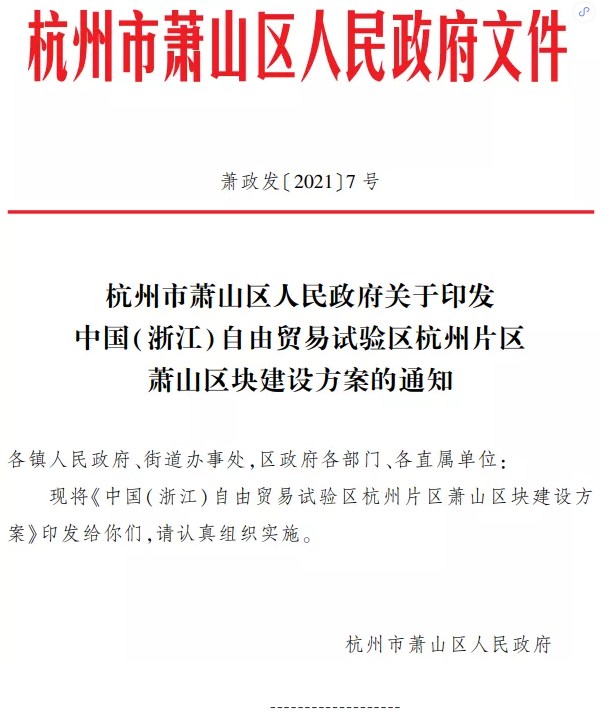
Recently, the People's Government of Xiaoshan District, Hangzhou City, officially released the "Construction Plan for the Xiaoshan Area of the Hangzhou Sub-region of the China (Zhejiang) Pilot Free Trade Zone" on its official website.
The plan explicitly states: "Explore pioneering initiatives in biomedicine." It aims to advance pilot programs in areas such as biomedical review and approval processes, import/export customs clearance, healthcare services, and the secure provision of data and talent resources. Focus on securing the opening of clinical and commercial approval pathways for cell and gene therapies, and explore the establishment of a fast-track process for submitting applications and conducting inspections during the development of cell- and gene-based therapeutic products. Support the approval of innovative medical technologies from overseas for clinical research, and pilot programs allowing foreign-invested entities—such as healthcare providers, health insurance companies, and health management organizations—to establish operations in China.
Recently, The Hangzhou Development and Reform Commission, Science and Technology Bureau, Health Commission, and Market Supervision Administration jointly issued the "Pilot Management Measures for the Hangzhou Regional Cell Preparation Center (Trial)."
The full text is as follows
Hangzhou Regional Cell Preparation Center Pilot Management Measures (Trial)
Chapter 1: General Provisions
Article 1: To promote the healthy and orderly development of the Hangzhou Cell Preparation Center, facilitate the clinical translation of cutting-edge, personalized cell therapy technologies, advance the research and development of cell-based drugs, and support their industrialization, this Regulation is hereby formulated in light of our city's specific circumstances.
Article 2: These Measures apply to the management activities related to the application, designation, and evaluation of the Hangzhou Regional Cell Preparation Center Pilot Program (hereinafter referred to as the "Pilot").
Article 3: Pilot units shall strictly adhere to relevant laws and regulations of the country, as well as the rules and guidelines issued by departments such as the Ministry of Science and Technology, the National Health Commission, the State Administration for Market Regulation, and the National Medical Products Administration, when establishing regional cell preparation centers.
Chapter 2: Declaration and Recognition
Article 4: The Municipal Development and Reform Commission is responsible for leading and coordinating pilot management activities across the city. Meanwhile, the Municipal Science and Technology Bureau, the Municipal Health Commission, and the Municipal Market Supervision Administration will carry out management tasks such as application review and evaluation within their respective areas of responsibility. Relevant departments in each district, county (city) will organize and manage pilot applications within their regions, as well as oversee and coordinate the implementation and operation of the pilot projects.
Article 5: The Municipal Development and Reform Commission, in collaboration with the Municipal Science and Technology Bureau, Municipal Health Commission, and Municipal Market Supervision Administration, will issue timely notices regarding the pilot program application process through appropriate channels, clearly outlining the relevant requirements and other pertinent details.
Article 6: The applying entity must meet the following criteria:
(1) Companies registered in Hangzhou City;
(II) The Cell Preparation Center has been completed and put into operation, with a floor area of at least 1,000 square meters. The center also has plans and the capability for ongoing investment in the construction and operation of a cell preparation facility serving the Hangzhou region. The center’s site selection, design, and layout must comply with current Good Manufacturing Practice (GMP) guidelines as well as the requirements set forth by the American Association of Blood Banks (AABB). Additionally, core cell preparation operations must be conducted in Class A environments maintained under a Class C background cleanliness standard at minimum.
(III) At least one cell therapy clinical trial application project must have a complete preclinical study and clinical trial protocol for the cells.
(4) There is an appropriate management and professional staffing structure, with expertise covering clinical-related disciplines, cellular basic research and clinical studies, as well as GMP-compliant cell preparation and quality control standards. Specifically, the Quality Manager must hold at least a bachelor’s degree in a biology-related field, possess more than 5 years of experience in cell preparation and quality management, have relevant experience in cell therapy clinical research, and demonstrate familiarity with GMP practices.
(5) The pilot Regional Cell Preparation Center must demonstrate a certain level of public benefit, prioritizing equitable access and ensuring that the community reaps tangible benefits, while also maintaining a solid credit history.
(6) Not listed on the joint punishment list by judicial or administrative authorities due to serious illegal or dishonest behavior;
(7) Complies with other relevant national, provincial, and municipal regulations.
Article 7: The applicant organization should have a certain level of influence within its professional field, be able to provide the necessary human, financial, and material support for the operation of the Cell Preparation Center, continuously strengthen collaboration with domestic and international research institutions, clinical facilities, standardization organizations, and other entities, consistently develop new technologies and products, and actively participate in the formulation of domestic and international technical standards and guidelines for cell quality.
Article 8: The applying entity must submit an application report, tailored to its own strengths and specific circumstances as outlined in the notice, and complete the Pilot Application Form for the Hangzhou Regional Cell Preparation Center. The completed forms should then be submitted to the relevant departments at the district, county (or city) level for preliminary review.
Article 9: Relevant departments at the district, county (city) level are responsible for reviewing applications submitted by local entities, providing their evaluation opinions, and submitting the application reports along with relevant supporting documents from eligible entities to the Municipal Development and Reform Commission.
Article 10: After receiving the submitted application materials, the Municipal Development and Reform Commission will re-examine them against the eligibility criteria. Based on the review results and considering the actual circumstances, the Commission will organize relevant departments and experts to conduct on-site inspections and expert evaluations of the applicant organizations. During the evaluation process, the Commission may request the applicant organizations to provide clarifications on specific issues. If necessary, opinions from other relevant departments and agencies will also be sought.
Article 11: The Municipal Development and Reform Commission, in collaboration with the Municipal Science and Technology Bureau, Municipal Health Commission, and Municipal Market Supervision Administration, will, based on the evaluation results and taking into account input from various stakeholders, comprehensively review and select the preferred list of pilot units to be recognized. This list will then be publicly announced for 7 working days on the Municipal Development and Reform Commission’s official website or other municipal-level media. Once the announcement period concludes without any objections, the joint list of pilot units will be officially issued and submitted to the Municipal Government for record-keeping purposes.
Chapter 3: Evaluation and Management
Article 12: A dynamic evaluation system will be implemented for pilot units, ensuring that the best performers thrive while weaker ones are phased out.
Article 13: Pilot units shall annually submit progress reports on the development of their cell preparation centers to the Municipal Development and Reform Commission, and cooperate in conducting operational evaluations.
Article 14: Led by the Municipal Development and Reform Commission, in collaboration with relevant departments, a centralized evaluation of pilot units will be conducted annually to monitor their progress. Additional units may be added as needed. Pilot units demonstrating slow progress, lack of tangible results, or insignificant outcomes will be removed from the pilot list.
Article 15: Relevant departments in each district, county (or city) shall be responsible for verifying the materials and data submitted by the pilot units, ensuring they are lawful, compliant, accurate, and reliable.
Article 16: Any entity falling under any of the following circumstances will be removed from the pilot list:
(1) Those that are developing slowly, showing no results, or achieving only insignificant outcomes;
(II) Those that fail the centralized assessment;
(III) Failure to submit evaluation materials on time or unwillingness to cooperate with the evaluation;
(IV) Providing false materials and data;
(5) Primarily due to technical reasons resulting in major quality or safety incidents;
(6) Those listed on the joint punishment list by judicial or administrative authorities due to serious illegal and untrustworthy behavior;
(7) Terminated in accordance with the law.
Chapter 4 Supplementary Provisions
Article 17: These Measures shall be interpreted jointly by the Municipal Development and Reform Commission, in collaboration with the Municipal Science and Technology Bureau, the Municipal Health Commission, and the Municipal Market Supervision Administration.
Article 18: These Measures shall come into effect on April 15, 2021, and will remain valid until April 15, 2024. Should the underlying policy or legal framework change, or upon expiration of this period, revisions will be assessed and implemented based on actual conditions.
Related News

Here is the title—h1 placeholder text


Copyright © Jiuzhitang Maker (Beijing) Cell Technology Co., Ltd.
Powered by: 300.cn SEO | Privacy Policy