

News
News Center
Big news! The National Health Commission has clarified that clinical applications of stem cells will now be regulated under the "Administrative Measures for Clinical Research and Translational Applications of Biomedical New Technologies"!
来源:National Health Commission website
2021-03-18
Recently, the National Health Commission's official website published "Reply to Proposal No. 7606 from the Third Session of the 13th National People's Congress."
The reply letter clearly states: Next, the State Council will soon introduce the "Regulations on Clinical Research and Translational Applications of Biomedical New Technologies," under which clinical research and translational applications of stem cell technology will be managed according to the relevant provisions of these regulations.
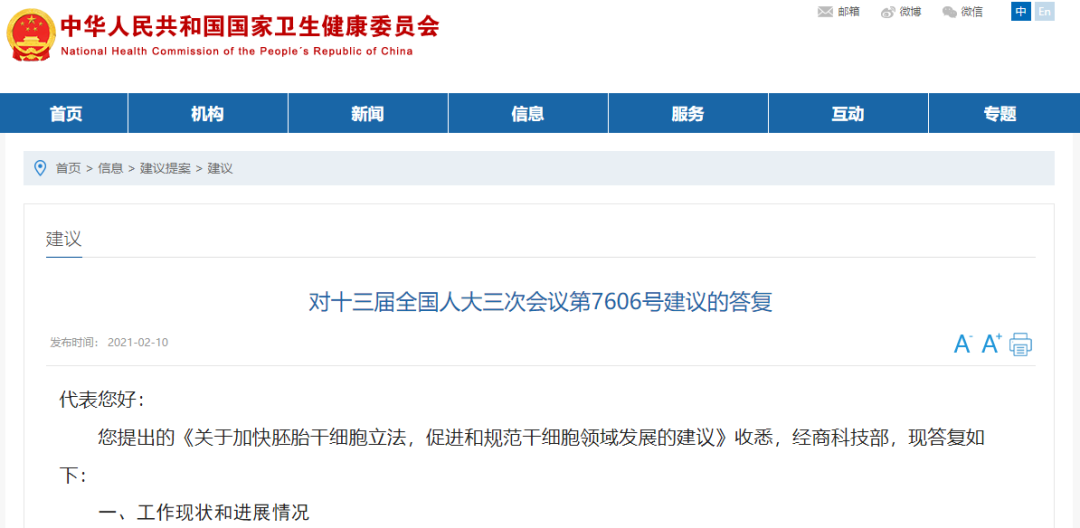
The full text is as follows.
Reply to Proposal No. 7606 of the Third Session of the 13th National People's Congress
Dear Representative:
We have received your proposal titled "Recommendations on Accelerating Legislation for Embryonic Stem Cells to Promote and Regulate the Development of the Stem Cell Field." After consulting with the Ministry of Science and Technology, we hereby provide the following response:
Current status and progress of the work
In 2003, the former Ministry of Health, jointly with the Ministry of Science and Technology, issued the "Ethical Guidelines for Human Embryonic Stem Cell Research," clearly defining the sources and methods for obtaining human embryonic stem cells, as well as outlining the ethical and operational standards that must be followed in such research. In 2015, our commission, along with the former State Food and Drug Administration (hereafter referred to as the "Two Commissions"), formulated the "Administrative Measures for Clinical Research on Stem Cells (Trial)" and the "Guiding Principles for Quality Control and Preclinical Research of Stem Cell Preparations (Trial)," tailored specifically to the unique characteristics of stem cell products—such as their in vitro preparation process, short active lifespan, and individualized application. These measures established a management framework where medical institutions serve as the primary entities responsible for quality control of stem cell preparations and clinical research, while also implementing a dual-registration system for both stem cell research institutions and individual projects. Currently, all nationally registered institutions and clinical research projects can be easily accessed and verified through the website of the China Association for Medical Biotechnology.
Response to the proposed recommendation
(1) On Improving Stem Cell Legislation. Rapid advancements in stem cell technology and other emerging biotechnologies hold immense potential for groundbreaking discoveries in biology, medicine, and agriculture—but they also pose significant biosecurity and ethical risks if misused, abused, or improperly applied. Accelerating legislation in the biotechnology sector and strengthening the legal framework and regulatory systems related to stem cells are crucial for ensuring the healthy, orderly development of China’s biotechnology industry and safeguarding national biosecurity. Since the implementation of the "Measures," clinical research involving stem cells has gradually been steered onto a path of standardized and sustainable growth. Under the guidelines outlined in the "Measures," medical and healthcare institutions are required to conduct stem cell clinical research in compliance with established regulations. Meanwhile, national and provincial health authorities, in collaboration with their respective drug regulatory agencies, have intensified oversight during and after the fact. Additionally, extensive efforts have been made to clarify relevant policies and provide ethics training, helping researchers enhance their understanding of both regulatory requirements and ethical principles, thereby promoting the responsible and compliant conduct of stem cell clinical studies.
The Ministry of Science and Technology has formulated a series of guidelines to strengthen the regulation of biotechnology development and protect biological genetic resources: First, to comprehensively standardize biotechnology research and development activities, the "Administrative Measures for the Safety Management of Biotechnology Research and Development" were introduced in 2017. Second, in response to new challenges and changes in the rapidly evolving field of biotechnology, the "Regulations on the Administration of Human Genetic Resources" were issued in 2019. Moving forward, the State Council is set to release the "Regulations on the Clinical Research and Translational Application of Biomedical New Technologies," under which clinical research and translational applications of stem cell technologies will be managed according to the specific provisions outlined in these regulations.
(II) Regarding the Review of Clinical Research Involving Stem Cells: The Measures stipulate that the ethics committees of medical institutions shall conduct independent ethical reviews of stem cell clinical research projects in accordance with the relevant requirements outlined in the "Ethical Review Measures for Biomedical Research Involving Human Subjects." Additionally, the measures emphasize that the sourcing and procurement processes of stem cells must adhere to ethical standards. Specifically, for stem cells derived from embryonic sources, such research must ethically comply with the "Ethical Guidelines for Human Embryonic Stem Cell Research." While adhering to general ethical principles, the institutional ethics committee will integrate these specific guidelines into its review process for embryonic stem cell sources, ensuring that all related research activities are both legally compliant and aligned with bioethical norms.
(III) On Enhancing the Composition of Ethics Review Committees. In 2016, our commission’s “Measures for Ethical Review of Biomedical Research Involving Human Subjects” stipulated that medical and health institutions conducting biomedical research involving human subjects are responsible for managing ethical review activities in this area. These institutions are required to establish an ethics committee and implement effective measures to ensure the committee can independently carry out its ethical review tasks. Committee members should be selected from experts in fields such as biomedicine, ethics, law, sociology, as well as individuals from outside the institution who are respected members of society. In October 2019, the Office of the Medical Ethics Expert Committee under our commission released the “Guidelines for Building Clinical Research Ethics Review Committees Involving Human Subjects (2019 Edition),” which further clarifies the disciplinary expertise expected of committee members and outlines the substantive requirements for ethical review, thereby strengthening the ethics committee’s role and authority within medical institutions.
(Four) Regarding the establishment of a reasonable accountability mechanism: In 2003, the Ministry of Science and Technology, together with the former Ministry of Health, issued the "Ethical Guidelines for Human Embryonic Stem Cell Research," explicitly prohibiting any research involving reproductive human cloning. When conducting human embryonic stem cell studies, it is strictly forbidden to implant blastocysts—obtained through in vitro fertilization, somatic cell nuclear transfer, parthenogenesis, or genetic modification—into the reproductive systems of humans or any other animals. Additionally, combining human germ cells with those from other species is also prohibited. For medical institutions or individuals found violating these ethical principles, civil legal responsibilities will be pursued according to Article 1,009 of the Civil Code, which states: "Medical and scientific research activities involving human genes, human embryos, and other related fields must comply with laws, administrative regulations, and relevant national provisions; they must not endanger human health, violate ethical standards, or harm the public interest." Furthermore, under Chapter 6 of the "Measures for Ethical Review of Biomedical Research Involving Humans," administrative legal liabilities will also be enforced as appropriate. Regarding your suggestion, our commission will actively promote the development of an accountability mechanism in future work, particularly for cases where illegal research activities result in severe harm to others' physical health.
(5) On Improving the Reporting and Information Disclosure System: To promote the standardized conduct of medical science research and strengthen ethical oversight and management of life sciences and medical research, our commission has leveraged the "National Health Security Informatization Project" to establish a Medical Research Registration and Filing Information System. Currently, this system supports an online mechanism for institutions and projects conducting clinical stem cell research to submit, verify, receive feedback on, and have their registration and filing materials reviewed. This ensures that both registered institutions and regulatory authorities at all levels can monitor the progress of stem cell clinical research in real time, enabling dynamic tracking of these studies. Moving forward, our commission will actively advance the system’s development, enhancing its functionality to better serve management departments and the public by providing easy access to relevant research information. Additionally, the system will publicly announce clinical stem cell research institutions and projects that meet the filing requirements, fostering comprehensive societal oversight.
Next steps: Goals and plans
Moving forward, our committee will integrate your suggestions to further strengthen the supervision and management of standardized clinical research involving stem cells. We will actively push ahead with revising and enacting relevant laws and regulations, continuously enhance ethical review and oversight mechanisms, and refine both the registration and approval system as well as the information functionalities of the medical research registration and filing information system. These efforts will help ensure that stem cell research plays an even more proactive role in safeguarding public health.
Thank you for your concern and support of health and wellness initiatives.
National Health Commission
Related News

Here is the title—h1 placeholder text


Copyright © Jiuzhitang Maker (Beijing) Cell Technology Co., Ltd.
Powered by: 300.cn SEO | Privacy Policy