

News
News Center
Stem Cell Anti-Aging | Instead of "fearing aging," it's better to "prevent it."
2020-06-30
The Dragon Boat Festival, a traditional Chinese holiday, has been celebrated for thousands of years. Legend has it that the fifth month—and especially the fifth day of the fifth month—is considered an "evil month" and an "evil day," prompting people to avoid certain activities during this time.
On the day of the Dragon Boat Festival, adults give gifts to children. Hanging delicate, adorable, and vibrantly colored sachets—shaped in various forms—on their clothes is said to ward off evil spirits and keep pesky insects at bay, ensuring good health and well-being. At the same time, parents would carefully remind their children not to simply wish "Happy Dragon Boat Festival" when greeting others, but instead to say, "Wishing you peace and health during the Dragon Boat Festival." As a child, I didn’t quite understand why we had to phrase it this way—or even bother to question it deeply. All I could do was nod obediently with a polite "Mm-hmm," while my mind was already racing ahead, eagerly imagining when those fragrant, tender, and deliciously savory triangular or square zongzi would finally grace our family table. Looking back now, I realize that these traditions likely arose out of practical concerns: Summer’s sweltering heat often made people more susceptible to illness, while outbreaks of disease tended to spread easily. Add to that the seasonal proliferation of snakes and other pests, which posed real risks of biting and harming people—and you’ve got the perfect recipe for caution. It’s no wonder that over time, these customs evolved into thoughtful rituals aimed at seeking safety, warding off misfortune, and soothing any anxieties about nature’s unpredictable forces.

Today, China is grappling with an increasingly severe shift toward an aging society, making the prevention and treatment of age-related diseases both critically important and urgently needed. Faced with the "three major health challenges"—an aging population growing heavier in weight, the rising trend of younger-onset cancers, and the persistent issue of birth defects among newborns—we must proactively shift our mindset and prepare in advance, recognizing that "prevention is better than cure."
Humanity has never stopped exploring ways to fight aging.
In fact, people have never stopped exploring ways to stay healthy and slow down the pace of aging and decline. From ancient times to the present day, everyone—from emperors and generals to ordinary citizens—has tirelessly sought longevity and the secret to preserving youthfulness. After all, how to withstand the passage of time while maintaining vitality and defying the signs of aging remains an eternal human quest. Since the last century, advancements in cutting-edge medical technologies, improvements in public healthcare systems, and robust socio-economic growth have collectively paved the way for better living conditions, ultimately helping to extend people's average lifespan.
Today, dietary approaches and medications that can slow down the aging process are gradually attracting widespread attention from the medical and scientific communities. An increasing number of studies indicate that stem cells play a crucial role in anti-aging efforts, offering new hope to humanity's age-old dream of delaying the onset of aging.
Stem cells are becoming the new anti-aging trend!
Stem cell-based anti-aging research has a long and rich history—stem cell technology was even named one of the Top 10 Scientific Breakthroughs of 1999 by *Science* magazine. In 2016, a review published in *Nature Cell Biology* explored the intricate link between stem cell metabolism and the body’s homeostasis as well as the aging process. Meanwhile, in 2017, an article in *Stem Cells* shed light on how brain stem cells may help delay aging, offering promising new avenues for treating age-related diseases.
Preclinical studies have shown that mesenchymal stem cells can promote cellular repair and tissue regeneration—key processes in treating age-related frailty—through their multidirectional differentiation potential, immunomodulatory functions, anti-inflammatory properties, homing capabilities, and ability to stimulate endogenous tissue stem cells. Additionally, several clinical studies have demonstrated the safety and efficacy of mesenchymal stem cell transplantation [2].
The University of Miami Miller School of Medicine's Biomedical Research Center has partnered with Longeveron to conduct a Phase I clinical trial evaluating allogeneic mesenchymal stem cell transplantation for the treatment of age-related frailty [3]. The trial enrolled a total of 15 participants, who received varying doses of the therapy. Transplant therapy using (2 × 10^7, 10 × 10^7, and 20 × 10^7 cells). No serious treatment-related adverse events were observed within 1 month post-transplant, and no significant donor-specific immune responses emerged during the first 6 months. Notably, all treatment groups showed a substantial increase in the 6-minute walk distance at both 3- and 6-month follow-ups, while TNF-α levels markedly declined by the 6-month mark. When evaluating all measured parameters collectively, the 10 × 10^7 cell group demonstrated the most favorable therapeutic outcomes, leading to a significant improvement in patients' quality of life.
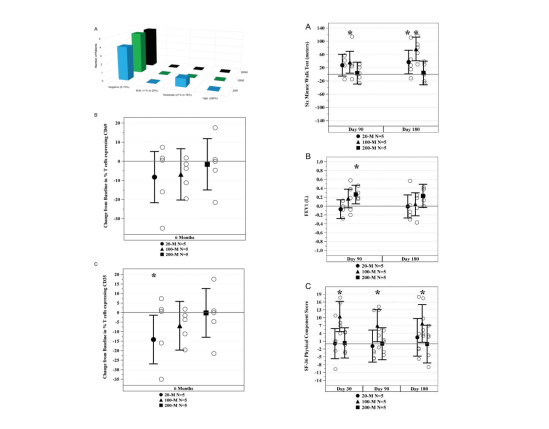
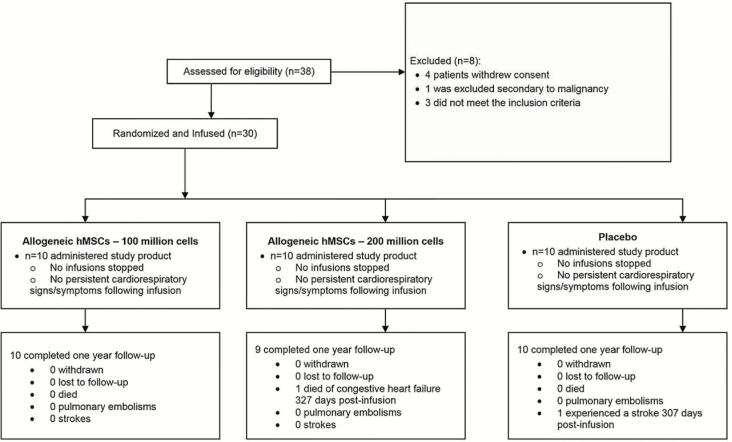
In the same year, the Miami team published findings reporting the results of a Phase II, randomized, double-blind clinical trial [4]. The trial enrolled 30 frail elderly participants who received either mesenchymal stem cell transplantation at doses of 10 × 10^7 or 20 × 10^7 cells, or a placebo. The study design is illustrated in the figure below. No treatment-related adverse events were observed within one month post-transplantation. Notably, the 10 × 10^7 dose group showed significant improvements in physical condition and immune function, as evidenced by enhanced performance on the 6-minute walk test, short physical performance battery, and forced expiratory volume in one second (FEV1). Additionally, women in this group experienced improved quality of life, accompanied by reduced serum levels of TNF. Meanwhile, the 20 × 10^7 dose group demonstrated marked improvements in immune function and intracellular TNF-α levels in B cells. Overall, mesenchymal stem cell therapy effectively reduced both early and late-activated T cells, leading to notable amelioration of frailty symptoms in older adults.
Bone marrow mesenchymal stem cells cultured under hypoxic conditions Stronger anti-aging capabilities
Research shows that stem cells cultured in a low-oxygen environment—distinct from the normal oxygen levels found in open spaces—can avoid damage caused by excessive reactive oxygen species, helping to maintain their stemness, enhance their activity, and improve their anti-aging effects.
Jiuzhitang Maker has established a hypoxic stem cell production platform and developed a GMP-compliant stem cell drug system, enabling the company to produce clinical-grade stem cells that meet both Chinese and U.S. regulatory requirements for pharmaceutical submissions. The company’s ischemia-tolerant allogeneic human bone marrow mesenchymal stem cells (it-hMSC), which are derived from the bone marrow of healthy, young adult donors, are cultured and expanded entirely under low-oxygen conditions.
The expansion, homing, tissue-repair, and inflammation-regulating capabilities of it-hMSCs are all superior to those of stem cells cultured under normal oxygen conditions, as illustrated in the figure below. Specifically, it-MSCs exhibit heightened sensitivity to cytokines such as EGF, bFGF, VEGF-121, IL-1β, IL-6, and TNF-α during the wound-healing process, which enhances their homing ability and, consequently, enables them to more effectively exert anti-aging effects.
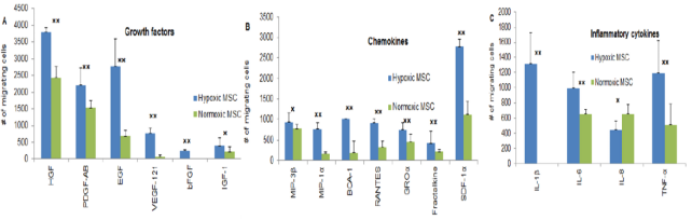
Research shows that MSCs cultured under normoxic conditions also exhibit some anti-inflammatory regulatory capacity, while it-hMSCs derived from hypoxic culture demonstrate even stronger anti-inflammatory abilities. As a result, these hypoxia-preconditioned MSCs are better equipped to play a crucial role in combating age-related frailty—and hold greater potential to safeguard human health.
References:
[1] "2020 Health and Medical Forecast Report" https://wenku.baidu.com/view/e0432fb630b765ce0508763231126edb6e1a7673.html
[2] https://www.finanzen.net/nachricht/aktien/longeveron-announces-japanese-approval-of-clinical-trial-for-treatment-of-aging-frailty-with-longeveron-s-stem-cells-8928181
[3] Samuel Golpanian et al., Allogeneic Human Mesenchymal Stem Cell Infusions for Aging Frailty, The Journals of Gerontology: Series A, Volume 72, Issue 11, November 2017, Pages 1505–1512, https://doi.org/10.1093/gerona/glx056
[4] Bryon A. Tompkins et al., Allogeneic Mesenchymal Stem Cells Ameliorate Aging-Related Frailty: A Phase II Randomized, Double-Blind, Placebo-Controlled Clinical Trial, The Journals of Gerontology: Series A, Volume 72, Issue 11, November 2017, Pages 1513–1522, https://doi.org/10.1093/gerona/glx137
Related News

Here is the title—h1 placeholder text


Copyright © Jiuzhitang Maker (Beijing) Cell Technology Co., Ltd.
Powered by: 300.cn SEO | Privacy Policy