

News
News Center
Aging and Disease: Clinical Trial Results for COVID-19 Stem Cell Therapy Are Encouraging
2020-03-23
In December 2019, pneumonia cases emerged in Wuhan, China. By March 19, 2020, the nearly two-month-long battle against the epidemic had achieved a new victory: all 31 provinces and cities across the country reported zero new locally transmitted COVID-19 confirmed cases.
However, currently, China still has more than 2,000 severe COVID-19 patients. How to treat these critically ill patients as quickly as possible and further reduce the mortality rate will be the key issue at this stage.
Mesenchymal stem cells (MSCs) not only possess potent anti-inflammatory and immunomodulatory functions but also significantly improve the body's microenvironment, promoting the host's intrinsic repair mechanisms and ultimately saving lives.
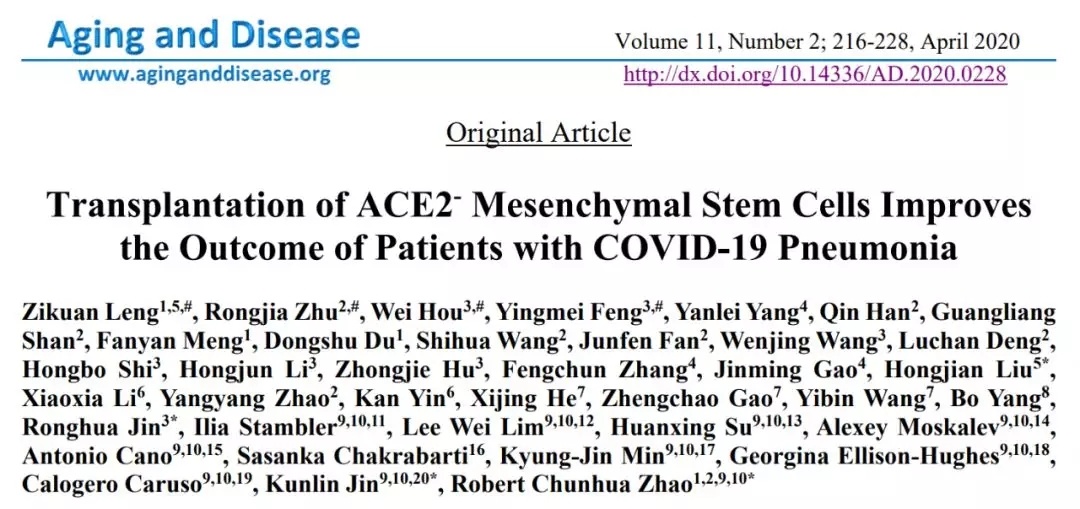
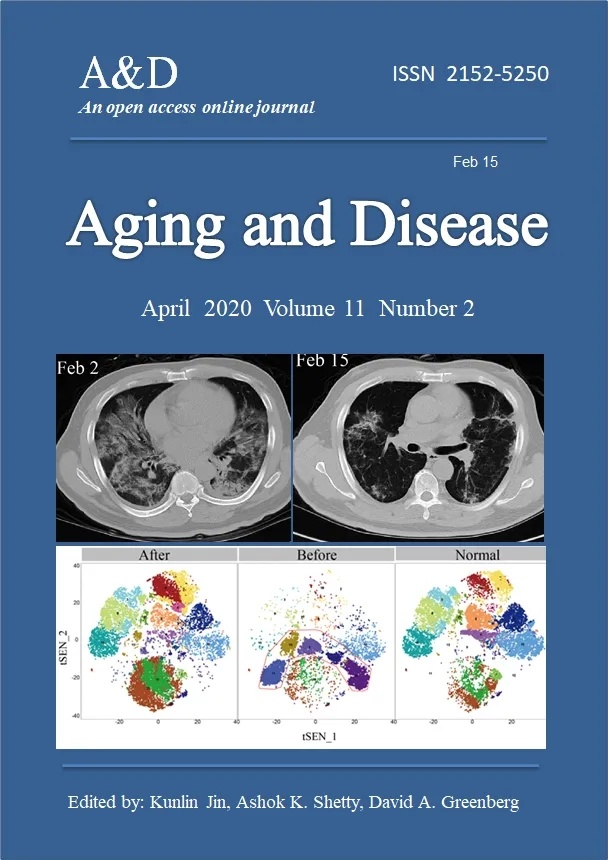
Led by Professor Chunhua Zhao's team and involving 20 research institutions from China and abroad, this groundbreaking work was featured as a cover article in the journal *Aging and Disease*. The study conducted clinical trials on seven COVID-19 patients and found that mesenchymal stem cell transplantation therapy could rapidly and significantly improve outcomes for severe and critically ill patients, effectively preventing cytokine storms while demonstrating no notable side effects. This innovative approach offers a fresh perspective for the clinical treatment of COVID-19 patients. (Click to learn more: How Stem Cells Are Unleashing Their Power in the Fight Against COVID-19.)
Currently, it is believed that because the ACE2 receptor is highly and widely expressed in type 2 alveolar cells, vascular endothelial cells, and other tissues, the novel coronavirus rapidly spreads throughout the body upon entering the human body. This rapid dissemination can easily overstimulate the immune system, triggering the release of cytokines such as IL-2, IL-6, G-CSF, IP-10, and MCP-1, which in turn may lead to a cytokine storm—and even death. Recent research published in The Lancet also revealed that critically ill COVID-19 patients in intensive care units exhibited significantly elevated plasma levels of these cytokines, underscoring the critical role cytokine storms play in the deadly progression of the disease.
In response to this situation, clinicians are employing hormone therapy to suppress cytokine production; using non-steroidal anti-inflammatory drugs and high-dose vitamin C to reduce the severity of inflammatory responses; or directly administering monoclonal antibodies targeting cytokines like IL-6 to dampen the immune system’s aggressive attack. However, these approaches primarily address the downstream effects of the immune response, making their impact somewhat one-sided and limiting their overall immunomodulatory efficacy. Consequently, researchers are now turning their attention toward mesenchymal stem cell (MSC) transplantation—a well-established and reliable technique that has already gained widespread use in treating immune-mediated inflammatory diseases such as transplant rejection and systemic lupus erythematosus. Mesenchymal stem cells, found in connective tissues like bone marrow and organ interstitium, possess remarkable differentiation potential. They exert immunomodulatory and immunosuppressive effects by interfering with the activation and maturation of antigen-presenting cells, inhibiting T-lymphocyte proliferation, inducing apoptosis in activated T cells, and modulating dendritic cell differentiation—all of which help restore balanced immune function.
Between January 23 and February 16, 2020, researchers recruited a total of 7 COVID-19 patients from Beijing Anzhen Hospital, Affiliated to Capital Medical University. These included 1 critically ill patient, 4 severely ill patients, and 2 mild cases. The study aimed to investigate changes in the patients' immune and inflammatory system functions, as well as any side effects observed within 14 days following mesenchymal stem cell transplantation.

Timeline of COVID-19 Patients Undergoing Transplantation
No significant adverse reactions
Before mesenchymal stem cell transplantation, patients exhibited symptoms including high fever (38.5°C ± 0.5°C), weakness, shortness of breath, and low oxygen saturation. However, within 2 to 4 days post-transplantation, all symptoms completely resolved in every patient, with resting blood oxygen saturation rising to above 95%. Additionally, no acute allergic reactions were observed within two hours after transplantation, and neither delayed-type hypersensitivity nor secondary infections occurred afterward, providing preliminary evidence of the therapy's safety.
Quickly and significantly improve patients' clinical symptoms and biochemical indicators.
In the study, one critically ill patient with a history of hypertension—whose condition had progressed to Grade 3 hypertension—underwent mesenchymal stem cell transplantation on January 31, showing particularly remarkable therapeutic effects. The immediate outcomes included a significant reduction in plasma lymphocyte levels within two weeks post-transplant, as well as a dramatic drop in plasma C-reactive protein levels, which plummeted from a peak of 191.0 g/L on February 1 to about 10 times lower, returning to 10.1 g/L. This indicates a rapid attenuation of the inflammatory response. Additionally, without the need for supplemental oxygen, the patient’s blood oxygen saturation improved dramatically—from 89% to 98%, reflecting near-complete restoration of alveolar gas exchange function.
Mesenchymal stem cell transplantation effectively prevented the immune system from attacking the organ. On February 1, the patient’s plasma levels of aspartate aminotransferase, creatine kinase activity, and myoglobin surged to 57 U/L, 513 U/L, and 138 ng/ml, respectively, indicating severe damage to the liver and heart. However, these key biochemical markers returned to normal reference ranges within 2 to 4 days after the transplant, reverting to baseline levels by February 13—at 19 U/L, 40 U/L, and 43 ng/ml, respectively.
Additionally, MSC transplantation significantly accelerates the treatment process. Four days after transplantation, critically ill COVID-19 patients showed a return of their respiratory rate to normal levels, with symptoms such as fever and shortness of breath completely resolving. By day 9 post-transplantation, chest CT imaging revealed a marked reduction in ground-glass opacities and pneumonia infiltrates.

Lung imaging in critically ill patients shows improved symptoms.
Effectively preventing cytokine storms
Researchers discovered through mass cytometry that, following mesenchymal stem cell transplantation, the culprits behind the cytokine storm—overactivated immune cells such as CXCR3⁺ CD4⁺ T cells, CXCR3⁺ CD8⁺ T cells, and CXCR3⁺ NK cells—disappeared within 3 to 6 days. Additionally, there was a sharp increase in the number of dendritic cells regulated by CD14⁺ CD11c⁺ CD11bmid. Notably, compared to the placebo control group, the MSC-treated group showed significantly lower TNF-α levels and elevated IL-10 levels. These findings were particularly pronounced in critically ill patients.
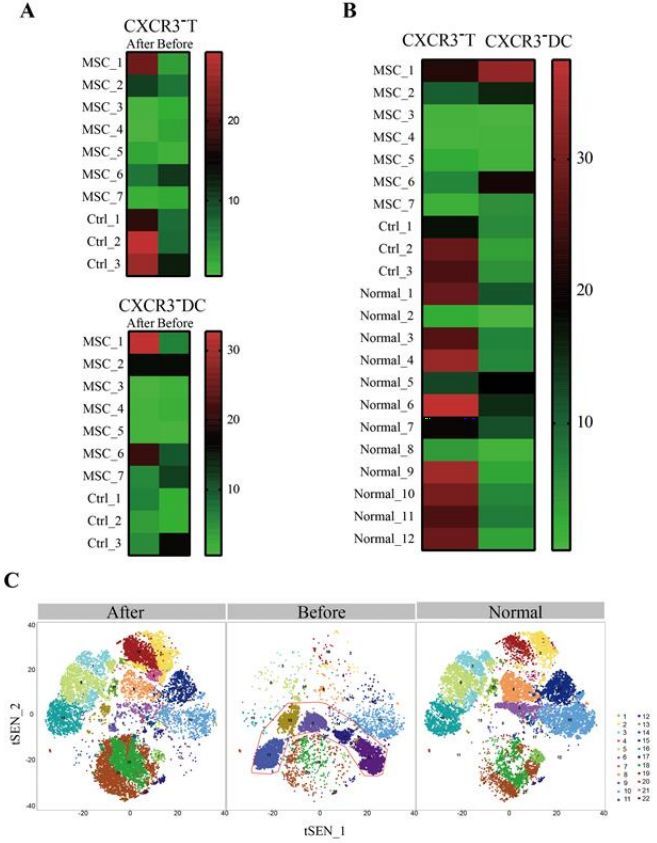
Peripheral Blood Cell Analysis in Mild and Critically Ill Patients
Mesenchymal stem cells themselves are not susceptible to COVID-19 infection.
Researchers performed RNA sequencing on mesenchymal stem cells transplanted into patients and found that these cells do not express the COVID-19 receptor ACE2 or TMPRSS2. Additionally, anti-inflammatory and trophic factors such as TGF-β, HGF, LIF, GAL, NOA1, FGF, VEGF, EGF, BDNF, and NGF were highly expressed in MSCs, further supporting their immunomodulatory and protective functions. Moreover, SPA and SPC markers were also prominently detected in MSCs, suggesting a potential pathway for MSCs to differentiate into type 2 alveolar cells—cells that are particularly susceptible to SARS-CoV-2 infection.

Changes in Plasma Cytokines in Transplant Patients
Conclusion: This study proposes a novel approach for critically ill COVID-19 patients, offering an alternative to conventional hormone and anti-inflammatory therapies. By leveraging the well-established technique of mesenchymal stem cell transplantation, we effectively mitigate cytokine storms—thanks to MSCs' immune-modulating effects that help regulate the body’s inflammatory response and promote natural repair mechanisms within the host. This strategy also improves the overall microenvironment of the body, significantly reducing side effects while markedly accelerating recovery progress. Importantly, the safety and efficacy of this method have already been validated in clinical practice, providing new hope in lowering mortality rates among severe and critically ill COVID-19 patients!
Reprint Statement: This article is reprinted from Aging and Disease.
Related News

Here is the title—h1 placeholder text


Copyright © Jiuzhitang Maker (Beijing) Cell Technology Co., Ltd.
Powered by: 300.cn SEO | Privacy Policy