

News
News Center
Latest research finding: Bone marrow mesenchymal stem cells can significantly improve behavioral deficits in mice with autism.
2023-12-11
On December 3, 2023, Jiuzhitang Maker’s preclinical pharmacological study titled "Intravenous transplantation of bone marrow-derived mesenchymal stem cells improved behavioral deficits and altered fecal microbiota composition of BTBR mice," which explores the use of human bone marrow mesenchymal stem cells (hBMMSC) to treat autism, was officially accepted and published in the internationally renowned academic journal *Life Sciences*.
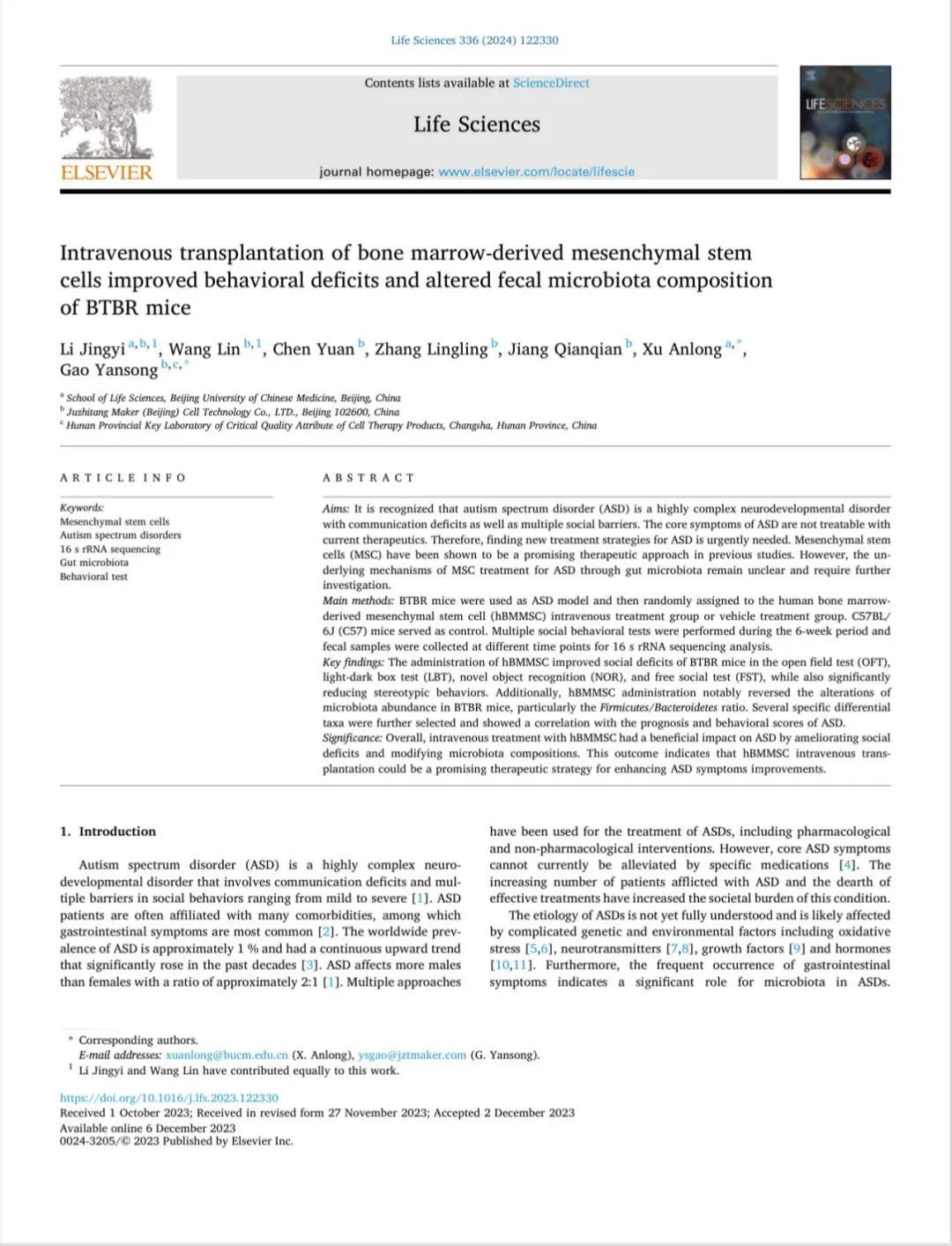
This paper, backed by comprehensive data, firmly demonstrates the effectiveness of human bone marrow mesenchymal stem cells (hBMMSCs) in treating autism model animals. Moreover, it is the first study internationally to reveal how stem cell therapy influences the gut microbiota of autism model animals. This finding suggests that stem cells hold significant potential for advancing autism treatment strategies.
Autism Spectrum Disorder (ASD), also known as autism, is a highly complex neurodevelopmental disorder. Typically emerging in early childhood, it is characterized primarily by impairments in social interaction, communication difficulties, restricted interests, and repetitive or stereotyped behaviors. Many affected children also experience varying degrees of intellectual disability. According to recent statistics, China currently has approximately 13 million children with autism—meaning roughly 1 in every 100 children is diagnosed with the condition. Globally, the number of children with autism has already surpassed 67 million. Unfortunately, there is currently no definitive cure for autism, making this an area of significant unmet medical need. As a result, there is an urgent call for the development of innovative therapeutic strategies to address this growing challenge.
The clinical team at Jiuzhitang Maker conducted a series of behavioral tests—including the open field test (OFT) at multiple time points, the light-dark box test (LDT), novel object recognition (NOR), free social test (FST), and stereotypic behavior (SB)—to reveal that intravenous treatment with human bone marrow mesenchymal stem cells (hBMMSCs) effectively alleviated autism-like symptoms in BTBR mice. These improvements were primarily observed as reductions in motor abnormalities, anxiety-related behaviors, and stereotyped actions, along with an amelioration of social deficits.
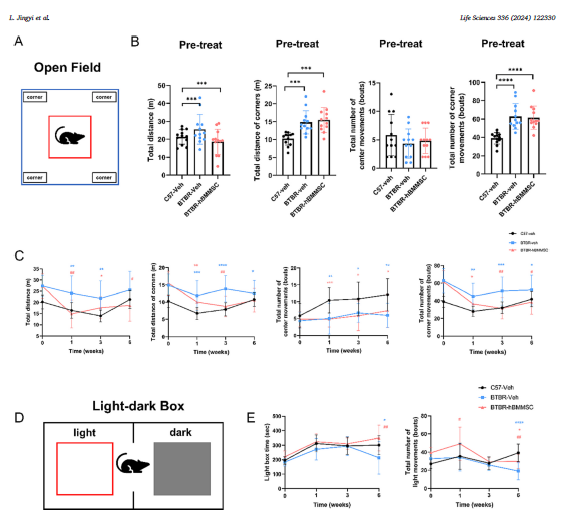
(Figure 1)
Figure 1 shows that treatment with human bone marrow mesenchymal stem cells (hBMMSCs) can modulate anxiety and exploratory behavior in BTBR mice. A. Experimental design for the open-field test. B. Pre-treatment effects of BTBR and C57 mice in the open-field test, assessed by total distance traveled, total distance turned, number of center entries, and total number of rearing movements. C. Line graphs illustrating the open-field test results, presented as total distance, total turning distance, total center movements, and total rearing movements. D. Experimental design for the light-dark box test. E. Line graphs depicting anxiety and exploratory behavior in the light-dark box test, measured by time spent in the light compartment and total number of light-to-dark transitions. Data are expressed as mean ± SEM, with N = 12 per group. Statistical comparisons were performed using one-way ANOVA with Tukey’s post-hoc test: ⁎p < 0.05; ⁎⁎p < 0.01; ⁎⁎⁎p < 0.001; ⁎⁎⁎⁎p < 0.0001 compared to the C57-veh group, and #p < 0.05; ##p < 0.01 compared to the BTBR-veh group.
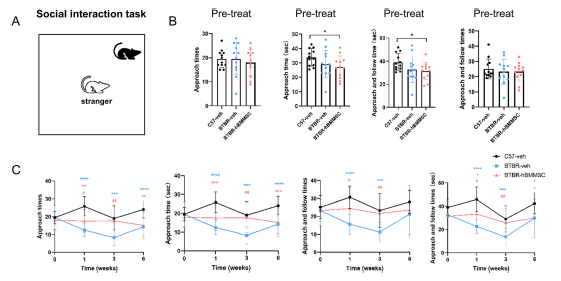
(Figure 2)
Figure 2 shows that treatment with human bone marrow mesenchymal stem cells (hBMMSC) can ameliorate social deficits in BTBR mice during social interaction tasks. A. Experimental design for the social interaction task. B. Pre-treatment profiles of BTBR and C57 mice in the social interaction task, including line graphs depicting the number and duration of approach events, as well as the frequency and duration of both approaching and following behaviors. Social interaction performance was assessed based on approach time, proximity duration, and the combined metrics of approach and follow-through behavior. Data are presented as mean ± SEM, with N = 12 per group. Statistical comparisons were made using Tukey’s post-hoc test following one-way ANOVA: ⁎p < 0.05; ⁎⁎⁎p < 0.001; ⁎⁎⁎⁎p < 0.0001; #p < 0.05; ##p < 0.01 compared to the C57-veh group, and #p < 0.05; ##p < 0.01 compared to the BTBR-veh group.
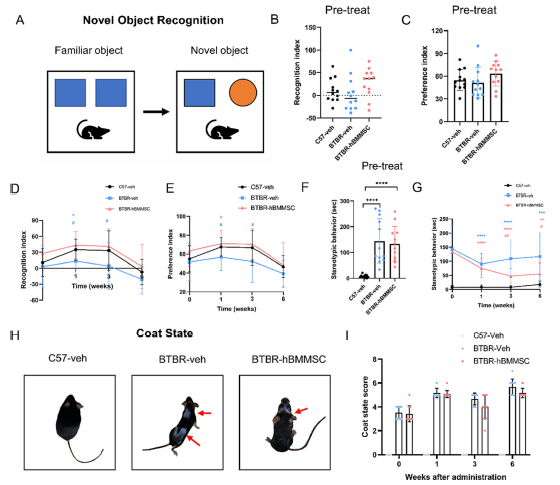
(Figure 3)
Figure 3 shows the effects of human bone marrow mesenchymal stem cell (hBMMSC) treatment on rescuing cognitive memory deficits and modulating stereotyped behaviors. A. Novel object recognition paradigm. B. Recognition indices for mice in each pretreatment group. C. Preference indices for mice in each pretreatment group. The line graphs depict novel object recognition outcomes. D. Recognition indices and E. Preference indices. F. Baseline duration of stereotyped behaviors in C57 and BTBR mice before treatment. G. Stereotyped behavior durations at each testing time point for C57 and BTBR mice. H. Fur condition of C57 and BTBR mice. I. Fur condition scores for C57 and BTBR mice. Data are presented as mean ± SEM. Each group consisted of N = 12 mice. Compared to the C57-veh group: ⁎p < 0.05; ⁎⁎⁎p < 0.001; ⁎⁎⁎⁎p < 0.0001. Compared to the BTBR-veh group: #p < 0.05; ##p < 0.01. Post-hoc comparisons within and between groups were performed using Tukey’s method for ANOVA.
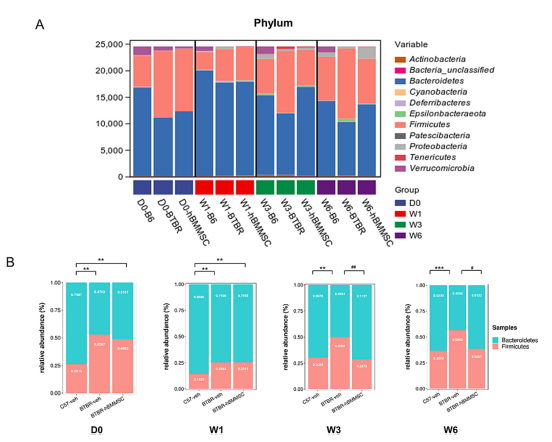
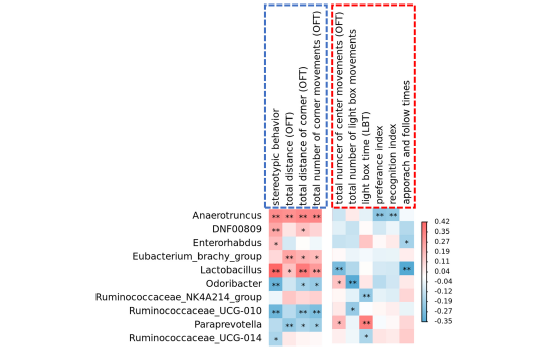
By performing 16S rDNA sequencing at various time points, we observed adjustments in the gut microbiota. Notably, treatment with human bone marrow mesenchymal stem cells (hBMMSC) successfully restored the dysregulated relative abundance of the microbial community in BTBR mice, while also identifying specific differentiated taxa (Figures 4 and 5).
(Figure 4)
Figure 4 shows that treatment with human bone marrow mesenchymal stem cells (hBMMSCs) normalized autism-related gut microbiota dysbiosis. A. Bar graphs illustrating the relative abundance of three microbial taxa at different time points, at the phylum level. Compared to the C57-veh group: ⁎⁎p < 0.01, ⁎⁎⁎p < 0.001; compared to the BTBR-veh group: #p < 0.05, ##p < 0.01. A Wilcoxon rank-sum test was used to analyze the ratio of Firmicutes to Bacteroidetes. B. Average relative abundances (%) of Bacteroidetes and Firmicutes in C57 and BTBR mice.
(Figure 5)
Figure 5 shows the Spearman correlation matrix, highlighting positive (red) and negative (blue) correlations. ⁎p < 0.05, ⁎⁎p < 0.01, ⁎⁎⁎p < 0.001.
"Life Sciences" is an internationally recognized SCI journal renowned for its comprehensive research in medicine and pharmacology, with a recent impact factor of 6.1. The successful publication of this SCI paper clearly highlights Jiuzhitang Maker’s strong capability in independent innovation within clinical research on autism. In less than a year, the Jiuzhitang Maker clinical team has already secured acceptance and publication for two consecutive SCI articles, marking a historic breakthrough. This achievement underscores Jiuzhitang Maker’s unwavering commitment to prioritizing scientific research, leveraging innovation to fuel the company’s growth engine, and steadily increasing investments in stem-cell product development—key steps that solidify the foundation for the company’s long-term success. It also signifies that Jiuzhitang Maker’s latest clinical research findings on autism have garnered significant attention and high recognition from the international academic community.
Note: The images in this article are sourced from the journal *Life Sciences*.
Related News

Here is the title—h1 placeholder text


Copyright © Jiuzhitang Maker (Beijing) Cell Technology Co., Ltd.
Powered by: 300.cn SEO | Privacy Policy