

News
News Center
Shenzhen expands openness! Foreign companies are encouraged to conduct clinical trials in Shenzhen—on the basis of the law—for cell and gene therapy drugs already approved for marketing overseas.
2024-07-18
Recently, the Shenzhen Municipal Government General Office website released the "Notice of the Shenzhen Municipal People's Government on Issuing Measures to Further Enhance the Attraction and Utilization of Foreign Investment," outlining 20 measures aimed at boosting foreign investment inflows. The Notice takes effect from June 1 and is valid for five years; however, specific policy measures with clearly defined implementation periods will follow those respective timelines.
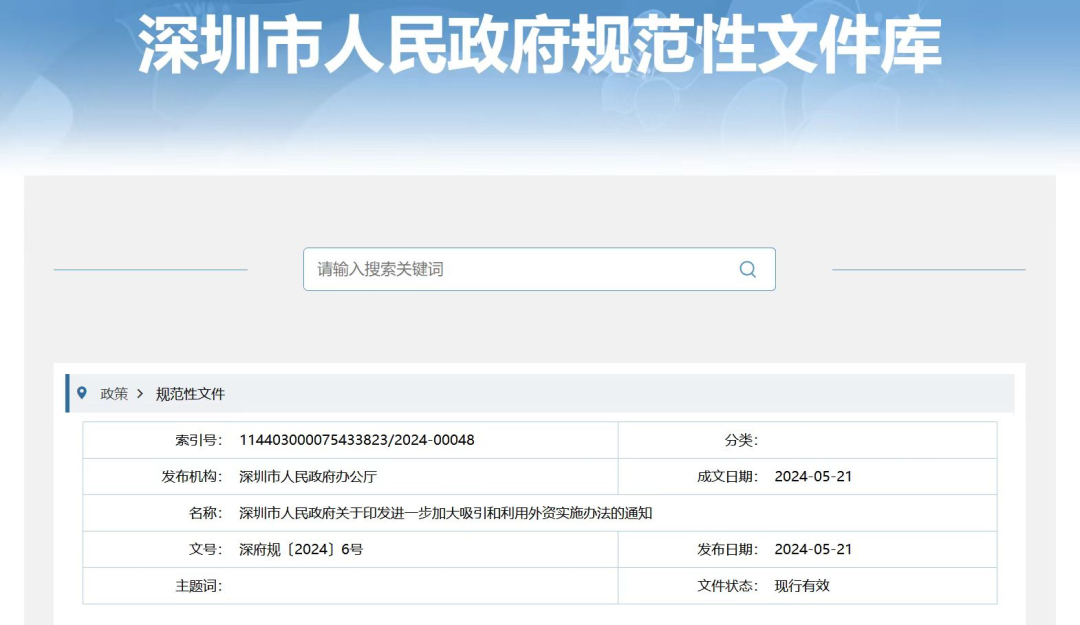
The "Notice" outlines 20 specific measures across five key areas: advancing high-level opening-up in priority sectors, continuously optimizing the business environment, enhancing the convenience of investment and operations, strengthening fiscal and tax support, and improving mechanisms to promote foreign investment. These initiatives aim to further boost Shenzhen's high-level openness and accelerate its development into a globally influential economic hub and a modern international metropolis.
Supporting foreign investment in the biopharmaceutical sector. Encourage foreign-invested enterprises to conduct clinical trials in Shenzhen, in accordance with the law, for cell and gene therapy drugs already approved for marketing overseas, and establish an international clinical trial center in the Guangdong-Hong Kong-Macao Greater Bay Area. Promote the approval of urgently needed pharmaceuticals and medical devices under the "Hong Kong and Macao Drug & Medical Device Facilitation" program for use in designated medical institutions in our city. Leverage the role of the Guangdong-Hong Kong-Macao Greater Bay Area Branch Center of the National Medical Products Administration—specifically its drug review, inspection, and approval mechanisms—and provide registration and acceptance services for pharmaceutical products from Hong Kong and Macao. Eligible foreign-invested enterprises will be allowed to participate in pilot programs aimed at expanding openness in areas such as the development and application of gene diagnostics and therapeutic technologies. (Responsible Units: Municipal Development and Reform Commission, Municipal Bureau of Industry and Information Technology, Municipal Health Commission, Municipal Market Supervision Administration, Municipal Investment Promotion Bureau, Municipal Qianhai Administration)
The full text is as follows:
Shenzhen Further Strengthens Measures to Attract and Utilize Foreign Investment
To deeply implement the spirit of the 20th National Congress of the Communist Party of China, the Central Economic Work Conference, and General Secretary Xi Jinping’s series of important speeches and instructions on Guangdong and Shenzhen, as well as to follow up on policy documents such as the "Opinions of the State Council on Further Optimizing the Foreign Investment Environment and Intensifying Efforts to Attract Foreign Investment" (Guofa [2023] No. 11) and the "Action Plan for Solidly Promoting High-Level Opening-Up and More Vigorously Attracting and Utilizing Foreign Investment" (Guobanfa [2024] No. 9), Shenzhen will further advance its high-level opening-up strategy. This is aimed at accelerating the city’s development into a globally influential economic hub and a modern international metropolis. To this end, the following policies and measures have been formulated.
I. Promote High-Level Opening-Up in Key Areas
1. Speed up International development of advanced manufacturing. We will fully implement the national policy of eliminating all foreign investment access restrictions in the manufacturing sector, encouraging and guiding foreign investors to focus on cultivating and developing the "20+8" industrial clusters, with advanced manufacturing as the core. This includes further strengthening and extending supply chains in critical areas such as high-end equipment manufacturing, next-generation information technology, and new materials. Additionally, we will support globally renowned manufacturing leaders in establishing their headquarters, R&D centers, design facilities, and production operations in Shenzhen. To ensure the successful implementation of these initiatives, key contiguous areas in our city will serve as vital platforms, providing ample space for large-scale projects and effectively attracting major industries and enterprise investment projects. (Responsible Units: Municipal Bureau of Industry and Information Technology, Municipal Development and Reform Commission, Municipal Bureau of Science, Technology and Innovation, Municipal Investment Promotion Agency)
2. Building an international hub for R&D and innovation. We encourage and support foreign-invested enterprises in establishing R&D centers, industry innovation hubs, concept validation centers, and new-product introduction centers in our city. Foreign-invested companies that meet the criteria for high-tech enterprises set by the national, provincial, and municipal governments will be eligible for Shenzhen’s relevant policy incentives as stipulated. Additionally, we encourage foreign-funded R&D institutions to apply for national, provincial, and municipal science and technology program projects. Leveraging the advantages of the Hetao Shenzhen-Hong Kong Science and Technology Innovation Cooperation Zone, we aim to create a vibrant, internationally-oriented R&D environment that attracts leading global companies to set up their regional R&D centers here. These partnerships will also foster joint research and development initiatives with local enterprises, driving technological innovation and its practical applications across industries.
3. Supporting foreign investment in the biopharmaceutical sector. Foreign-invested enterprises are encouraged to conduct clinical trials in Shenzhen—on cell and gene therapy drugs already listed overseas—while complying with the law, and to establish an International Clinical Trial Center for the Guangdong-Hong Kong-Macao Greater Bay Area. Additionally, efforts will be made to expedite the approval process for urgently needed pharmaceuticals and medical devices under the "Hong Kong and Macao Drug & Medical Device Facilitation" program, enabling their use in designated medical institutions within our city. The National Medical Products Administration’s Greater Bay Area Sub-center for Drug Review and Inspection will continue to play a key role in streamlining the review, approval, and inspection processes, while also providing registration and acceptance services for pharmaceutical products from Hong Kong and Macao. Furthermore, qualified foreign-invested enterprises will be allowed to participate in pilot programs aimed at further opening up sectors such as gene diagnostics and therapeutic technology development and application.
4. Speed up Expanding openness in modern service industries. Introduce international capital to strengthen and expand the financial sector, while accelerating the development of information technology and elevating the quality of professional services. Support qualified foreign institutions in legally conducting bank card clearing operations. Further deepen industry openness in areas such as commercial pension insurance and health insurance, and encourage eligible overseas professional insurance firms to invest in or take stakes in domestic insurance companies. Explore launching a pilot program in Qianhai for the transfer of private equity and venture capital partnership interests. Actively coordinate and promote further opening up of basic telecommunications services, removing foreign ownership caps in value-added telecom sectors—including internet data centers, content delivery networks, internet access services, and online data processing and transaction processing businesses. Additionally, advance reforms to deepen the partnership model between mainland law firms in Qianhai and law firms from Hong Kong and Macao, encouraging these overseas firms to establish operational entities in Qianhai.
5. Broaden channels for attracting foreign investment. Foreign-invested enterprises established in Shenzhen by foreign-invested companies are eligible to enjoy treatment equivalent to that of other foreign-invested enterprises, as per relevant regulations. Foreign investors are encouraged to invest in our city through various channels, including mergers and acquisitions, cross-border RMB capital contributions, equity-based investments, and reinvestment of distributed profits. Additionally, we will deepen the implementation of the Qualified Foreign Limited Partner (QFLP) pilot program for domestic investments and actively promote the introduction of a total QFLP management system in Qianhai. Furthermore, qualified fund management firms will be supported in launching private equity investment funds that involve overseas partners, are raised privately, and conduct investment activities within China.
2. Continuously optimize the business environment
6. Ensure that foreign-invested enterprises can participate in government procurement and standards development. In government procurement activities, products manufactured by both domestic and foreign-invested enterprises will be treated equally and without discrimination, provided they meet the relevant standards. Foreign-invested enterprises producing goods that comply with national regulations for domestic manufacturing are entitled to enjoy applicable policies in government procurement processes. Furthermore, we will promote transparency throughout the entire process of standard-setting and revision, ensuring that foreign-invested enterprises can legally and equally participate in the city’s standardization efforts. [Responsible Units: Municipal Finance Bureau, Municipal Market Supervision Administration, Municipal Administration of Government Services and Data, Municipal Qianhai Authority, and all district governments (including the Dapeng New Area Management Committee and the Shenzhen-Shantou Special Cooperation Zone Management Committee; hereinafter referred to as "district governments")]
7. Ensure that foreign-invested enterprises equally benefit from supportive policies. Except where explicitly stipulated by laws and regulations or involving national security concerns, no organization shall exclude or discriminate against foreign-invested enterprises and their products and services by imposing restrictions on specific brands or using foreign brands as a pretext. When introducing various city-level foreign-related economic and trade policies and measures, it is essential to enhance transparency and predictability, legally consult with foreign-invested enterprises, and ensure that newly introduced policies include reasonable transition periods. (Responsible Units: All relevant municipal departments, the Qianhai Authority of Shenzhen, and district governments.)
8. Continue strengthening protection for foreign-invested enterprises. Establish and improve a robust coordination mechanism for handling complaints from foreign-invested enterprises, facilitating the resolution of issues that involve multiple departments or are rooted in policy and institutional challenges. Fully leverage the role of the China (Shenzhen) Intellectual Property Protection Center to provide foreign investors with a one-stop, comprehensive service package—integrating rapid examination, swift rights confirmation, and efficient enforcement of intellectual property rights. Accelerate the development and enhancement of the Guangdong-Hong Kong-Macao Greater Bay Area International Arbitration Center and Shenzhen’s One-Stop Multi-Dispute Resolution Center for Foreign-Related and Hong Kong/Macau Commercial Matters, ensuring effective management of international investment disputes while refining the streamlined administrative adjudication process for patent infringement cases. Additionally, optimize enforcement inspection methods targeting foreign-invested enterprises and implement a "comprehensive single-check" system for business-related law enforcement activities.
9. Strengthen Policy Services to Support Project Implementation 。 During the process of attracting foreign-invested projects, all districts and units should thoroughly inform investors in advance about the obligations they are required to fulfill under the industry regulatory agreements, ensuring timely compliance with contractual commitments and facilitating the lawful and compliant implementation of project construction and business operations. (Responsible entities: Relevant municipal departments, Shenzhen Qianhai Authority, and district governments.)
3. Enhance the Convenience of Investment and Operations
10. Comprehensively optimize the foreign talent service system 。 Visas valid for up to 2 years—matching both the validity and duration of stay—will be issued to eligible foreign executives, technical personnel, and their family members. For significant and priority foreign-invested projects, multiple-entry business visas will be granted to qualified foreign project-related personnel based on actual work requirements. In cases where foreign executives and technical staff of foreign-invested enterprises face urgent circumstances requiring immediate entry but do not have time to obtain a visa overseas, they may apply for a port visa at the border checkpoint by submitting an invitation letter along with other relevant supporting documents. Eligible foreign executives and technical staff of foreign-invested enterprises, if they need to enter and exit the country multiple times for legitimate and reasonable reasons, can apply to the public security authorities' immigration offices after entering China for an extension to their existing multiple-entry visa. Foreign investors are permitted to freely remit into and out of China—either in RMB or foreign currency—their contributions, profits, capital gains, proceeds from asset disposals, royalties earned from intellectual property rights licensing, legally obtained compensation or indemnities, and liquidation proceeds, all in accordance with the law. Additionally, salaries and other lawful income earned by foreign employees of foreign-invested enterprises, as well as employees from Hong Kong, Macao, and Taiwan, may also be freely remitted abroad according to legal regulations.
11. Exploring a streamlined security management mechanism for cross-border data flows. Support the flow of data between foreign-invested enterprises and their headquarters. Under the national and industry frameworks for managing cross-border data transfer security, we will launch pilot programs to ensure the safe management of cross-border data transfers (outbound). Focusing on critical areas such as finance, scientific research, credit, and trade—where there is significant demand for cross-border data—we will explore the establishment of a general data list that enables free and seamless data flows. Leveraging the Qianhai Shenzhen-Hong Kong Modern Service Industry Cooperation Zone and the Hezhou Shenzhen-Hong Kong Science and Technology Innovation Cooperation Zone, we will build cross-border data flow service platforms and a Shenzhen-Hong Kong cross-border data verification platform, providing compliant services for cross-border data transfers. (Responsible Units: Municipal Cyberspace Administration, Municipal Development and Reform Commission, Municipal Public Services and Data Administration, Municipal Market Supervision Administration, Qianhai Authority, and Shenzhen Park Development Agency in Hezhou)
12. Further convenience Cross-border trade and investment 。 A comprehensive package of cross-border investment and financing facilitation policies has been systematically implemented, including streamlining the payment process for foreign exchange income from capital accounts, supporting non-investment-oriented foreign-invested enterprises in conducting equity investments, and simplifying registration and management procedures for capital account transactions. Additionally, the settlement and review processes for innovative offshore international trade finance operations have been optimized. Foreign-invested enterprises that meet the eligibility criteria are encouraged to participate in pilot programs such as integrated cross-border fund pooling operations in both domestic and foreign currencies, as well as initiatives aimed at facilitating foreign debt management. Banks are also encouraged to handle foreign debt registration for non-financial enterprises. Furthermore, high-level pilot programs for opening up cross-border trade and investment activities will be deepened and implemented effectively.
13. Increase Foreign-invested enterprises Services Intensity. Establish and improve the roundtable meeting system for foreign-invested enterprises, deepen regular exchanges with foreign business associations and foreign-invested companies operating in China, and continuously enhance the quality of services provided to foreign investors. Leverage the public service system for promoting foreign investment and the dedicated task force supporting foreign-invested enterprises at the municipal level, ensuring timely identification and resolution of challenges faced by these companies. (Responsible entities: Municipal Investment Promotion Bureau, Municipal Council for the Promotion of International Trade, relevant municipal departments, Shenzhen Qianhai Authority, and district governments.)
4. Increase Fiscal and Tax Support Measures
14. Increase Manufacturing industry Support for foreign-invested projects. We will continue to intensify efforts to attract foreign investment from companies such as Hidden Champions and manufacturing industry leaders. For manufacturing enterprises that achieve annual new actual foreign investment totaling USD 50 million or more between 2023 and 2027, incentives will be provided. Specifically, high-tech manufacturing firms will receive rewards at a rate not exceeding 3% of their incremental foreign investment, while other manufacturing companies will be rewarded at a rate not exceeding 2% of the same amount. The maximum annual incentive per company is capped at RMB 50 million, with a cumulative cap of RMB 150 million across all eligible firms. (Responsible units: Municipal Investment Promotion Bureau, Municipal Bureau of Industry and Information Technology, Municipal Development and Reform Commission, Municipal Finance Bureau, Qianhai Authority, and district governments.)
1 5. Focusing on supporting large-scale foreign-invested projects 。 Focus on comprehensively advancing deep-level, multi-sectoral cooperation with major global economies, and supporting foreign-invested enterprises in increasing capital and expanding production. For foreign-invested enterprises that achieve annual new actual foreign investment totaling USD 50 million or more between 2023 and 2027 (excluding those in the financial and real estate sectors), incentives will be provided. Specifically, high-tech service sector companies will receive rewards at a rate not exceeding 2% of their newly added actual foreign investment, while other industry sectors will be rewarded at a rate not exceeding 1%. Each enterprise can receive a maximum annual incentive of RMB 20 million, with a cumulative cap of RMB 80 million over the entire period.
16. Cultivate Headquarters Economy Development momentum 。 Cultivate and strengthen clusters of headquarters enterprises with core competitiveness, vigorously develop headquarters economies that wield global influence, and significantly enhance support and service guarantees for headquarters companies across various sectors. For foreign-invested multinational corporations recognized as regional headquarters in Guangdong Province between 2023 and 2027, those with newly added annual actual foreign investment totaling USD 10 million or more (excluding financial and real estate enterprises) will each receive a one-time reward of 5 million yuan. Similarly, multinational headquarters enterprises in Shenzhen that achieve the same threshold of USD 10 million or more in new annual actual foreign investment (again excluding finance and real estate sectors) will also be awarded 5 million yuan per company on a one-time basis. However, no single enterprise will receive duplicate rewards from both the provincial and municipal levels for its multinational headquarters status. (Responsible units: Municipal Investment Promotion Bureau, Municipal Development and Reform Commission, Municipal Finance Bureau, Municipal Qianhai Authority, and district governments.)
17. Implement tax incentive policies for foreign-invested enterprises. Implement the policy allowing foreign investors to directly reinvest their distributed profits without withholding tax, and further strengthen promotional efforts to enhance the ease with which foreign-invested enterprises can benefit from this policy. Additionally, streamline the application and approval process for personal income tax preferential policies aimed at attracting high-end and urgently needed talent—both from overseas (including Hong Kong, Macao, and Taiwan) and within the Greater Bay Area. Finally, ensure that foreign-funded R&D centers continue to enjoy the national tax incentives supporting scientific and technological innovation, including import tax exemptions and VAT refunds on domestically produced equipment purchases, as stipulated by relevant regulations. (Responsible Units: Municipal Finance Bureau, Municipal Human Resources and Social Security Bureau, Municipal Science, Technology and Innovation Bureau, Municipal Investment Promotion Bureau, Shenzhen Taxation Bureau, Shenzhen Customs, Shenzhen Qianhai Authority, and District Governments)
V. Enhance the Mechanism for Promoting Foreign Investment
18. Improve the investment attraction mechanism 。 Encourage all districts to explore more effective and flexible recruitment mechanisms and compensation systems for non-civil servant, non-establishment positions within foreign investment promotion departments and teams. By leveraging cross-district and cross-departmental reallocation strategies, strengthen staffing in foreign investment promotion roles, accelerate the establishment of a diversified foreign investment promotion framework, and foster a collaborative, agile, and efficient coordination mechanism involving multiple stakeholders—such as government agencies, investment attraction organizations, business associations, intermediary firms, and leading enterprises across industrial chains. Additionally, refine the evaluation and assessment system for foreign investment initiatives, ensuring that foreign-funded projects swiftly translate into tangible outcomes like increased output value, tax revenues, and R&D investments, thereby further enhancing the contribution of foreign capital to economic growth. Finally, fully leverage the power of comprehensive investment promotion events and various trade shows to attract businesses and drive collaboration. (Responsible units: Municipal Investment Promotion Bureau, Municipal Development and Reform Commission, Municipal Commerce Bureau, Municipal Qianhai Administration, and district governments.)
19. Improve the service mechanism for advancing foreign-invested projects. Improve the coordinated mechanism of the dedicated task force for major and key foreign-invested projects, providing comprehensive support services to these projects—including land, energy, and human resources—to facilitate their smooth operation. Actively seek to include more foreign-invested projects in the national list of major or task-force-approved projects. Strengthen environmental impact assessment (EIA) review and approval guidance for significant foreign investments, and implement a streamlined "project checklist" approach—eliminating the need for separate EIAs—for eligible major foreign projects located in areas where EIA processes have already been completed. Establish a Green Electricity & Green Certificate Service Center to offer one-stop public services such as green electricity traceability, certification, and inquiry. Additionally, refine renewable energy power trading mechanisms to encourage foreign-invested enterprises to participate in green electricity transactions, thereby expanding the overall scale of green power trading. (Responsible Units: Municipal Development and Reform Commission, Municipal Investment Promotion Bureau, Municipal Planning and Natural Resources Bureau, Municipal Ecology and Environment Bureau, Municipal Council for the Promotion of International Trade)
20. Facilitating Overseas Investment Promotion Efforts 。 Deepen the development of international economic and trade networks, leveraging the pivotal role of Shenzhen's overseas economic and trade representative offices and foreign economic and trade liaison offices as "bridgeheads," while actively attracting high-quality resources from abroad. Capitalize on the business advantages and synergies between Shenzhen and Hong Kong in finance, commerce, and professional services, and collaborate with Hong Kong's global investment promotion network to promote Shenzhen and Hong Kong to the international community. (Responsible units: Municipal Investment Promotion Bureau, Municipal Commerce Bureau, Municipal Council for the Promotion of International Trade, Municipal Foreign Affairs Office of the CPC Committee, Qianhai Authority, and district governments.)
The financial incentive funds covered by these measures are jointly shared by the province and municipalities according to provincial policies on foreign investment incentives. In our city, the portion allocated to us is further divided between the city and its districts. Specifically, for newly established enterprises eligible under the "Administrative Measures for Fiscal Incentive Funds Granted to Districts for Newly Established Enterprises" (Shen Cai Yu [2023] No. 199), the corresponding subsidy funds will be borne by the respective districts.
This measure will come into effect on June 1, 2024, and will remain in force for a period of 5 years. However, if specific policy measures have clearly defined implementation periods, those provisions will take precedence.
Reprint Notice: This article is reprinted from the official website of the Shenzhen Municipal People's Government. If any infringement occurs, please contact us for removal.
Related News

Here is the title—h1 placeholder text


Copyright © Jiuzhitang Maker (Beijing) Cell Technology Co., Ltd.
Powered by: 300.cn SEO | Privacy Policy