

News
News Center
People's Daily reports: Cell therapy propels the treatment of complex and critical illnesses into a new era.
2024-06-27
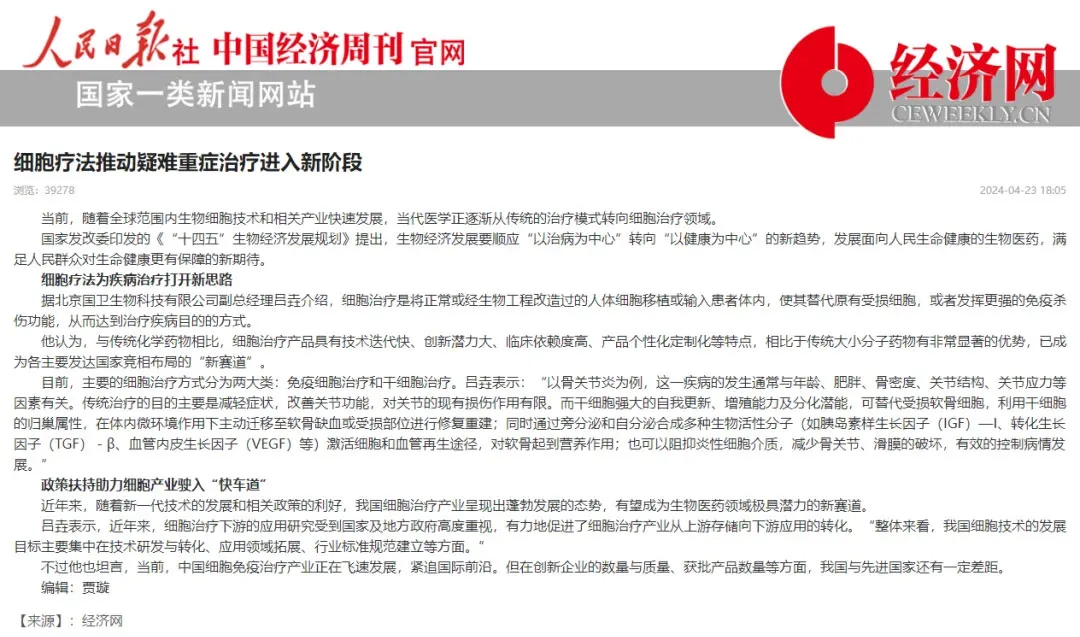
Currently, as biocell technology and related industries rapidly advance worldwide, modern medicine is gradually shifting from traditional treatment approaches toward the field of cell therapy.
The "14th Five-Year Plan for Bioeconomy Development," issued by the National Development and Reform Commission, emphasizes that bioeconomy development should align with the emerging trend of shifting from a "disease-centered" approach to a "health-centered" one. It calls for advancing biopharmaceuticals aimed at safeguarding people's health and well-being, thereby meeting the growing public demand for greater security in life and healthcare.
Cell therapy opens up new avenues for disease treatment.
According to experts, cell therapy involves transplanting or introducing normal or bioengineered human cells into a patient’s body, enabling them to replace damaged cells or enhance their immune-mediated killing functions, thereby achieving the goal of treating diseases.
Experts believe that, compared to traditional chemical drugs, cell therapy products boast rapid technological iteration, immense innovation potential, high clinical dependency, and the ability for personalized customization. These features give them a significant edge over conventional small- and large-molecule drugs, making them the "new frontier" that major developed countries are eagerly racing to establish themselves in.
Currently, the main types of cell-based therapies are divided into two broad categories: immune cell therapy and stem cell therapy. Experts explain: "Take osteoarthritis as an example—this condition typically develops due to factors such as age, obesity, bone density, joint structure, and joint stress."
Traditional treatments primarily aim to alleviate symptoms and improve joint function, but they offer limited benefits in repairing existing joint damage. In contrast, stem cells—thanks to their remarkable abilities for self-renewal, proliferation, and differentiation—can effectively replace damaged cartilage cells. Leveraging the stem cells' intrinsic homing properties, they naturally migrate toward areas of cartilage ischemia or injury within the body's microenvironment, where they initiate repair and regeneration. Additionally, through paracrine and autocrine mechanisms, these cells produce a variety of bioactive molecules (such as insulin-like growth factor I [IGF-I], transforming growth factor β [TGF-β], vascular endothelial growth factor [VEGF], and others), which not only stimulate cellular and vascular regenerative pathways but also provide essential nutrients to the cartilage. Moreover, stem cells can suppress inflammatory mediators, thereby reducing degradation of bone, joints, and synovial tissues—and ultimately helping to effectively control disease progression.
Policy support accelerates the cell industry into high gear.
In recent years, thanks to the advancement of next-generation technologies and supportive government policies, China's cell therapy industry has been thriving, positioning itself as a promising new frontier in the biopharmaceutical sector.
In recent years, downstream application research in cell therapy has received significant attention from both national and local governments, strongly driving the industry's transition—from upstream storage to downstream applications. Overall, China's development goals for cell technology are primarily focused on areas such as technology R&D and translation, expansion of application fields, and the establishment of industry standards and regulations.
However, experts also admit that China's cell immunotherapy industry is currently growing rapidly, keeping pace with international cutting-edge advancements. Yet, in terms of both the number and quality of innovative companies, as well as the number of approved products, China still lags behind more advanced nations to some extent.
Reprint Statement: This article was compiled from the official website of China Economic Weekly. If there is any infringement, please contact us for removal.
Related News

Here is the title—h1 placeholder text


Copyright © Jiuzhitang Maker (Beijing) Cell Technology Co., Ltd.
Powered by: 300.cn SEO | Privacy Policy