

News
News Center
People's Daily: Cell Therapy Industry Holds Significant Growth Potential
2023-02-27
As usual, at 8 a.m., Zhang Yingchi, a researcher at the Haihe Laboratory of Cellular Ecology in Tianjin, arrived at the lab. He changed into his clean suit, turned on the UV lamp in the biosafety cabinet, and placed the culture medium into the water bath. Half an hour later, he began working with the cells. Under the microscope, the cells were evenly distributed and appeared to be thriving. The digested and passaged cells will now be used to equip T cells with precise tools capable of effectively targeting and killing tumor cells—steps that ultimately pave the way for clinical applications and, eventually, the development of third-generation therapies: cell-based therapeutic drugs.
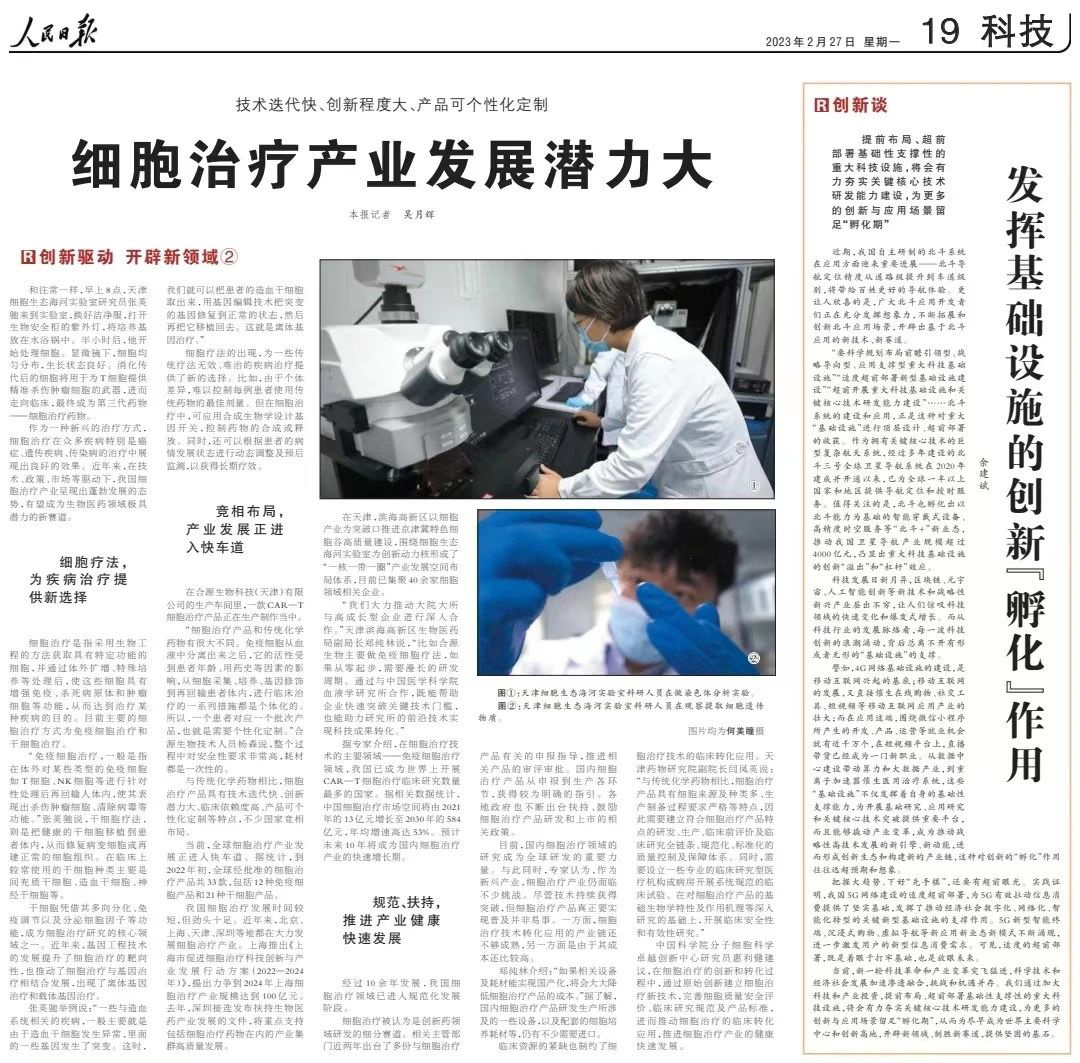
As an emerging therapeutic approach, cell therapy has demonstrated remarkable efficacy in treating a wide range of diseases, particularly cancer, genetic disorders, and infectious illnesses. In recent years, driven by advancements in technology, supportive policies, and growing market demand, China's cell therapy industry has experienced rapid growth—and is poised to become a highly promising new frontier in the biopharmaceutical sector.
Cell therapy offers a new option for disease treatment.
Cell therapy refers to the use of bioengineering techniques to obtain cells with specific functions. After being expanded and specially cultured outside the body, these cells are equipped with enhanced immune capabilities, enabling them to target and eliminate pathogens as well as tumor cells—ultimately aiming to treat certain diseases. Currently, the two main types of cell therapy are immune cell therapy and stem cell therapy.
"Immune cell therapy generally refers to the targeted manipulation of certain types of immune cells—such as T cells or NK cells—in a laboratory setting, followed by their reintroduction into the body to enhance their ability to kill tumor cells and eliminate viruses," said Zhang Yingchi. "Stem cell therapy, on the other hand, involves transplanting healthy stem cells into a patient’s body to repair damaged cells or help rebuild normal tissue structures. The most commonly used stem cell types in clinical practice include mesenchymal stem cells, hematopoietic stem cells, and neural stem cells."
Stem cells have become one of the central areas of cell therapy research, thanks to their versatile differentiation capabilities, immunomodulatory functions, and ability to secrete cytokines. In recent years, advancements in genetic engineering technologies have enhanced the targeting precision of cell therapies, while also driving the integration of cell therapy with gene therapy—leading to the emergence of ex vivo gene therapy and vector-based gene therapy approaches.
Zhang Yingchi gave an example: "Some diseases related to the hematopoietic system typically arise primarily from abnormalities in hematopoietic stem cells—specifically, when mutations occur in certain genes within these cells. In such cases, we can extract the patient’s hematopoietic stem cells, use gene-editing technology to correct the mutated genes back to their normal state, and then transplant them back into the patient. This is what we call ex vivo gene therapy."
The emergence of cell therapy has opened up new treatment options for diseases that are often resistant to conventional therapies. For instance, due to individual variability, it’s challenging to determine the optimal dosage of traditional medications for each patient. However, in cell-based treatments, synthetic biology can be employed to design genetic switches that precisely control the synthesis or release of therapeutic drugs. Additionally, these therapies allow for dynamic adjustments based on a patient’s evolving condition, along with real-time monitoring of disease progression, ultimately leading to sustained therapeutic benefits over the long term.
Competing to make strategic moves, the industry is now accelerating into high gear.
"Cell therapy products differ significantly from traditional chemical drugs. After immune cells are isolated from the bloodstream, their activity is influenced by factors such as the patient’s age and medical history. From cell collection and culture to genetic modification and eventual reinfusion into the patient, every step of the clinical treatment process is tailored individually. That’s why each patient receives a unique batch of product—essentially requiring personalized customization," explained technician Yang Sen. He added that the entire process demands stringent safety measures, with all consumables used only once.
Compared to traditional chemical drugs, cell therapy products feature rapid technological iteration, significant innovation potential, high clinical dependency, and the ability to offer personalized customization—driving many countries to actively invest in this field.
Currently, the global cell therapy industry is rapidly accelerating. According to statistics, as of early 2022, there were a total of 33 approved cell therapy products worldwide—12 immune-cell therapies and 21 stem-cell products.
China's cell therapy industry is still relatively young but has already gained significant momentum. In recent years, cities like Beijing, Shanghai, Tianjin, and Shenzhen have been aggressively advancing their cell therapy sectors. Shanghai recently unveiled the "Shanghai Action Plan for Promoting Innovation and Industrial Development in Cell Therapy (2022–2024)," aiming to propel the city’s cell therapy industry to reach a market value of 10 billion yuan by 2024. Meanwhile, last year, Shenzhen issued a series of policies aimed at bolstering the biopharmaceutical industry, with a strong focus on supporting the high-quality growth of cluster industries—including cell therapy drugs.
In Tianjin, the Binhai High-Tech Zone is leveraging the cell industry as a key breakthrough to drive the high-quality development of the Beijing-Tianjin-Hebei Regional Cell Valley. Centered around the Haihe Laboratory—a hub for cellular innovation—the zone has established an industrial development layout system dubbed "One Core, One Belt, One Circle," which has already attracted more than 40 companies active in the cell-related sector.
"We are actively promoting in-depth collaboration between leading research institutions and high-growth enterprises," said Zheng Chunlin, Deputy Director of the Biomedical Industry Bureau at Tianjin Binhai High-Tech Zone. "For instance, with immune cell therapy—when starting from scratch—it typically requires a lengthy R&D process. By partnering with the Institute of Hematology, Chinese Academy of Medical Sciences, we can help companies swiftly overcome critical technological barriers while also supporting the institute in translating its cutting-edge innovations into practical applications."
According to experts, China has become the country with the largest number of ongoing clinical studies in CAR-T cell therapy—the leading area within cell therapy technology—in the field of immune cell therapy. Relevant data indicate that China’s cell therapy market is projected to grow from 1.3 billion yuan in 2021 to 58.4 billion yuan by 2030, representing an impressive annual growth rate of up to 53%. The next decade is expected to usher in a period of rapid expansion for China’s cell therapy industry.
Standardize and support to drive the healthy and rapid development of industries.
After more than 10 years of development, China's cell therapy field has entered a stage of standardized growth.
Cell therapy is regarded as a niche yet innovative area within the pharmaceutical R&D landscape. Over the past two years, relevant regulatory authorities have issued multiple guidance documents on the submission of cell therapy products, accelerating the review and approval process. Domestically, clear guidelines have been provided to companies navigating the entire journey—from product application through to manufacturing. Meanwhile, local governments continue to roll out supportive policies aimed at fostering and encouraging the development and commercialization of cell therapy products.
Currently, research in the domestic cell therapy field has become a significant global driver of innovation and development. At the same time, experts believe that, as an emerging industry, cell therapy still faces numerous challenges. Although technological breakthroughs continue to emerge, making cell therapy products widely accessible remains no easy feat. On one hand, the industrial chain for translating and applying cell therapy technologies is still not fully mature; on the other hand, the high costs associated with these therapies remain a major barrier to broader adoption.
Zheng Chunlin explained: "If the relevant equipment and consumables can be localized, it will significantly reduce the cost of cell therapy products." It is understood that several key pieces of equipment—and even essential cell culture consumables—used in the research and production of domestic cell therapy products still need to be imported.
The shortage of clinical resources also poses a significant barrier to the clinical translation and application of cell therapy technologies. Yan Fengying, Vice President of the Tianjin Institute of Pharmaceutical Research, stated: "Compared to traditional chemical drugs, cell therapy products stand out due to their diverse cellular sources and types, as well as stringent requirements for production and preparation processes. Therefore, it is essential to establish a comprehensive, standardized, and regulated quality control and assurance system that aligns with the unique characteristics of cell therapy products—covering R&D, manufacturing, preclinical evaluation, and clinical studies. At the same time, specialized clinical research-oriented medical institutions or wards should be established to conduct systematic and standardized clinical trials. Building on in-depth research into the fundamental biological properties and mechanisms of action of cell therapy products, we can then move forward with clinical studies focused on safety and efficacy."
Hui Lijian, a researcher at the Center of Excellence in Molecular Cell Science of the Chinese Academy of Sciences, suggests that during the innovation and translation of cell therapies, pioneering new technologies should be established to enhance the quality and safety assessment of cells, refine clinical research guidelines and product standards, thereby accelerating the clinical application of cell therapies and fostering the healthy, rapid growth of the cell therapy industry.
Reprint Notice: This article is reprinted from People's Daily. If it infringes on any rights, please contact us for removal.
Related News

Here is the title—h1 placeholder text


Copyright © Jiuzhitang Maker (Beijing) Cell Technology Co., Ltd.
Powered by: 300.cn SEO | Privacy Policy