

News
News Center
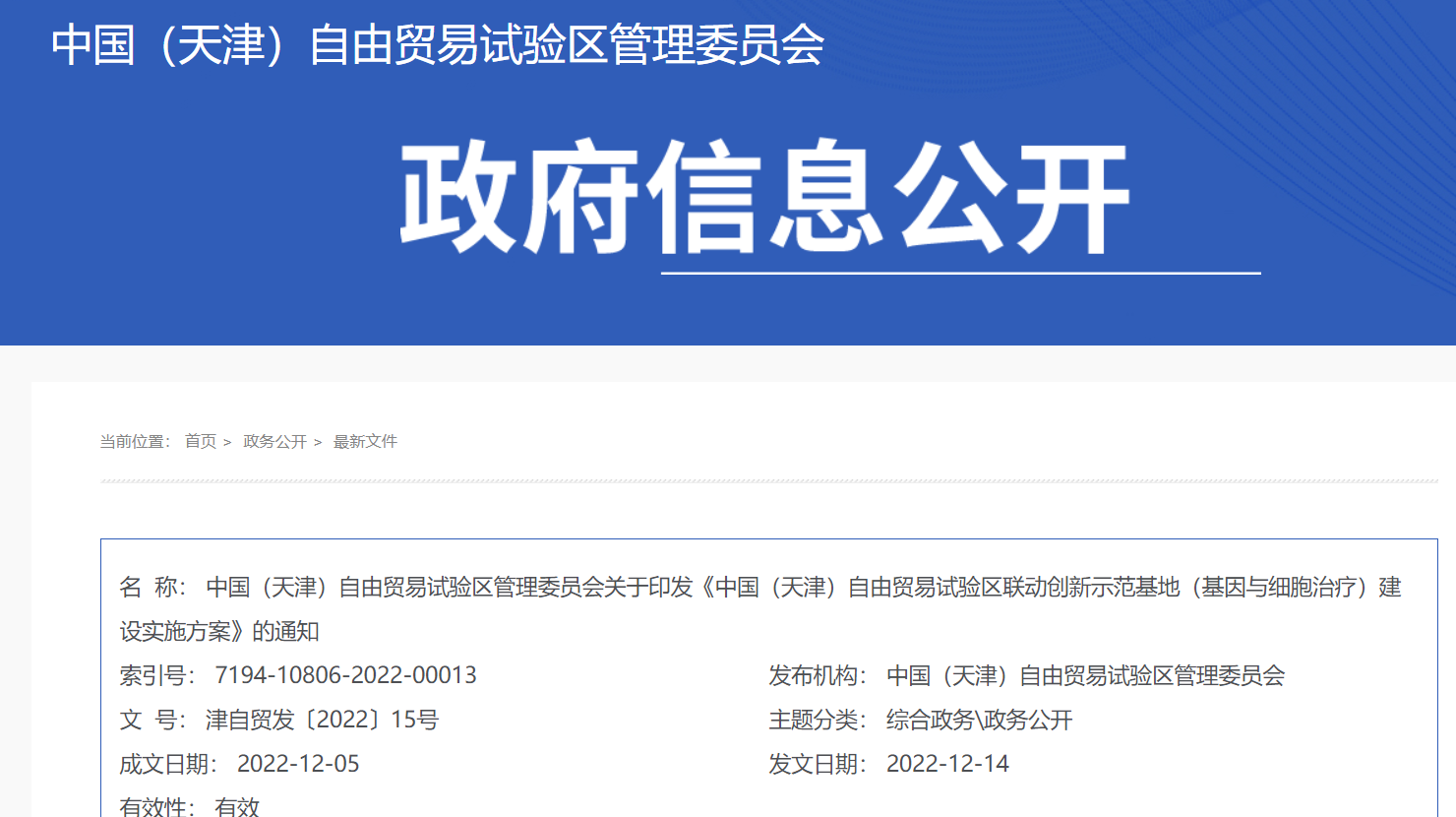
The "Implementation Plan for Building the China (Tianjin) Pilot Free Trade Zone's Collaborative Innovation Demonstration Base (Gene and Cell Therapy)" has been officially released.
2022-12-21
9. For innovative drugs that have completed Phase I–III clinical trials and received marketing authorization within China by companies registered in the free trade pilot zone, a pilot program will explore allowing their direct use in qualified medical institutions on a "batch-by-batch, entry-once" basis, eliminating the need for additional market准入 requirements.
Under the condition of effectively managing and controlling risks, launch pilot reforms in the field of gene and cell therapies, aligning with internationally accepted practices and standards. Pioneering the "risk-based classification and access categorization" management approach for gene and cell therapies, Establish a regulatory framework for gene and cell therapy applications, along with a standardized guidance system for cell preparation, to advance the standardization of cell therapies—benefiting patients by enhancing their treatment options, testing innovative systems and standards for the nation, and fostering industry growth while expanding opportunities for the sector.
Actively seek pilot policies for biopharmaceuticals , launching pilot reforms in the fields of gene and cell therapies, developing cutting-edge technologies such as gene-based diagnostics and treatment, stem cell therapy, and immune cell therapy, accelerating the translation of these innovative technologies into market-ready products and clinical applications, and driving the emergence of new treatment paradigms in regenerative medicine and precision medicine.
Establishing/introducing a third-party certification platform for quality control of gene and cell therapy products, with inspection reports that can be used in clinical gene and cell research, and setting up a coordination mechanism with the National Expert Committee on Clinical Stem Cell Research. Accelerate the registration process for gene and cell clinical research institutions and projects.
Promote the clinical and standardized application of cell therapy products, prioritizing support for autologous therapies under conditions where risks are manageable. Focus on minimizing procedural complexity and advancing the translational application of cell-based treatments that currently lack effective alternatives but have demonstrated clear clinical efficacy.
The full plan and policy analysis are as follows:
Implementation Plan for the Construction of the China (Tianjin) Pilot Free Trade Zone's Collaborative Innovation Demonstration Base (Gene and Cell Therapy)
To implement the requirements outlined in the "Approval from the China (Tianjin) Pilot Free Trade Zone Management Committee on Approving the Establishment of the China (Tianjin) Pilot Free Trade Zone Collaborative Innovation Demonstration Base within the National Stem Cell Engineering Product Industrialization Base" (Jin Zifa Han [2022] No. 2), and guided by the principle of "standards first, safety paramount," we are launching a pilot initiative to advance reforms in gene and cell therapies. This Implementation Plan has now been formulated accordingly.
I. Overall Approach
(1) Guiding Principles.
Guided by Xi Jinping Thought on Socialism with Chinese Characteristics for a New Era, we will deeply implement the decisions and deployments of the Party Central Committee, the State Council, as well as the Tianjin Municipal Party Committee and Government. In accordance with Article 27 of the Regulations on the China (Tianjin) Pilot Free Trade Zone—specifically, the provision allowing medical institutions within the zone to conduct cutting-edge clinical research on stem cell technologies based on their technical capabilities and in compliance with relevant regulations—we will fully leverage the pilot zone’s advantages in being first to test and innovate. Drawing on the strengths of the National Team in cell therapy from the Institute of Hematology & Blood Diseases, Chinese Academy of Medical Sciences, we will adopt a pragmatic, incremental approach while maintaining a strong sense of risk management. Under the premise of effectively controlling potential risks, we will launch pilot reforms in the field of gene and cell therapies, aligning ourselves with internationally accepted practices and standards. Pioneering efforts will focus on implementing a "risk-based classification and access-based categorization" framework for gene and cell therapies, establishing a robust regulatory chain for their application, and developing a standardized guidance system for cell preparation. This initiative aims to advance the standardization of cell therapies, ultimately benefiting patients by enhancing treatment options, while also serving as a national testing ground for innovative policies and standards, paving the way for industry growth and expanding opportunities across the sector.
(II) Construction Objectives.
Establish a demonstration base for gene and cell therapies that is standardized, safe, innovation-driven, application-led, and characterized by complementary advantages. Develop a series of technical guidelines or standards covering key areas such as cell collection, production preparation, transportation, quality control, in-hospital release, and risk management. Additionally, generate a set of institutional innovations in areas like the tiered classification management system for gene and cell therapies, the review and approval process, and the regulatory framework for ongoing and post-market oversight. Explore breakthroughs in initiatives such as IIT research in gene and cell therapies, clinical translation of cell-based treatments, and real-world data studies. Ultimately, cultivate a portfolio of replicable and scalable pilot experiences, laying a robust foundation for expanding the scope of these innovative approaches even further.
II. Key Tasks
1. Actively seek pioneering policies for biomedicine, launching pilot reforms in the fields of gene and cell therapies. We will develop cutting-edge technologies such as gene-based diagnostics and treatment, stem cell therapy, and immune cell therapy, accelerate the translation of these innovative technologies into market-ready products and clinical applications, and ultimately help establish new models for regenerative medicine and precision medicine treatments.
2. Encourage the initiation of clinical research in the fields of gene and cell therapies, while refining approval processes, regulatory frameworks, and clinical trial incentive mechanisms. Support IIT research (investigator-initiated clinical trials) conducted under a filing system, accelerate the registration process for clinical research institutions and projects, and enhance mechanisms for translating and applying advanced medical technologies.
3. Establish or introduce a third-party certification platform for quality control of gene and cell therapy products, ensuring that the resulting inspection reports can be used in gene and cell clinical research. Additionally, set up a coordination mechanism with the National Expert Committee on Clinical Stem Cell Research to expedite the registration process for gene and cell clinical research institutions and projects.
4. Develop and implement management measures, review mechanisms, and technical guidelines for Investigational Initiated Trials (IITs) in gene and cell therapies; refine the IIT research initiation process; and promote the establishment of a Gene and Cell Therapy Foundation to support the conduct of IIT research in this field.
5. Establish smooth communication channels for non-technical review issues in the cell therapy field, strengthen early involvement of regulatory authorities, guide the standardized conduct of Investigational Initiated Trials (IITs), and explore opportunities to submit relevant research findings as clinical study data under compliant conditions.
6. Conduct research to develop technical specifications or standards covering cell collection, production and preparation, transportation, in-house release, risk control, and more. Explore standardized criteria for accessing cell therapy technologies, as well as review pathways and clinical application guidelines, ultimately aiming to elevate these technical standards and regulations to national or Tianjin municipal-level standards.
7. Promote the clinical and standardized application of cell therapy products, prioritizing support for autologous therapies—under conditions where risks are manageable—and encouraging the translation and implementation of cell-based treatments that currently lack effective alternatives but have demonstrated clear clinical efficacy, while minimizing procedural complexity.
8. On the premise of controllable risks, support qualified diversified investment entities in conducting research and development of human cell and gene technologies, as well as advancing their industrialization. Additionally, establish a biopharmaceutical industry innovation fund within the free trade pilot zone at an appropriate time to help eligible base enterprises achieve rapid growth.
9. For innovative drugs that have completed Phase I–III clinical trials and received marketing authorization within China by companies registered in the free trade pilot zone, a pilot program will explore allowing their direct use in qualified medical institutions on a "batch-by-batch, entry-once" basis, eliminating the need for additional market准入 requirements.
10. Explore the development and application of real-world data in cell therapy, launch pilot studies on real-world data, standardize data collection processes, and encourage companies to submit real-world research data for new drug applications.
11. Streamline domestic and international supply chain systems, establish a customs clearance service platform, expand public service functions such as supply chain matchmaking, technology brokering, and innovation-to-application support, and build a bio-industry ecosystem that fosters the integrated development of five key chains: the value chain, innovation chain, industrial chain, supply chain, and factor chain.
12. Strengthen the collaborative innovation demonstration base's linkage with the free trade zones and the free trade zone collaborative innovation areas, fostering participation from all parties in the pilot program for gene and cell therapies.
13. Promote collaborative partnerships between the Pilot Free Trade Zone's Demonstration Base for Collaborative Innovation and relevant medical institutions, the Haihe Laboratory for Cellular Ecology, the Cell Therapy Regulatory Research Center, and other organizations and platforms. Additionally, facilitate the establishment of a Clinical Research Consortium for Gene and Cell Therapies, fostering shared systems and strengthening cooperative efforts.
14. Support technology cooperation between enterprises registered within the Free Trade Zone Demonstration Base for Collaborative Innovation and those located in the Free Trade Zone (including its Collaborative Innovation Zones) in areas such as gene and cell therapy IIT research, translational applications of cell therapies, urgently needed imported medical devices and drugs for clinical use, and real-world studies.
15. Explore leveraging the Clinical Research Alliance for Gene and Cell Therapy to achieve rational allocation of industry resources, establish quality control standards, and facilitate data exchange and utilization—providing comprehensive services for clinical research, including trial design, ethical review, pharmacovigilance, evaluation of urgently needed imported medical devices and drugs, and assessment of special-purpose items.
16. Establish a database of experts specializing in risk assessments for special biomedical products, collaborating with relevant authorities to conduct risk evaluations of high-risk special items entering or leaving the country. Additionally, engage third-party professional service organizations and promote a public-benefit agency model to help companies efficiently process approvals for these specialized items.
III. Assurance Measures
(1) Strengthen organizational leadership.
Led by the Management Committee of the Pilot Free Trade Zone (the Innovation and Development Bureau of the Pilot Free Trade Zone), the initiative is being jointly supported by the Municipal Science and Technology Bureau, Municipal Industry and Information Technology Bureau, Municipal Health Commission, Municipal Commerce Bureau, Municipal Drug Administration, and Tianjin Customs. Together, they have established a dedicated task force to provide guidance, support, and strategic impetus for the pilot program. A coordinated mechanism for promotion and daily monitoring has also been put in place to promptly address any bottlenecks or challenges encountered during the pilot process.
(II) Establish a coordination mechanism.
The Institute of Hematology, Chinese Academy of Medical Sciences (affiliated with the Chinese Academy of Medical Sciences Hospital of Hematology) has established a dedicated task force to oversee the construction of a collaborative innovation demonstration base for the industrialization of Peking Union Medical College stem cell engineering products. This team will further refine the supporting systems for the demonstration base, effectively integrate and leverage the specialized expertise of all involved parties, assign specific personnel to manage day-to-day operations, and ensure that the pilot project’s objectives are fully implemented.
(III) Strengthen Replication and Promotion
Based on the progress of the pilot program, we will promptly commission a third-party authoritative organization to conduct a comprehensive and systematic assessment of its effectiveness and risks. The insights gained will be summarized into successful case studies, which can then be replicated and scaled up across a wider range of applications.
(IV) Enhance the Support Mechanism
Promote the introduction of commercial insurance products, develop specialized treatment plans, advance clinical applications of cell therapies, and provide coverage for urgently needed imported medical devices and drugs—providing robust support for the pilot program in gene and cell therapies.
Support the High-Tech Zone and its Collaborative Innovation Area in formulating special support policies to promote the development of the gene and cell industries.
(5) Strengthen Risk Management and Control
Explore establishing a multi-departmental joint regulatory mechanism, leveraging functional platforms such as the Cell Therapy Regulatory Research Center for daily oversight and management. Introduce third-party quality control platforms to conduct batch-by-batch testing of cell therapy products before release, and develop emergency protocols to ensure immediate action is taken—and relevant authorities are promptly notified—should any abnormalities arise.
Policy Interpretation of the "Implementation Plan for Building the China (Tianjin) Pilot Free Trade Zone Collaborative Innovation Demonstration Base (Gene and Cell Therapy)"
I. Background and Significance
Cell therapy is a key research focus in contemporary medicine for the 21st century. To implement the requirements outlined in the "Approval from the China (Tianjin) Pilot Free Trade Zone Management Committee on Approving the Establishment of the China (Tianjin) Pilot Free Trade Zone Collaborative Innovation Demonstration Base within the National Stem Cell Engineering Product Industrialization Base" (Jin Zifa Han [2022] No. 2), and to align with internationally recognized practices and standards, this initiative leverages the strengths of the "national team" in cell therapy alongside the pilot-zone advantages of being a first-mover in innovation. Guided by the principle of "standards first, safety paramount," the Free Trade Zone Innovation Development Bureau has drafted the "Implementation Plan for the Construction of the China (Tianjin) Pilot Free Trade Zone Collaborative Innovation Demonstration Base (Gene and Cell Therapy)"—referred to as the "Plan"—to drive pilot reforms in gene and cell therapies.
II. Drafting Process
The "Plan" is guided by relevant laws such as the *Drug Administration Law of the People's Republic of China* and the *Regulations of the China (Tianjin) Pilot Free Trade Zone*. During its drafting process, a dedicated working team was established in collaboration with municipal-level departments to systematically review regulatory policies and draw on best practices from other provinces and cities. The team also conducted an in-depth assessment of the specific needs of medical institutions, cell-related enterprises, and research platforms in Tianjin, while actively seeking national support and empowerment. In parallel, the team visited Hainan, Shanghai, Beijing, Zhejiang, and other regions to study advanced approaches in gene and cell therapy policies and industry development. Multiple workshops and expert consultations were held to refine and finalize the document, involving repeated discussions and revisions with specialists from municipal departments, medical institutions, leading cell companies, and innovative research platforms. Two rounds of feedback were solicited from seven municipal departments, and after thorough communication and consensus-building, the final draft of the "Plan" was approved. Finally, the document was entrusted to a law firm for legal review and fair competition assessments before being officially issued under the name of the Tianjin Free Trade Zone Management Committee.
III. Main Content
The "Plan" consists of three key sections: the overall vision, priority tasks, and supporting measures.
1. The overarching vision encompasses two key aspects: the guiding principles and the development objectives. First, the vision calls for the base to be built under the guidance of Xi Jinping Thought on Socialism with Chinese Characteristics for a New Era, ensuring thorough implementation of decisions and deployments made by the Central Party Committee, the State Council, as well as the Tianjin Municipal Party Committee and Government. It also emphasizes full compliance with the "Regulations of the China (Tianjin) Pilot Free Trade Zone," leveraging the pioneering advantages of the FTZ while capitalizing on the national-level expertise of the Institute of Hematology, Chinese Academy of Medical Sciences—specifically its "national team" position in cell therapy. Under the premise of effectively managing risks, the initiative aims to launch pilot reforms in the field of gene and cell therapies, ultimately benefiting patients, revitalizing treatment options, testing institutional frameworks and standards for the nation, and fostering industry growth while expanding market opportunities. Second, the development objectives are clearly defined: to establish a benchmark demonstration base for gene and cell therapies that is standardized, safe, innovation-driven, application-led, and characterized by complementary strengths. This will involve developing a comprehensive set of technical guidelines or standards covering critical areas such as cell collection, production and preparation, transportation, quality control, internal hospital release processes, and risk management protocols. Additionally, the initiative seeks to generate innovative institutional breakthroughs in areas like tiered and categorized management systems for gene and cell therapies, streamlined review and approval procedures, and robust regulatory frameworks for ongoing and post-market oversight. Ultimately, these efforts will yield replicable and scalable pilot experiences, laying a solid foundation for broader expansion of similar initiatives in the future.
2. The key tasks, totaling 16 initiatives, are divided into two main areas: institutional innovation and collaborative innovation. First, institutional innovation focuses on pioneering breakthroughs in areas such as the "tiered and categorized management model for gene and cell therapies," the "regional mutual recognition mechanism for ethical reviews of cell therapies," "new models for clinical translation and application of cell therapies," "the application of real-world data research in drug review and approval processes," and "a streamlined customs clearance model for special biological materials used in globally coordinated R&D projects." These efforts aim to establish robust regulatory frameworks and standardized preparation guidelines, accelerating the standardization process. Second, collaborative innovation emphasizes fostering partnerships between the base and pilot free trade zones as well as collaborative innovation hubs. Additionally, it encourages the formation of a Clinical Research Alliance for Gene and Cell Therapies, promoting shared institutional frameworks and deepening cooperative ties.
3. The safeguard measures include five key areas: strengthening organizational leadership, establishing a coordination mechanism, enhancing replication and promotion, refining the support system, and reinforcing risk management and control.
Reprint Notice: This article is reprinted from the official website of the Binhai New Area Government of Tianjin. If there is any infringement, please contact us for removal.
Related News

Here is the title—h1 placeholder text


Copyright © Jiuzhitang Maker (Beijing) Cell Technology Co., Ltd.
Powered by: 300.cn SEO | Privacy Policy