

News
News Center
The Shanghai Municipal Government has issued a document: Accelerating the R&D and commercialization of cell and gene therapy, as well as related technology products.
2022-10-20
The Shanghai Municipal People's Government recently issued the "Action Plan for Building Shanghai into a Global Innovation Hub and Expanding Future Industry Clusters," aiming to achieve a future industry output value of approximately 500 billion yuan by 2030. By 2035, the plan seeks to establish several cutting-edge industrial clusters that will lead globally. Key initiatives will be rolled out in areas such as Pudong, Baoshan, Minhang, Jinshan, and Fengxian, enhancing Shanghai's capacity to support "Zhangjiang R&D + Shanghai Manufacturing." The focus includes advancing fields like gene and cell therapy, synthetic biology, and biosecurity.
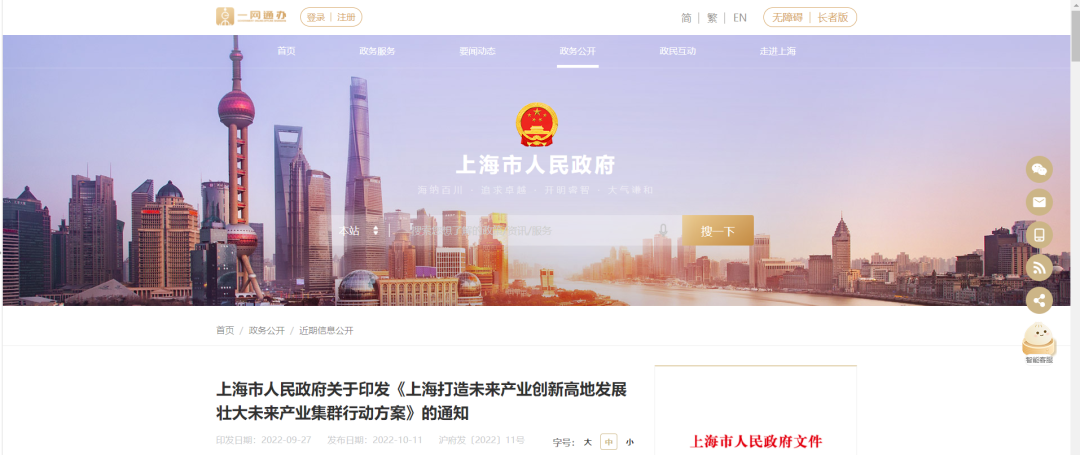
The plan clearly states: Encourage breakthroughs in key technologies such as clinical-grade viral vectors and scalable cell culture processes. Accelerate the research, development, and commercialization of advanced technology products related to cell therapy, gene therapy, oncolytic viruses, and more. Additionally, support innovation and industrial applications in critical raw materials, essential equipment, and consumables.
Original text:
Shanghai's Action Plan to Build a Future Industry Innovation Hub and Foster the Growth of Emerging Industrial Clusters
To implement the innovation-driven development strategy, we will fully strengthen the innovation engine, cultivate new growth drivers, and establish a leading hub for future industry innovation. Additionally, we aim to expand and develop cutting-edge future industry clusters. This action plan is designed to support these ambitious goals.
1. Clearly Define the Overall Requirements
(1) Guiding Principles
Guided by Xi Jinping Thought on Socialism with Chinese Characteristics for a New Era, we will comprehensively implement the spirit of the 19th National Congress of the Communist Party of China and all subsequent plenary sessions of the 19th Central Committee. We will strengthen the leading role of high-end industries, driven by the implementation of major national strategic tasks, and promote the integrated development of science & technology and industry in a coordinated manner. This approach will seamlessly combine short-term priorities with long-term vision, as well as effective government intervention with vibrant market dynamics. Leveraging our robust industrial foundation and unique ecological advantages, we will concentrate resources, foster continuous growth, and strive to build a world-class innovation hub for future industries with global influence.
(II) Development Goals
By 2030, a number of world-class breakthroughs, innovative companies, and leading talents will emerge in fields such as future health, future intelligence, future energy, future space, and future materials. Meanwhile, the output value of these future industries is expected to reach approximately 500 billion yuan.
——Building a future high ground for independent innovation in core technologies. Leveraging diverse societal stakeholders, we will establish a Future Industries Research Institute, set up around five Future Technology Colleges, nurture approximately 15 Future Industry Innovation Centers, and create a series of innovative consortiums. This initiative will forge seamless two-way pathways—from fundamental research and applied basic research all the way to industrialization.
——Paving the way as the future engine for strengthening the development of next-generation industrial clusters. We will cultivate 5 cutting-edge industrial clusters, establish around 15 pioneering zones for future industries, tackle key challenges in approximately 100 core components, launch roughly 100 high-end products, and develop about 100 Chinese standards—ultimately driving industry aggregation and leading growth in these sectors.
——Shaping a future paradigm of integrated innovation among large, medium, and small enterprises. We will encourage around 10 leading companies to strategically position themselves in emerging industries, nurture approximately 20 ecosystem-leading enterprises, establish around 100 enterprise technology centers, cultivate roughly 1,000 high-tech firms, and foster greater collaboration and integration among businesses of all ownership types.
——Fostering a future ecosystem characterized by concentrated innovation, openness, and inclusivity. Actively participating in major international science initiatives and large-scale scientific projects, we will attract a group of high-level strategic scientists and entrepreneurs, continuously refining our innovation ecosystem. Ultimately, we aim to establish around 50 comprehensive application scenarios, creating an innovative ecosystem that seamlessly integrates industry, academia, research, and practical applications for maximum collaborative efficiency.
By 2035, several globally leading future industry clusters will have emerged.
II. Strategically planning for future industries to build next-generation industry clusters
(1) Building a Future-Ready Health Industry Cluster
In areas such as Pudong, Baoshan, Minhang, Jinshan, and Fengxian, enhance the capacity to support "Zhangjiang R&D + Shanghai Manufacturing," and build a thriving future health industry cluster.
1. Brain-computer interfaces: Accelerate breakthroughs in non-invasive BCI technologies, brain-machine fusion techniques, neuromorphic chip technologies, and brain-inspired computational neural models. Strengthen fundamental research in areas such as brain engineering, brain neuroinformatics, and artificial neural networks, while driving innovation in the development of neuromorphic chips, brain-like micro- and nanophotonic devices, brain-inspired computers, neural interfaces, and intelligent prosthetics. Additionally, explore the application of BCI technologies in medical rehabilitation fields like limb movement disorders, chronic disorders of consciousness, and mental health conditions.
2. Biosafety: Achieve breakthroughs in key technologies such as rapid identification of novel microorganisms and pathogens, short-term scalable detection methods, and scientific traceability and source-tracking systems. Drive the research, development, and commercialization of cutting-edge technologies—including next-generation vaccines, antibodies, molecular diagnostics, and immunodiagnostic tools—and foster the creation of innovative drugs for major infectious disease prevention and control, backed by independent intellectual property rights. Additionally, establish a robust biosafety industry ecosystem. Support the production and stockpiling of critical pharmaceuticals, diagnostic reagents, and medical devices tailored for combating major infectious diseases.
3. Synthetic Biology: Drive breakthroughs in foundational DNA/RNA technologies and develop automated DNA/RNA synthesis systems leveraging bioinformatics and machine learning. Focus on the interplay between primary and secondary metabolism in living organisms, fostering cross-disciplinary metabolic science technologies. Additionally, accelerate the application and commercialization of synthetic biology in areas such as innovative drug development, medical beauty product creation, microbial strain engineering, and biodegradable material production.
4. Gene and Cell Therapy: Accelerate breakthroughs in technologies such as vector delivery systems and gene editing, and encourage advancements in critical areas like clinical-grade viral vectors and scalable cell-culture processes. Speed up the research, development, and commercialization of innovative cell-based therapies, gene therapies, oncolytic viruses, and other related technology products. Additionally, support R&D innovation and industrial applications for essential raw materials, key equipment, and vital consumables.
(II) Building a Future-Ready Smart Industry Cluster
In areas such as Pudong, Xuhui, Yangpu, Baoshan, Minhang, Jiading, and Qingpu, scenario-based demonstrations will drive industrial development and help build a future-oriented smart industry cluster.
1. Intelligent Computing: Drive breakthroughs in intelligent computing for ultra-large models, foster the development of independent computing frameworks and algorithm platforms, and advance domestically developed smart chips. Collaborate across cloud, edge, and end-device computing resources to promote innovative applications of technologies such as knowledge-enhanced modeling, cross-modal unified modeling, prompt learning, and continual learning within ultra-large models. Accelerate the integration of these advanced models into key areas like machine vision, intelligent speech and semantics, natural language processing, and human-machine interaction, paving the way for AI to benefit society at large.
2. General-purpose AI: Develop general-purpose AI models equipped with generalized knowledge, dynamic learning capabilities, and autonomous planning skills, while deepening their deployment and application in areas such as urban governance and biosecurity early warning systems. Additionally, explore AI-driven applications in drug discovery and AI-enhanced new materials development, fostering deep integration between AI and fundamental sciences like physics, chemistry, and mathematics to create cutting-edge tools that serve scientific research. Finally, tackle key technologies such as flexible sensing, adaptive transfer learning, and collective intelligence, building machine agents that seamlessly integrate perception, decision-making, planning, and control—ultimately advancing their use in critical sectors like healthcare, caregiving, and elderly care.
3. Extended Reality (XR). Break through key XR technologies, driving advancements in near-eye displays, sensing and interaction technologies, rendering and computing capabilities, and cloud-based content creation and sharing solutions. Accelerate the development of XR-enabled devices and application software, fostering innovative convergence between Next-Generation Networks (NGN) and XR, and nurturing a robust ecosystem for integrated hardware-and-software smart interactive devices. Additionally, create diverse XR technology application scenarios, speeding up adoption across industries such as education, healthcare, industrial manufacturing, sports, and entertainment.
4. Quantum Technology: Actively foster the quantum technology industry centered around quantum computing, quantum communication, and quantum measurement. Focus on breakthroughs in areas such as quantum materials and device design, multi-degree-of-freedom quantum sensing, and opto-electro-acoustic quantum devices. Achieve significant advancements in the research and application of silicon photonics, optical communication components, and photonic chips. Additionally, drive the practical application of quantum technologies in fields like finance, big data computing, healthcare, and resource & environmental management.
5.6G technology: Scientifically and systematically advancing the research and development of critical core technologies, future network test facilities, and large-scale commercial deployment. Key breakthroughs will be made in integrated space-air-sea solutions and deterministic networking technologies. Focusing on 6G-enabled smart terminals, system equipment, integrated communication-sensing-computing networks, and converged applications, we’ll drive the industry toward greater innovation and growth. Additionally, a 6G National Standards and Technology Promotion Center will be established to strengthen 6G standards leadership.
(III) Building a Future Energy Industry Cluster
Building a future energy industry cluster in areas such as Pudong, Minhang, and Jiading.
1. Advanced Nuclear Energy: Accelerate the development of commercialized advanced nuclear technologies, focusing on the research and development of next-generation small reactors, ultra-high-temperature gas-cooled reactor systems, and innovative nuclear engineering materials for practical applications. Target key advancements in small modular thorium-based molten salt reactor systems and their modular intelligent equipment, as well as in high-temperature superconducting controlled nuclear fusion experimental devices. Additionally, initiate pre-research on novel nuclear fusion energy system technologies, advance the validation of compact nuclear energy solutions, and pilot demonstration projects integrating multiple energy sources.
2. Next-generation energy storage. We will accelerate the development of strategic energy-storage technologies, promote the commercialization of long-duration storage solutions such as compressed air and flow batteries, facilitate the deployment of innovative "solar-storage-charging" integrated energy stations, speed up pilot testing of technologies like flywheel energy storage and sodium-ion batteries, and drive breakthroughs in solid-state battery electrolyte technologies. Additionally, we’ll advance innovations in high-power, long-life hydrogen fuel cells, along with key materials such as carbon paper, proton exchange membranes, and catalysts, while also fostering applied research into fuel cell combined heat and power systems and solid oxide fuel cells.
(IV) Building a Future-Ready Space Industry Cluster
Building future-oriented spatial industry clusters in areas such as Pudong, Yangpu, Minhang, Jinshan, Songjiang, Qingpu, and Chongming.
1. Deep-sea exploration and resource extraction: Drive research and development of advanced deep-sea and polar vessels, as well as marine engineering equipment. Develop cutting-edge polar technologies such as heavy-duty icebreakers and high-ice-class LNG carriers, establishing a comprehensive system of equipment for polar scientific expeditions and resource exploitation. Additionally, create specialized vessels tailored for deep-sea operations, maintenance support, and multifunctional rescue missions, enhancing emergency response capabilities. Also, design large-scale, deep-water floating production, storage, and offloading units—key energy-related marine infrastructure—as well as stationary floating research platforms. Finally, advance the development of deep-sea mining equipment, accelerating sea trials, verification processes, and demonstration applications.
2. Aerospace Utilization: Breakthroughs will be made in technologies such as tiltrotor systems, composite-wing designs, and intelligent flight systems, leading to the development of manned electric vertical takeoff and landing (eVTOL) aircraft and paving the way for innovative air transportation models. Focusing on advancements in smart onboard systems, advanced composite materials, and next-generation energy propulsion, we’ll create next-generation commercial aircraft featuring supersonic capabilities and blended wing-body configurations. Additionally, we’ll drive the validation and demonstration of cutting-edge hydrogen-powered aviation technologies, including hydrogen fuel cells and hydrogen turbofans. We’ll also develop cost-effective satellites and reusable launch vehicles, accelerating the deployment and commercial operation of broadband communication satellite networks. By actively leveraging space frequency and orbital resources, we aim to build a global, all-weather satellite internet infrastructure spanning land, sea, air, and space.
(5) Building a Future Materials Industry Cluster
In areas such as Pudong, Baoshan, and Jinshan, enhance the capacity to facilitate industrial transformation and build a future materials industry cluster.
1. High-end membrane materials: Enhance the foundational structural design and raw material self-sufficiency capabilities for membrane materials, achieve breakthroughs in advanced separation membrane technologies, and develop cutting-edge solutions such as proton exchange membranes and specialized resins for fuel cells, hollow fiber membranes used in extracorporeal membrane oxygenators, liquid crystal polymer films for 5G/6G antenna applications, and high-thermal-conductivity graphene films—along with their corresponding manufacturing technologies. Continuously drive innovation and industrialization of materials like high-performance membranes for advanced lithium batteries, next-generation optical films for display technologies, and release liners for integrated circuits.
2. High-performance composite materials. Strengthen the high-performance fiber industry chain by focusing on cutting-edge areas such as extreme-environment fibers, bio-medical fibers, and AI-enabled fibers. Enhance R&D efforts in polyacrylonitrile-based carbon fibers, while supporting advancements in technologies and processes for manufacturing viscose-based, pitch-based, aramid fibers, and ultra-high-molecular-weight polyolefin fibers. Simultaneously, tackle key challenges in core catalytic materials to achieve breakthroughs in mass-production technologies for high-performance carbon fibers and composites. Additionally, develop application-oriented technologies for energy conversion and storage fibers, color-changing fibers, shape-memory fibers, and actuation fibers. Ongoing research will also target advanced materials like high-temperature alloys for aerospace engines, metal matrix composites, and premium biodegradable medical alloys.
3. Non-silicon-based core materials. We will drive the development of wide-bandgap semiconductor compounds such as silicon carbide and gallium nitride, continuously advancing the technological capabilities and production scale of wide-bandgap semiconductor crystal fabrication. At the same time, we will proactively invest in research and development of advanced manufacturing processes for wide-bandgap semiconductor wafers, strengthen our expertise in designing wide-bandgap semiconductor chip products, and expand the applications of these cutting-edge technologies across various industries. Additionally, we will actively promote research and deployment of next-generation non-silicon semiconductor materials, including carbon-based chip materials like graphene and carbon nanotubes, as well as emerging two-dimensional semiconductor materials.
III. Implement Six Major Initiatives to Compete in Tomorrow’s Growth Areas
(1) The "Foundation Building" Initiative for Future Technologies
We plan to establish a group of Future Technology Institutes to strengthen discipline development and talent cultivation in higher education institutions. Leveraging the role of the China Academy of Engineering's Center for Demonstrating and Commercializing Academic Achievements, we will attract diverse innovation resources and set up a Future Industry Research Institute. Additionally, we will foster innovative consortia by establishing a series of Future Industry Innovation Centers, enhancing multidirectional exploration of cutting-edge technologies, promoting cross-disciplinary integration, and driving the development of disruptive technological solutions. Finally, we will refine the global innovation network for future industries, bolstering international collaboration and co-creation, while strategically deploying overseas nodes within our technology transfer and commercialization networks, as well as establishing international centers for technology transfer and innovation partnerships.
(II) Future Deployment of the "Leading Plan"
Plan and develop pioneering zones for future industries, focusing on areas like Lingang, Zhangjiang, and Zizhu. These zones will attract innovative resources and foster deep integration between the innovation and industrial chains. Establish future industry acceleration parks by selecting several specialized industrial clusters for forward-looking development, leveraging the role of future industry science parks to create a network of accelerators that drive the commercialization of groundbreaking innovations. Additionally, build "future industry testbeds" by constructing benchmark demonstration scenarios—such as future-oriented communities, factories, hospitals, commercial spaces, and agricultural systems—that showcase cutting-edge applications and technologies.
(III) Future Partners "Hand-in-Hand Initiative"
Cultivate industry-leading enterprises that drive ecosystem development, encourage state-owned enterprises to strengthen their strategic positioning in future industries, and enhance corporate innovation and openness—incorporating these efforts into annual innovation performance evaluations. Additionally, attract and nurture a group of innovative companies, launch the "Top 100 Hardcore Tech Companies" list, and help identify a cohort of "future stars" poised to lead in niche market segments. Leveraging the "Pujiang Stars" program, we will establish an integrated mechanism for project identification and selection, bringing together scientists, entrepreneurs, and investors.
(Four) Future Scenarios "Open Source Initiative"
Release early validation scenarios to explore the feasibility of future technologies and accelerate "0-to-1" innovation breakthroughs. Launch integrated testing scenarios to support joint efforts between enterprises and research institutions in establishing pilot-scale facilities and verification platforms, enabling cross-sector collaboration and showcasing landmark demonstration projects that drive the rapid incubation of "1-to-100" industrial applications. Finally, introduce comprehensive promotion strategies aimed at scaling up through large-scale demonstrations, sparking exponential growth from "100 to 1 million," while simultaneously accelerating iterative advancements and full-scale industrialization.
(5) The Future Talent "Goose Formation" Program
We are launching a new batch of "Challenge-Based, Leadership-Driven" projects aimed at the global market, fully empowering scientists with autonomy and decision-making authority to foster an environment conducive to free exploration. Additionally, we will attract top-tier global talent, cutting-edge research teams, and innovative enterprises by establishing a market-oriented mechanism for sharing risks and rewards, thereby accelerating the industrialization of R&D activities. Furthermore, we will leverage platforms such as Academician (Expert) Workstations and Postdoctoral Research Workstations to closely monitor emerging technological breakthroughs, nurture future industry leaders in innovation, and provide robust support for applicants seeking various talent programs.
(6) The Future Ecosystem "Rainforest Project"
Explore establishing a market-driven, future-industry guidance fund to encourage financial institutions to innovate in products and services. Promote the establishment of internationally recognized industry organizations and support enterprises in participating in the development of future industry standards and guidelines. Build a robust intellectual property protection system for emerging industries, with a strong emphasis on data security, industrial safety, and ethical framework development. Amplify the spillover effects of premier global events like the World Top Scientists Forum and the World Artificial Intelligence Conference, creating platforms that foster collaboration and knowledge exchange in future industries. Additionally, collaborate with the "Haiju Yingcai" Global Innovation and Entrepreneurship Competition to launch a dedicated Future Industry Challenge.
4. Implementing Assurance Measures
(1) Strengthen Organizational Promotion
Leveraging the city's Leading Group for High-Quality Manufacturing Development, we will establish and refine a robust city-level mechanism to advance future industries. This includes strengthening the integrated deployment of foundational research, technological innovation, and industrialization, while simultaneously scaling up industry growth and ensuring coordinated development of future sectors. We will also enhance collaboration between central ministries and the municipal government, actively attracting major national projects, landmark initiatives, and critical platforms to settle in Shanghai. Additionally, we’ll strengthen coordination between the city and its districts, reinforcing regional planning and securing essential resources and support.
(II) Strengthen Strategic Research
Leveraging the city's Strategic Advisory Committee on Industrial and Technological Innovation, a specialized expert panel for future industry strategy has been established. A white paper on the development of future industries will be prepared, and efforts will be accelerated to refine the statistical framework. Additionally, a future industry promotion platform will be set up to facilitate resource matching, drive technology commercialization, and foster a more robust ecosystem for the growth of future industries.
(III) Strengthen Policy Support
Develop and implement supportive policies to drive the growth of future industries, while significantly boosting targeted initiatives such as high-quality industrial development, the expansion of strategic emerging industries, and science-and-technology innovation action plans. Fully enforce policies like the additional deduction for R&D expenses, incentives for the first-of-its-kind equipment installations, science-and-tech innovation vouchers, and programs promoting innovative products. Encourage market-based consumer subsidies to stimulate and expand demand. Strengthen efforts to provide robust talent services, guarantees, and financing support. Additionally, individual districts are encouraged to introduce tailored, region-specific support measures based on their unique circumstances.
(IV) Strengthen Reform and Innovation
Establish and refine institutional frameworks that align with the rapid pace of technological advancements and industrial transformations in emerging sectors. Adhering to the principles of inclusivity and prudent regulation, strike a balance between oversight and support, while appropriately easing market access for innovative products and services in cutting-edge fields. Additionally, deepen policy innovations aimed at reducing bureaucratic burdens on research talent, accelerating the market-oriented allocation of key production factors, strengthening enterprises' pivotal role in driving innovation, exploring new land-use models tailored for future industries, and fostering greater openness and efficiency in data sharing and trading.
(5) Strengthen Atmosphere Building
Foster a vibrant social atmosphere and innovation culture that encourages creativity, embraces failure as a learning opportunity, and honors both talent and innovation. Strengthen scenario-building efforts, ramp up pilot applications, and intensify the documentation and dissemination of exemplary innovation cases to inspire broader adoption. Deepen science communication and education initiatives, nurturing and cultivating more "seeds of future science" to lay a solid foundation for the sustained growth of tomorrow's industries.
Reprint Notice: This article is reprinted from the official website of the Shanghai Municipal Government. If any infringement occurs, please contact us for removal.
Related News

Here is the title—h1 placeholder text


Copyright © Jiuzhitang Maker (Beijing) Cell Technology Co., Ltd.
Powered by: 300.cn SEO | Privacy Policy