

News
News Center
Up to 300 million yuan in funding available! Shenzhen Development and Reform Commission issues a notice on three policies, including the "Several Measures to Promote High-Quality Development of the Biopharmaceutical Industry Cluster in Shenzhen."
2022-07-28
On July 24, the Shenzhen Development and Reform Commission issued three policy measures: "Several Measures to Promote High-Quality Development of the Biopharmaceutical Industry Cluster in Shenzhen," "Several Measures to Promote High-Quality Development of the High-End Medical Device Industry Cluster in Shenzhen," and "Several Measures to Promote High-Quality Development of the Greater Health Industry Cluster in Shenzhen."
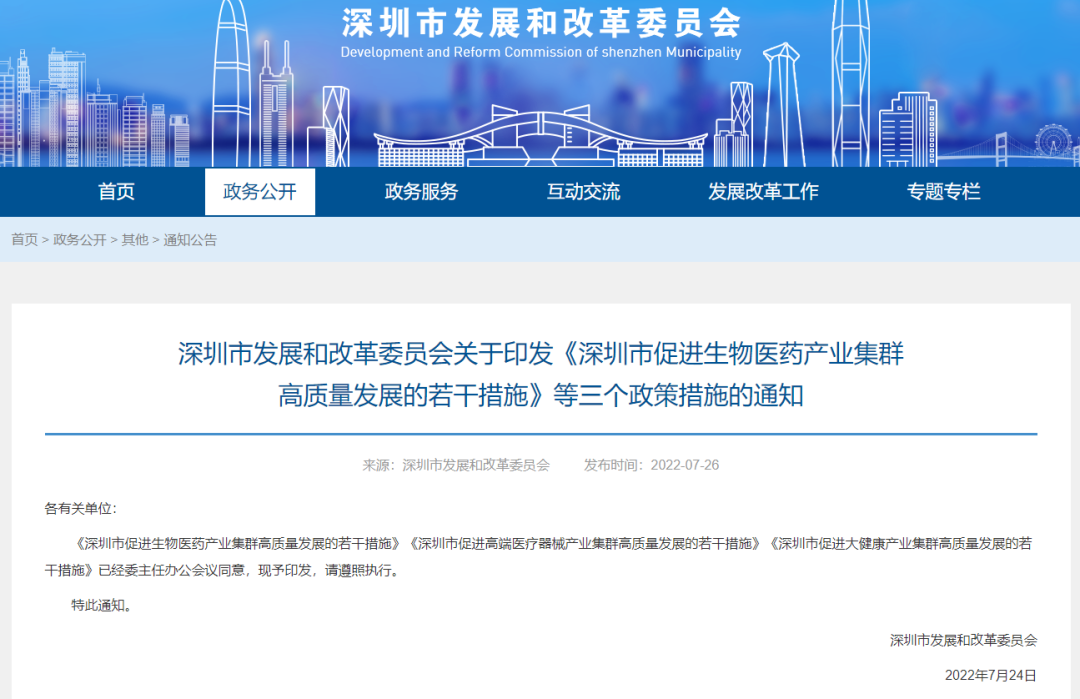
The "Notice" includes the following information regarding cells:
Several Measures to Promote the High-Quality Development of Shenzhen's Biopharmaceutical Industry Cluster
I. Eligible Institutions and Key Support Areas
This measure focuses on supporting innovative chemical drugs, including Cell therapy drug Including high-end bioproducts such as gene therapy drugs, gene testing equipment, biosafety protection systems, innovative blood products, and next-generation vaccines; cutting-edge result-based proteins and peptide-based therapeutics; pediatric medications; rare disease treatments; personalized treatment technologies; bioenzyme innovations; advanced dosage forms and premium formulation techniques; modern traditional Chinese medicine; time-honored classic formulations of TCM preparations; state-of-the-art pharmaceutical equipment; and digital healthcare solutions. For products and platform projects that boast high technological content, promising application prospects, and strong demonstration effects—particularly those enterprises that have played a leading role in emergency response and the fight against COVID-19—we will provide prioritized support in areas such as financial assistance, land and facility allocation, talent incentives, regulatory approvals, and government services.
(III) Strategically plan city-level basic research on drugs and tackle core technological challenges. Support relevant institutions in pooling their top research strengths to establish several innovative research centers that will make significant impacts. Continue to launch multiple batches of major city-level science and technology and industry initiatives, providing full funding—up to a maximum of 30 million yuan—to projects poised to address critical clinical and market needs by advancing cutting-edge biomedical research in areas such as novel targets, new drug sites, groundbreaking mechanisms, and revolutionary scientific principles. For breakthroughs in critical core technologies and major industrial projects—including novel chemical drugs targeting emerging pathways, antibody therapies, gene therapies, cell-based products, microbial treatments, bacterial therapies, peptide drugs, phage-based medicines, and enzyme engineering—funding will be provided in phases, covering up to 40% of the total project investment, with a maximum cap of 300 million yuan.
(21) Supporting Innovative Drug Development: For Class 1 chemical drugs, Class 1 biologics, and Class 1 traditional Chinese medicines licensed by applicants registered in this city and manufactured locally, eligible projects that have already obtained clinical trial approval will receive preclinical R&D funding of up to 40% of eligible expenses, with a cap of 8 million yuan. Additionally, for studies that have completed Phase I, Phase II, or Phase III clinical trials domestically, funding support will be provided at up to 40% of the actual R&D investment—capped at 10 million yuan for Phase I, 20 million yuan for Phase II, and 30 million yuan for Phase III. For projects that entrust drug clinical trial institutions located in Shenzhen to serve as the lead organization for conducting clinical trials, an additional 10% funding boost will be applied. Each institution can receive cumulative annual support totaling no more than 100 million yuan.
Several Measures to Promote the High-Quality Development of Shenzhen's Greater Health Industry Cluster
3. Vigorously promote the development of the precision medicine industry
(6) Building a new high ground for the gene and immune cell therapy industry. Support enterprises, research institutions, and medical organizations in fostering industry-academia-research collaborations. Encourage cutting-edge basic research in key areas such as major theoretical advancements, pioneering technologies, and interdisciplinary fields at the forefront of gene and immune cell therapies. Strive to achieve significant technological breakthroughs and groundbreaking discoveries in areas like gene editing, gene therapy, and immune cell therapy. Additionally, support clinical trials and investigator-initiated studies in the fields of gene therapy and immune cell therapy, with a particular focus on exploring innovative gene and immune cell-based treatments for cancers, cardiovascular and cerebrovascular diseases, diabetes, immune deficiency disorders, and chronic illnesses.
(7) Foster the development of new industries such as stem cell technologies. Support applications for national-level qualifications that enable clinical translation and pilot-scale promotion of cutting-edge stem cell technologies and products. Prioritize fundamental research on hematopoietic stem cells, umbilical cord-derived mesenchymal stem cells, storage of umbilical cord mesenchymal stem cells, and pluripotent stem cells. Encourage thorough registration of clinical research institutions and projects related to stem cells, and accelerate the healthy growth of our city’s stem cell and regenerative medicine industry. For entities that secure municipal-level cell bank accreditation, financial assistance will be provided at 40% of the total project investment, with a cap of 30 million yuan.
(9) Support the establishment of cell and gene biosecurity testing platforms. For third-party inspection and testing institutions whose cell and gene safety assessment platforms have been accredited by the American Association of Blood Banks (AABB), certified under the China Metrology Accreditation (CMA), or recognized by the China National Accreditation Service for Conformity Assessment (CNAS), eligible projects will receive funding equivalent to 40% of the total project investment, with a cap of 5 million yuan.
Reprint Notice: This article is reprinted from Shenzhen Development and Reform Commission. If there are any issues, please contact us for removal.
Related News

Here is the title—h1 placeholder text


Copyright © Jiuzhitang Maker (Beijing) Cell Technology Co., Ltd.
Powered by: 300.cn SEO | Privacy Policy