

News
News Center
Patient good news! Stem cell therapy is safe and effective for treating osteoarthritis!
来源:This article partially excerpts content from Cell World.
2020-10-23
There’s a condition in the world that’s truly terrifying—it ranks alongside cardiovascular diseases and cancer as one of the three leading killers threatening the health of older adults. Known to the World Health Organization as the "number one disability-causing disease" of the 21st century, this condition is none other than arthritis!
Arthritis is one of the most common chronic conditions, with over 100 different types—two of the most prevalent being osteoarthritis and rheumatoid arthritis. Osteoarthritis (OA) is a common degenerative joint disease characterized by cartilage loss, abnormal changes in the underlying bone, synovitis, and the formation of bone spurs. It often leads to pain and restricted movement in affected joints, ultimately resulting in impaired joint function. With the rapid advancement of aging populations, osteoarthritis has become the leading cause of reduced quality of life and disability among middle-aged and older adults.
According to surveys, there are 360 million osteoarthritis patients worldwide, with over 130 million in China—accounting for more than 10% of the global total. Among them, more than half of individuals aged 60 and older suffer from the condition, and among those over 70, the prevalence of osteoarthritis reaches as high as 80% to 90%, significantly surpassing the incidence rate of cardiovascular diseases. As predicted by the World Health Organization, China is expected to become the country with the largest number of osteoarthritis cases in the world.
Traditional treatments for osteoarthritis address the symptoms but fail to tackle the root cause.
Osteoarthritis poses a serious threat to human health and quality of life, placing a significant economic burden on society. Traditional approaches to managing osteoarthritis—such as physical exercises, physiotherapy, lifestyle modifications, and the use of pain medications—only provide temporary relief of symptoms but fail to address the underlying disease mechanisms or reverse the progression of osteoarthritis.
For more severe cases, joint replacement surgery is necessary; however, this approach comes with a limited lifespan, requires complex maintenance during use, and is not ideal for younger patients who are highly active. As a result, identifying an effective intervention for osteoarthritis has become one of the key research areas in this field.
Stem cell therapy effectively treats osteoarthritis through two distinct mechanisms of action.
With the advancement of regenerative medicine technologies, stem cell therapy has undergone more than a decade of rigorous safety and efficacy testing in the treatment of cartilage defects and for promoting cartilage regeneration.
Stem cells, as seed cells with multiple differentiation potentials, have recently demonstrated their advantages in treating cartilage lesions associated with osteoarthritis. Beyond their differentiation capabilities, stem cells can also secrete a variety of enzymes and trophic factors that participate in paracrine signaling—such as growth factors, cytokines, and chemokines—exerting protective effects against apoptosis, fibrosis, oxidative stress, and inflammation, while simultaneously promoting angiogenesis. Stem cell therapy effectively treats osteoarthritis through two distinct mechanisms:
1. Stem cells directly repair damaged tissues through their multidirectional differentiation potential. Under specific in vitro or in vivo induction conditions, stem cells can be transformed into osteoblasts and chondrocytes, enabling the regeneration of bone and articular cartilage.
2. Stem cells induce their own differentiation into chondrocytes by secreting various factors, such as transforming growth factor-β1 and insulin-like growth factor-1, while also inhibiting local inflammation progression and enhancing the natural repair capabilities of damaged tissues in the area—thereby achieving the desired therapeutic intervention.
Clinical data from both domestic and international studies demonstrate the safety and efficacy of stem cell therapy for osteoarthritis.
Because human osteoarthritis develops relatively slowly—typically over about 30 years—it creates a favorable environment for stem cell applications. A growing body of ongoing and completed clinical study data suggests that stem cell therapy can effectively alleviate patients' pain, improve joint function, and enhance their overall quality of life.
In 2009, ChondroCelect, a product developed by Belgium's TiGenix (an autologous cartilage-derived cell therapy), was approved for use in repairing knee cartilage damage. In 2012, Cartistem, a stem-cell therapy from South Korea whose main ingredient is umbilical cord blood-derived mesenchymal stem cells, received approval for treating degenerative arthritis and repairing damaged knee cartilage. In October 2017, the *American Journal of Sports Medicine* published an article by Korean researchers including Chris Hyunchul Jo. The study found that, over a two-year follow-up period, intra-articular injections of autologous adipose tissue–derived mesenchymal stem cells were both safe and effective in treating knee osteoarthritis.

In April 2019, Chilean researchers Francisco Espinoza and colleagues published a phase I/II randomized, controlled clinical trial on stem cell therapy for knee osteoarthritis in *Stem Cell Translational Medicine* (NCT02580695). The trial findings revealed that multiple-dose stem cell treatment yielded superior outcomes compared to a single dose or hyaluronic acid (HA) supplementation.

The journal *Stem Cell Translational Medicine* has published the latest clinical trial data. Twelve patients aged 45 to 65, who suffered from moderate to severe knee osteoarthritis, underwent clinical treatment with stem cell therapy. After 12 months of follow-up, all participants showed significant improvements in both pain levels and quality of life. The study also demonstrated that stem cell therapy is safe, with higher doses correlating with more pronounced therapeutic effects.

The U.S. FDA has approved an Investigational New Drug (IND) application for a stem cell therapy targeting osteoarthritis. The treatment uses fat-derived stem cells and was developed by the U.S.-based stem cell company, Personalized Stem Cells. The company has now initiated the first clinical study focused on knee osteoarthritis.

Currently, several domestic clinical research projects focusing on stem cell therapy for osteoarthritis have completed their registration in accordance with the "Administrative Measures for Clinical Research on Stem Cells (Trial)" (Guowei Kejiaofa [2015] No. 48). In February 2019, CCTV.com—[Hunan News Broadcast] reported that osteoarthritis can be effectively managed through stem cell intervention, and several domestic projects have already been approved to advance into clinical research and eventual translational application stages.

Earlier, the article "15 Clinically Supported Evidence: Mesenchymal Stem Cell Therapy for Knee Osteoarthritis Cartilage Injury Is Safe and Effective" compiled data from 15 human clinical trials evaluating mesenchymal stem cell treatment for osteoarthritis. These findings not only highlight the efficacy and safety of MSC intervention in addressing osteoarthritis but also suggest that, in some cases, MSC-based treatment approaches come closer to achieving desired outcomes compared to conventional therapies.

As shown in the image, cartilage gradually heals over time, moving from left to right.

As shown in the figure, both the low-dose and high-dose groups experienced a decrease in VAS scores (a pain indicator).
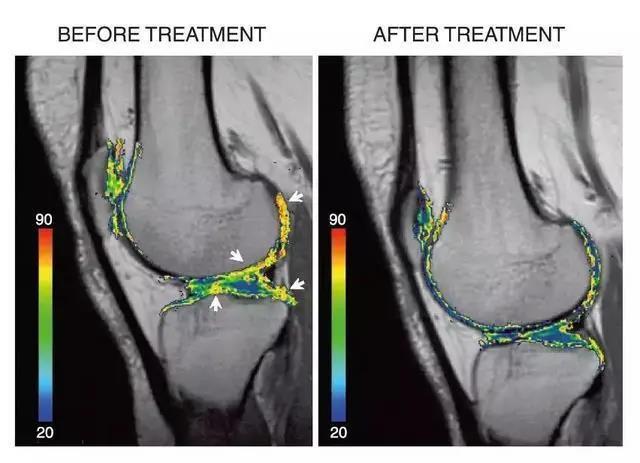
Before treatment (left), most of the cartilage is yellow; after treatment (right), blue clearly predominates, indicating an improvement in cartilage quality.

The image above shows an MRI comparison before and after treatment. As before, the bluer the color, the better the cartilage quality. Clearly, cartilage quality has improved significantly following the treatment.
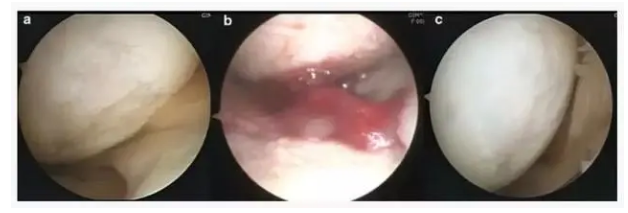
Figure A shows the arthroscopic findings before treatment, revealing cartilage defects. Figure B illustrates the treatment combining adipose-derived mesenchymal stem cells with PRP, while Figure C presents the post-treatment results, demonstrating successful cartilage repair.
In summary, extensive clinical research data from both domestic and international studies have confirmed that stem cell therapy is safe and effective in treating knee osteoarthritis. Stem cell therapy significantly improves joint pain symptoms and functional impairments in patients with knee osteoarthritis, while also demonstrating promising long-term benefits, making it a treatment approach with broad potential. Stem cell therapy offers new hope for healing to millions of arthritis patients worldwide, and we look forward to even more robust research and groundbreaking advancements in cellular treatment technologies.
Related News

Here is the title—h1 placeholder text


Copyright © Jiuzhitang Maker (Beijing) Cell Technology Co., Ltd.
Powered by: 300.cn SEO | Privacy Policy