

News
News Center
Exploring stem cell therapy for autism: Lighting up the world for "children of the stars"!
2020-04-02
Around us, there’s a group of children who are often withdrawn, rigid, and repetitive in their behavior—sometimes agitated, other times calm and gentle—as if they’re living in their own little worlds, much like stars in the sky. They may not be deaf, yet they seem to ignore sounds altogether; they’re not blind, but they appear oblivious to the people and objects around them; and though they’re not mute, they simply don’t know how to find the words to communicate. Some even call them "children from the stars"! In fact, what they’re dealing with is exactly the condition we’ll be discussing today: autism.

Autism and the Current State of Its Treatment
Autism (Autism Spectrum Disorders, ASD), also known as autism, is the most typical and common condition within the broader category of Pervasive Developmental Disorders (PDD) seen in childhood. Its primary characteristics include profound social isolation, a lack of emotional responsiveness, delayed language development, and repetitive, stereotyped behaviors.
Before the concept was introduced in 1943, people referred to autistic children as "children whose souls had been stolen by the devil." Today, however, they are often described as kids from a distant planet—or "star children."
In December 2007, the United Nations General Assembly adopted a resolution designating April 2 of each year, starting in 2008, as "World Autism Awareness Day," aiming to increase global attention toward autism, as well as advancements in its research, diagnosis, and support for individuals living with autism.
Autism is a broad category of neurodevelopmental disorders with biological underpinnings. Epidemiological studies both domestically and internationally reveal that the prevalence of autism has been steadily increasing over the years, making it an increasingly common condition. Unfortunately, autism is a lifelong condition that cannot be reversed, placing significant economic and social burdens on affected families and society as a whole.
Genetic factors account for only 10% to 30% of the causes of autism, suggesting that other factors may deserve greater attention. These include pesticides, agricultural chemicals, food additives, preservatives, heavy metals, as well as prenatal and perinatal influences, gut inflammation, gut microbiota, diet and nutrition, metabolic abnormalities, allergies, and autoimmune responses.
Currently, clinical treatment for autism primarily relies on behavioral interventions, specialized educational training, and family therapy programs to promote language development in children, improve their behavior, enhance social interaction skills, and help them acquire essential life and learning abilities—though the effectiveness remains limited.
These treatments primarily aim to alleviate associated comorbid symptoms rather than address the core symptoms of autism, making it urgently necessary for researchers and clinicians to develop an effective therapy that thoroughly improves autism itself.
Stem cells hold promise for treating patients with autism. Offering new pathways
Initially, autism was thought to be a psychological disorder caused by improper education, with no observable morphological changes in nerve cells. However, it was later discovered that individuals with autism exhibit numerous neuroanatomical alterations throughout the brain—ranging from macroscopic structures down to the cellular level. Further research revealed that factors such as incomplete brain development, insufficient cerebral perfusion (inadequate blood flow to brain tissue and the nervous system), and immune system dysfunction play critical roles in the onset of autism. These findings provide a strong theoretical foundation for regenerative therapies using stem cells to treat autism patients.
Due to the limited regenerative capacity of the nervous system after injury, many scientists in neuroscience and mental health fields have turned their attention to stem cells. Stem cells have already made significant appearances in research on conditions such as cerebral palsy, autism, acquired hearing loss, childhood stroke, and developmental delays.
Stem cells are a type of cell characterized by their ability to self-renew, proliferate extensively, and differentiate into multiple cell types. Research has shown that stem cells possess immunomodulatory properties and can improve microcirculation in the brain, helping patients develop essential life skills—such as communication abilities, self-care skills, and learning capabilities—thereby playing a potential role in the treatment of autism.

Clinical Advances in Stem Cell Therapy for Autism
In China, Lü Yongtao from Shandong Provincial Hospital of Transportation and his team randomly divided 42 autism patients into three groups. Two treatment groups received umbilical cord blood mononuclear cell (MNCs) therapy and combined umbilical cord blood with umbilical cord mesenchymal stem cells (MSCs) therapy, respectively, while the control group underwent only conventional rehabilitation training. The study found that both single MNCs therapy and the MNCs-MSCs combination treatment showed significant therapeutic effects on autism, with an overall efficacy rate exceeding 70%—a marked improvement compared to the traditional rehabilitation training provided to the control group.
In India, Sharma and colleagues conducted an intrathecal injection treatment using autologous bone marrow MNCs on 32 autistic patients aged 3 to 33 years. Some side effects were observed during the treatment, possibly related to the intrathecal administration route. With follow-up periods ranging from 5 to 26 months, researchers noted statistically significant improvements on both the Clinical Global Impression-Improvement scale (CGI-I) and the Indian Autism Assessment Scale (ISAA).
In Ukraine, Bradstreet and colleagues conducted a safety study involving intravenous infusions of embryonic stem cells in a total of 45 autistic children aged 3 to 15. Follow-up assessments at 6 and 12 months post-treatment revealed improvements across the sensory, language, social, and overall health domains of both the Autism Treatment Evaluation Checklist (ATEC) and the Autism Behavior Checklist (ABC). However, the one-year follow-up period may not yet be sufficient to fully evaluate the long-term safety profile of embryonic stem cell therapy.
In the United States, Kimberly and Kurtzberg from Duke University, among others, conducted a Phase I clinical trial investigating the use of autologous cord blood to treat autism. Following the infusion of autologous cord blood, children with autism showed improved social skills, enhanced communication abilities, and a notable reduction in clinical symptoms.
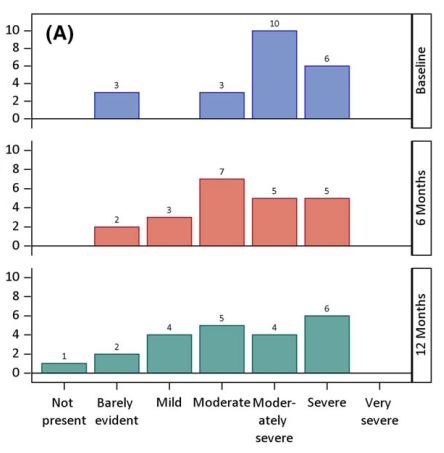
Overall Impression Scale Improvement
The follow-up results of this clinical trial were published in 2019 in the journal *Stem Cell Translational Medicine*, revealing that improvements in behavioral symptoms among children with autism were associated with enhanced neuronal connectivity within the brain's limbic, frontal, temporal, and basal ganglia neural networks—networks previously implicated in the pathophysiology of autism.
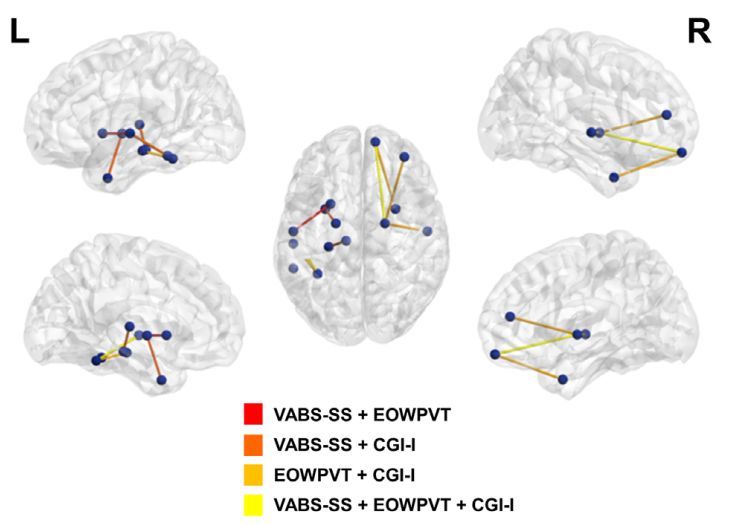
Connectivity Map – The relationship between changes in frontotemporal and subcortical white matter connectivity and behavioral improvements following umbilical cord blood therapy. Blue dots represent node pairs; differently colored connecting lines between blue dots indicate increased edge connectivity between nodes, correlating with at least two outcome measures.
Given the inherent heterogeneity of autism, identifying biomarkers that are useful for predicting and measuring treatment outcomes is crucial. Therefore, understanding how autologous umbilical cord blood infusion might influence autism symptoms is the first step toward pinpointing potential biomarker targets.
Existing research shows that umbilical cord blood is increasingly used in autism studies due to its early clinical application, convenient collection process, mature stem cells, and diverse cell types.
In 2015, CBR, the largest cord blood bank in the U.S., launched a survey. Out of 280,000 families invited to participate—whether they had donated or stored their baby’s cord blood privately—94,803 families responded. The survey assessed these families’ awareness of potential medical applications for cord blood. Notably, 16% of respondents were able to identify at least one applicable condition, with autism spectrum disorder emerging as the most widely recognized condition (2,885 families, or 3%).
Currently, the primary treatments for autism focus on behavioral interventions, specialized educational training, and family therapy programs aimed at fostering language development, improving behavior, enhancing social interaction skills, and helping children master essential life and learning abilities—though these approaches often yield limited therapeutic outcomes. In contrast, stem cell therapy has demonstrated significantly better results than traditional rehabilitation training, offering patients and their families renewed hope and a brighter future. This innovative treatment not only eases the burden on society and families but also dramatically improves patients' quality of life, ultimately helping "star children" shine brightly in the world!
Statement: This article was compiled from the National-Local Laboratory of Adult Stem Cells.
Related News

Here is the title—h1 placeholder text

Copyright © Jiuzhitang Maker (Beijing) Cell Technology Co., Ltd.
Powered by: 300.cn SEO | Privacy Policy