

News
News Center
"Cell" Makes a Major Breakthrough: Adult Islet Stem Cells in Mice Identified for the First Time—A Promising Step Toward Curing Type 1 Diabetes
2020-03-30
Recently, Yiyi Zeng's research group at the Institute of Biochemistry and Cell Biology, Chinese Academy of Sciences, made a groundbreaking discovery by identifying adult stem cells in mouse pancreatic islets for the first time. They subsequently developed a system for culturing and long-term expansion of islet organoids. The findings were published in the journal *Cell*, raising exciting prospects for potentially curing type 1 diabetes.
In type 1 diabetes, the body's immune system mistakenly identifies pancreatic beta cells as foreign invaders and relentlessly attacks them. As a result, these beta cells either partially or completely lose their ability to produce insulin, leading to an absolute deficiency of insulin in the body. This triggers a sustained rise in blood glucose levels, ultimately resulting in the onset of diabetes.
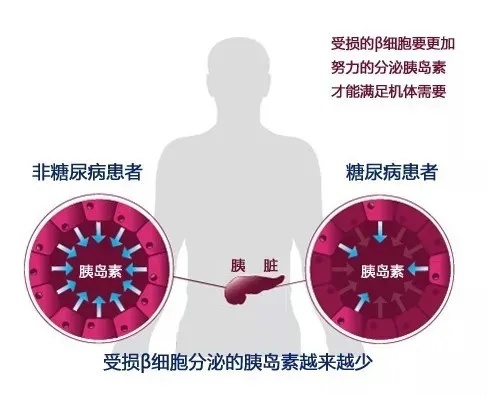
To meet the body's insulin needs, diabetic patients must administer insulin daily to maintain normal blood sugar levels—otherwise, persistently high blood glucose can lead to a range of serious complications. Unless the patient’s pancreatic function is restored, either through their own cells or through an allogeneic transplant, they will need to manage their blood sugar levels carefully for the rest of their lives.
Unlike type 2 diabetes, which can often be reversed through lifestyle changes like diet and exercise—already leading to countless remarkable success stories—scientists have yet to discover a way to prevent or cure type 1 diabetes.
The cellular inhabitants of the islets
Since type 1 diabetes is caused by damage to pancreatic beta cells, leading to an absolute deficiency in insulin secretion, let’s discuss how to better regulate insulin production.
As the only hormone in the human body capable of lowering blood sugar—insulin—is produced by the pancreatic islets (also known as Islets of Langerhans). As their name suggests, these islets are clusters of cells varying in size and shape, resembling tiny islands scattered throughout the pancreas. Each islet plays host to a diverse "population," with its own specialized functions. The cells within the islets are primarily composed of alpha cells, beta cells, delta cells, and PP cells. Alpha cells make up about 20% of the islet population and secrete glucagon, which helps raise blood glucose levels. Beta cells, accounting for as much as 70%, produce insulin—a key player in lowering blood sugar. Delta cells, representing around 10% of the islet cells, release somatostatin, a hormone that regulates the activity of other endocrine cells. Lastly, PP cells are present in very small numbers and secrete pancreatic polypeptide, a hormone involved in various digestive processes.
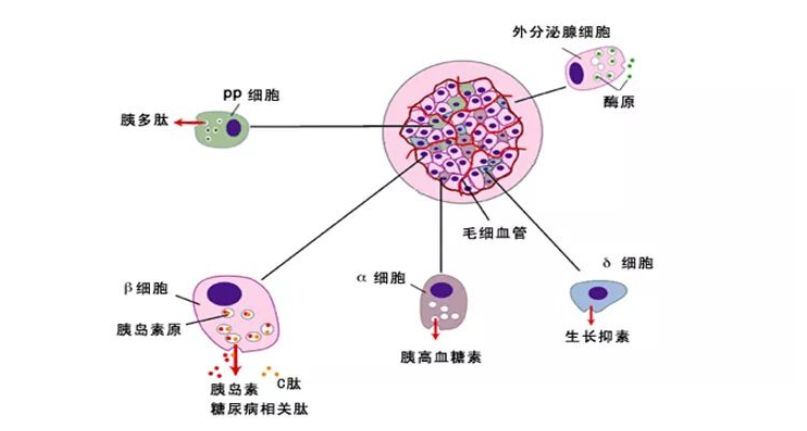
The cellular inhabitants of the islets
When it comes to diabetes, our goal is to save insulin—so our focus is firmly on those insulin-secreting pancreatic beta cells! That’s right, we’re talking about you!
From pluripotent stem cells to pancreatic beta cells
Think creatively—what are some ways to boost insulin secretion in the body?
This certainly doesn’t pose a challenge for our researchers. Diverse and innovative methods to boost pancreatic beta cells have emerged one after another, popping up like mushrooms after a spring rain!
Transplanting allogeneic pancreatic islet cells (such as from a donor) is an option, but this source is highly limited.
Transplanting animal pancreatic islet cells—such as those from pigs, whose insulin differs from human insulin by just one amino acid—represents a promising avenue for exploration. With the rise of CRISPR-Cas9 technology, this approach may be closer to success than ever before.
Embryonic stem cells (ESCs)—the progenitors of pancreatic beta cells—can be massively expanded in vitro, induced to differentiate specifically into beta cells, and then reintroduced into the body.
Even more remarkable is the process of taking a tiny skin cell, culturing it outside the body, inducing its differentiation to become rejuvenated iPSCs, then guiding those cells to specialize into beta cells—and finally transplanting them back into the body.
However, theory may be robust, but reality is harsh—these methods can indeed boost the number of pancreatic beta cells in the body, yet achieving functional beta cells that aren’t rejected by the immune system remains an enormous challenge.
In this regard, the professor who has gone the furthest is none other than the renowned Douglas Melton from Harvard University. He first succeeded in developing a method to efficiently direct the differentiation of pluripotent stem cells (ESC/iPSC) into functional pancreatic beta cells. More recently, he further refined the process of converting these pluripotent stem cells into insulin-producing beta cells, boosting the purity of beta cells in the resulting stem cell samples from 30% to an impressive 80%. On the application front, Professor Melton has also pioneered an innovative "encapsulated" islet therapy—technique that allows transplanted islets to secrete insulin while simultaneously shielding them from attack by the body's own immune system.
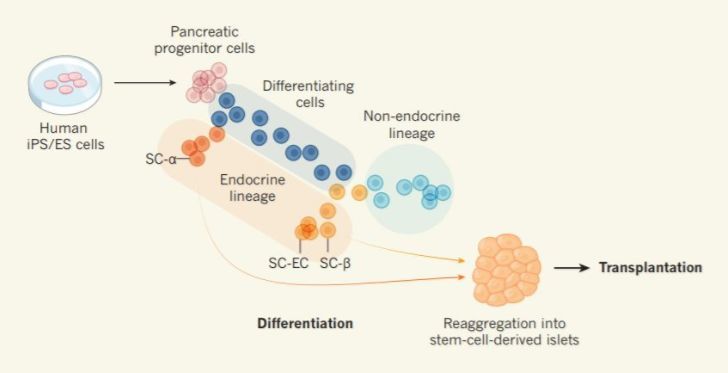
In vitro differentiation and reassembly of pancreatic functional cells from pluripotent stem cells. (Image source: Nature)
The discovery of pancreatic stem cells
The existence of adult stem cells within the islets has long been a subject of intense debate. As a result, identifying and characterizing adult stem cells in the islets has remained a persistent challenge. If it were definitively established that adult islets contain such stem cells, Mr. Melton wouldn't have taken such a roundabout approach—instead opting to derive pancreatic beta cells directly from pluripotent stem cells.
No matter how many challenges Mr. Melton has solved, they’ve always been limited to allogeneic pancreatic islet β-cells. Today, we’re thrilled to announce that, for the first time, the research group led by Zeng Yi at the Institute of Biochemistry and Cell Biology of the Chinese Academy of Sciences has identified and characterized adult stem cells within mouse pancreatic islets, as published in the prestigious academic journal *Cell*. Building on this groundbreaking discovery, they have also successfully established a system for culturing and long-term expansion of pancreatic islet organoids.
Zeng Yi's research group approached the study as follows: Using high-throughput single-cell RNA sequencing, they identified a Procr cell with epithelial-mesenchymal transition characteristics amidst the vast population of islet cells. Further validation confirmed that this Procr cell remains in an undifferentiated state. Through lineage tracing experiments, they demonstrated that these cells can differentiate into all major types of islet cells in mice. Building on this discovery, they successfully established functional islet organoids along with a long-term expansion system—both of which were able to restore normal blood glucose levels in diabetic mice.
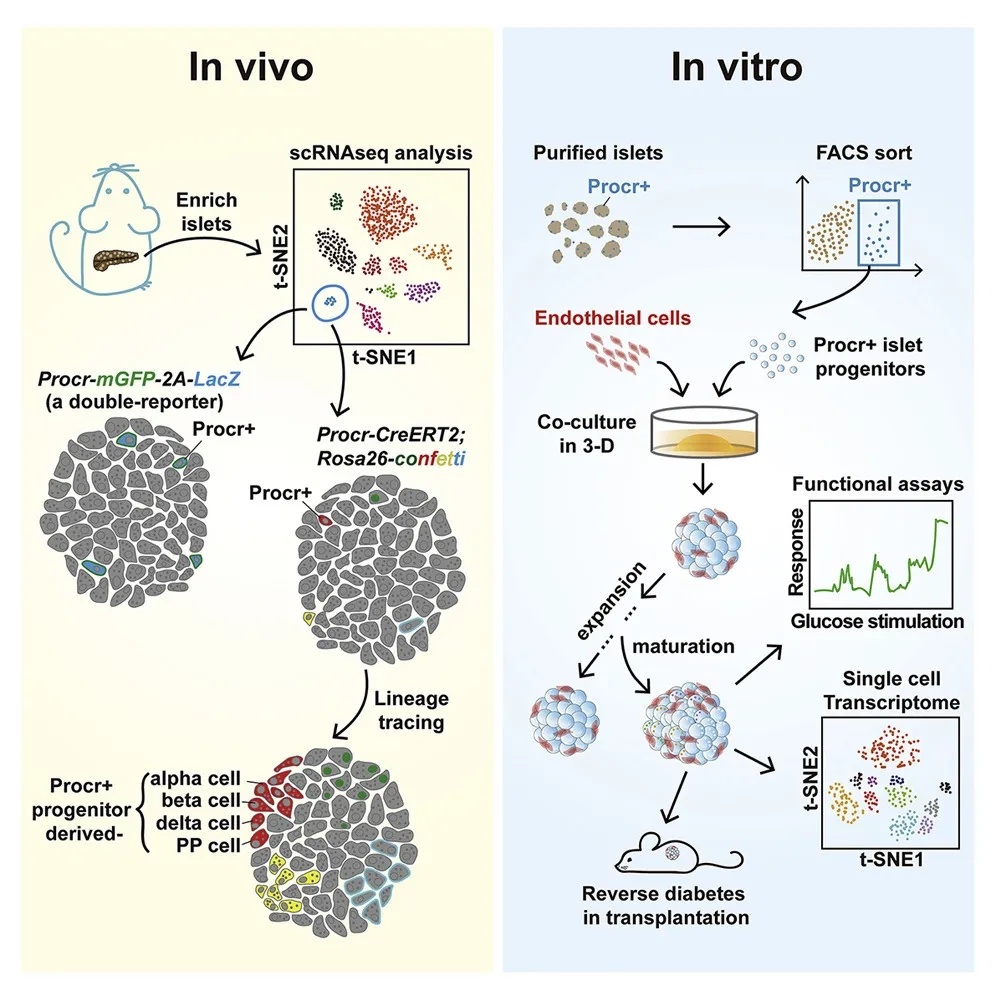
Discovered and identified Procr+ adult stem cells in mouse pancreatic islets (left); established a system for culturing and long-term expansion of pancreatic islet organoids (right).
This groundbreaking study marks a significant milestone by, for the first time, identifying and characterizing adult stem cells within mouse pancreatic islets—resolving a long-standing debate over whether adult islets harbor such cells. This discovery represents a major breakthrough in stem cell research. The study also establishes a robust system for culturing and long-term expansion of functional islet organoids, particularly through an innovative multi-cellular co-culture approach. This novel culture platform enables the continuous production of insulin-producing β cells, making them readily available for transplantation. While this work was initially conducted using mice, it opens up exciting new avenues for uncovering analogous islet stem cells in the human body. Who knows? In the near future, humanity may usher in a new era of islet cell therapy for type 1 diabetes!
References:
[1] Mapping cellular identity during human in vitro β-cell differentiation Nature, May 2019, vol. 569
[2] How to Generate a Functional β-Cell Development 2013, Vol. 140, 2472–2483
[3] Long-Term Expansion of Pancreatic Islet Organoids from Resident Procr+ Progenitor Cells, 2020
[4]Fasting-Mimicking Diet Promotes Ngn3-Driven β-Cell Regeneration to Reverse Diabetes, Cell, 2017
Related News

Here is the title—h1 placeholder text


Copyright © Jiuzhitang Maker (Beijing) Cell Technology Co., Ltd.
Powered by: 300.cn SEO | Privacy Policy