

News
News Center
Jiuzhitang Maker's stem-cell-based new drug receives approval for clinical trials
2020-02-20
On February 19, 2020, Jiuzhitang Maker (Beijing) Cell Technology Co., Ltd. received the "Clinical Trial Notification" issued by the Center for Drug Evaluation (CDE) under the National Medical Products Administration. The notification stated: "In accordance with the Drug Administration Law of the People's Republic of China and relevant regulations, and after review, the allogeneic human bone marrow mesenchymal stem cells with ischemic tolerance, which were accepted on November 15, 2019, meet the requirements for drug registration. Therefore, we approve the initiation of clinical trials for ischemic stroke according to the submitted protocol." This marks the approval of our company's clinical trial application.
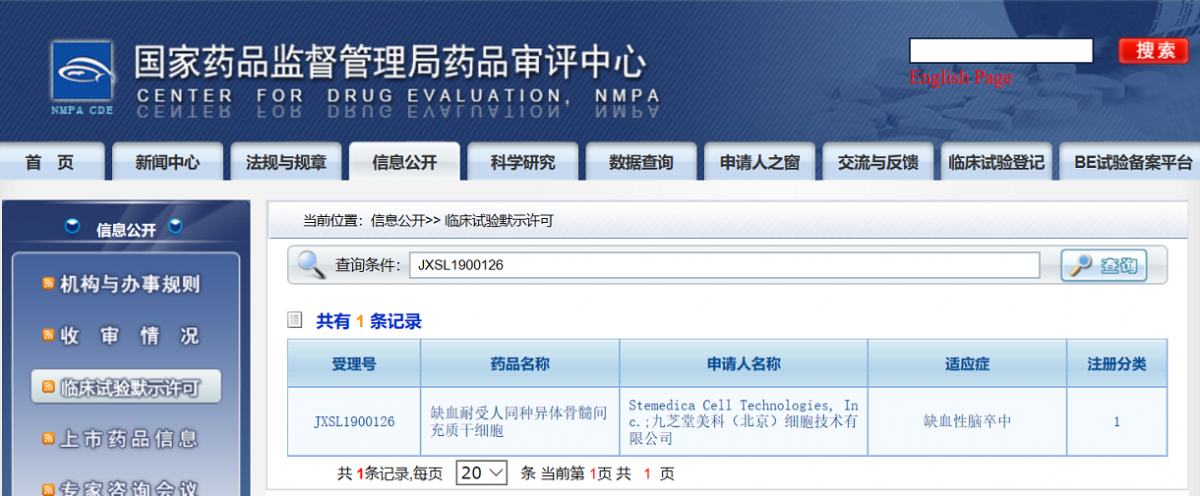
Third in the industry
As of February 19, 2020, the CDE had received IND applications for 13 stem cell-based investigational new drugs (INDs) submitted by 12 companies, with 6 of these applications already approved. Prior to Meike's IND approval, the previous five approved INDs utilizing stem cells were all domestically produced, with cell sources including umbilical cord and autologous fat tissue. These trials targeted conditions such as knee osteoarthritis, diabetic foot ulcers, and graft-versus-host disease. With Meike's IND now approved, this marks the first time the CDE has authorized a clinical trial using imported stem cells, the first to employ bone marrow-derived mesenchymal stem cells, and also the first to explore stem cell therapy for major neurological indications. This milestone holds significant importance for the development of China's stem cell industry.
After receiving IND approval, Jiuzhitang Maker will collaborate with Beijing Tiantan Hospital, Affiliated to Capital Medical University, to conduct clinical trials for the treatment of ischemic stroke.
Ischemia-Tolerant Human Allogeneic Bone Marrow Mesenchymal Stem Cells
The stem cell product used in this clinical trial is ischemia-tolerant allogeneic human bone marrow mesenchymal stem cells (ithMSC), manufactured by Stemedica Cell Technologies, Inc. of the United States (hereafter referred to as Stemedica). Established in 2005, Stemedica obtained a manufacturing license from the California state government in 2010 and has been operating under GMP-compliant conditions for nearly a decade. Today, it stands among the world’s few companies capable of producing both bone marrow mesenchymal stem cells and neural stem cell products under cGMP standards. Stemedica’s ischemia-tolerant human bone marrow mesenchymal stem cells (ithMSC) are produced entirely under low-oxygen conditions, with a manufacturing process and quality system that fully comply with U.S. FDA regulations and cGMP requirements. The company has already secured 6 Investigational New Drug (IND) approvals in the U.S. and was recognized by Life Technologies—now part of Thermo Fisher—as the "best-in-class" product in its category. Since 2012, Stemedica has published 15 high-quality research papers and holds 7 patents. Globally, Stemedica has initiated multiple clinical trials across various indications. Notably, the use of ithMSC for treating acute myocardial infarction has completed Phase III clinical trials in Kazakhstan, earning approval from the Kazakh Ministry of Health for commercialization.
Stem cells offer a new approach to treating ischemic stroke.
Ischemic stroke is characterized by high incidence, high disability rates, and a significant mortality rate—and since 1990, it has remained the leading cause of death among Chinese citizens for 29 consecutive years. According to the 2018 "China Stroke Prevention and Control Report," based on the 2016 age-standardized prevalence rate, an estimated 12.42 million people aged 40 and older in China currently have or have previously experienced a stroke. Notably, there is a clear trend toward younger stroke patients, and among those who survive the condition, 70% are left with disabilities of varying degrees. Currently, stroke treatment primarily focuses on the acute phase. While acute ischemic stroke therapies such as thrombolysis can help intervene in the ischemic penumbra, potentially reducing mortality and disability rates, the number of clinically available drugs remains limited, treatment outcomes are still unsatisfactory, and their application is often restricted.
The advancement of stem cell technology has opened up new avenues for treating stroke. According to data from the ClinicalTrials.gov website, as of now, approximately 40 clinical trials worldwide are investigating stem cell therapy for ischemic stroke. Most of these trials are still in Phase I or Phase II, with only one having progressed to Phase III. Currently, no stem cell-based drug for stroke treatment has been approved for commercial use internationally. A major challenge lies in the complexity of stem cell products—variations in cell sources and manufacturing processes significantly impact both the quality of the cells and their therapeutic efficacy. This, in turn, has been a key reason behind the less-than-ideal outcomes reported in several previously published clinical trials exploring stem cell therapies for stroke.
In September 2019, Stemedica published the results of its U.S.-conducted Phase I/IIa clinical trial evaluating ithMSC therapy for ischemic stroke in the international stroke specialty journal *Stroke*. The findings demonstrated that ithMSC treatment was well-tolerated, with patients receiving ithMSC showing significant improvements in mental status, depression levels, and ability to perform daily activities—providing preliminary evidence of the efficacy of stem cell therapy. This recent approval by Jiuzhitang Maker for a clinical trial in China builds on earlier research, further advancing the exploration of ithMSC’s therapeutic potential in ischemic stroke and marking a new chapter in China’s development of stem cell-based treatments for stroke.
Jiuzhitang Re-enters and Expands Its Presence in the Regenerative Medicine Field
In 2017, Jiuzhitang initiated and established the Zhuhai Hengqin Jiuzhitang Yonghe Qihang Fund (hereafter referred to as the Yonghe Qihang Fund). In 2018, the Yonghe Qihang Fund made an investment in Stemedica Corporation. Concurrently, it invested in and founded Jiuzhitang Maker (Beijing) Cell Technology Co., Ltd. in Beijing, serving as the sole Chinese partner for Stemedica’s stem cell technology. Meanwhile, Meike has already completed construction of a production and R&D facility at Beijing Daxing Bio-Medical Base—known as "China's Pharmaceutical Valley"—that meets both Chinese and U.S. cGMP standards. Moving forward, Meike plans to manufacture bone marrow mesenchymal and neural stem cell products at its Daxing facility in Beijing, ensuring that these products will adhere precisely to Stemedica’s proven processes and quality standards.
Responding to the Belt and Road Initiative, the China-Kazakhstan Regenerative Medicine Cooperation Center has been established in Horgos.
Responding to the Belt and Road Initiative, Jiuzhitang Group has partnered with Kazakhstan’s ALACO Company to jointly establish the Jiuzhitang-ALTACO International Medical Center at the China-Kazakhstan Khorgos International Border Cooperation Center. This center serves as an innovative collaboration platform for international stem cell research and clinical translation. The International Medical Center officially opened in September 2019, focusing on scientific research and clinical applications centered around ischemia-tolerant mesenchymal stem cells produced by Stemedica.
Related News

Here is the title—h1 placeholder text


Copyright © Jiuzhitang Maker (Beijing) Cell Technology Co., Ltd.
Powered by: 300.cn SEO | Privacy Policy