

News
News Center
Beijing unveils new plan: deploying "nuclear-level" initiatives in cutting-edge technology fields such as cell and gene therapy, and synthetic biology.
2024-05-24
On May 23, the General Office of the Beijing Municipal People's Government issued the "Beijing Action Plan for Accelerating Collaborative Innovation in Pharmaceuticals and Healthcare (2024-2026)." The plan mentions, among other things, Deploying specialized "nuclear-fission" initiatives in cutting-edge technology fields such as cellular gene therapy, brain-computer interfaces, and synthetic biology, to catalyze groundbreaking, game-changing scientific discoveries and technological breakthroughs.
Strengthening research into critical core technologies urgently needed for industries such as gene editing. Support the rapid development of industry growth in high-potential areas such as cell therapy and gene-based drugs. In areas such as inflammation and infection, we are driving the development of groundbreaking drugs targeting entirely new pathways and mechanisms.
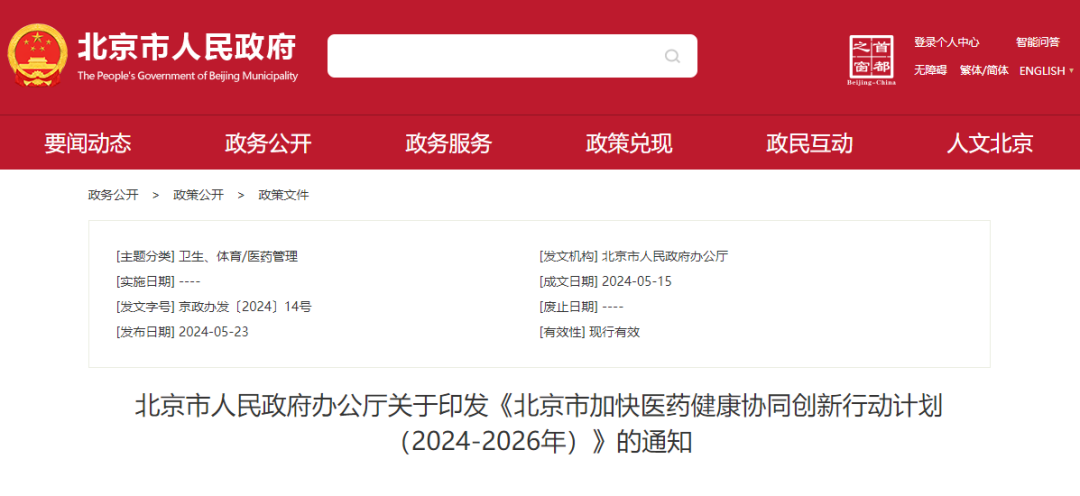
Original text:
Beijing Accelerates the Pharmaceutical and Healthcare Collaborative Innovation Action Plan (2024–2026)
The pharmaceutical and healthcare industry is a key priority in China's strategy to develop strategic emerging industries, serving as a vital engine driving Beijing's innovation-driven growth. To accelerate the development of new-quality productivity and promote higher-quality, higher-level growth in the pharmaceutical and healthcare sector, this Action Plan has been specifically formulated.
I. Development Goals
By 2026, the total scale of the pharmaceutical and healthcare industry will reach 1.25 trillion yuan—of which, the pharmaceutical industry's operating revenue is expected to hit 240 billion yuan—while fixed-asset investments will exceed 10 billion yuan annually. The sector aims to achieve 5 to 8 globally leading scientific discoveries and technological breakthroughs, along with 10 newly approved innovative drugs and 30 innovative medical devices. Additionally, the integrated development of the "Three Medicines" initiative will further enhance its capabilities, with 1 to 2 new research-oriented hospitals established. The industry also plans to attract and cultivate over 10,000 professionals across multiple skill levels. Meanwhile, the city’s pharmaceutical and healthcare industry investment fund will leverage an additional 20 billion yuan in annual social venture capital, while 10 high-quality, specialized industrial parks will be developed. As a result, the industry’s overall capacity will continue to strengthen, accelerating the emergence of a world-class, modernized pharmaceutical and healthcare industry cluster with global influence.
II. Key Tasks
(1) Strengthen innovation as a source of ideas and accelerate the commercialization of cutting-edge technologies.
1. Strengthen the leading role of national strategic scientific and technological forces. Fully support and ensure the successful construction of national laboratories, while intensifying research efforts to achieve breakthroughs in major scientific challenges and critical technologies—particularly in areas such as degenerative diseases. Enhance the innovation leadership and industrial support roles of key national laboratories nationwide. Promote the establishment, operation, and global open-access sharing of large-scale scientific facilities in the life sciences field. Additionally, encourage leading technology companies to collaborate with national research institutions, universities, and other entities in forming innovative consortia, working together to advance fundamental and cutting-edge scientific research, tackle critical core technologies, and drive integrated systems innovation.
2. Strengthen and expand new forces driving innovation. Provide stable support to emerging R&D institutions in the life sciences sector, actively take on major national strategic science and technology missions, and conduct high-level, pioneering research. Collaborate with industry needs to tackle common technological challenges, while also improving mechanisms for commercializing scientific and technological achievements and fostering the incubation and growth of innovative enterprises. Establish a group of research institutions with innovative governance structures and systems in areas such as medical translational research, respiratory infectious diseases, gene storage applications, and ribonucleic acid technologies. Additionally, encourage foreign-invested R&D centers to set up operations in Beijing, helping them integrate seamlessly into the city’s vibrant innovation ecosystem.
3. Accelerate the generation of groundbreaking achievements in the life sciences. Deploy specialized "nuclear-fission" initiatives in cutting-edge technology areas such as cell-based gene therapy, brain-computer interfaces, and synthetic biology, fostering disruptive, game-changing scientific discoveries and technological breakthroughs. Supporting fundamental research into cutting-edge scientific questions such as the principles of brain cognition and aging mechanisms; strategically advancing application-oriented basic research focused on reproductive health disorders and rare, challenging diseases; and strengthening research into critical core technologies—such as gene editing—that are urgently needed for industrial development.
4. Promote the translation of innovations driven by clinical needs and market demands. Support collaboration between medical institutions, national laboratories, cutting-edge R&D organizations, universities, research institutes, and industry players, leveraging the strengths of both basic and clinical research to establish 5 to 10 integrated research hubs that combine foundational and clinical expertise. This will accelerate the pace at which basic scientific discoveries are translated into practical clinical applications. Implement a "dual-leader" model involving clinicians and scientists working together on collaborative projects. Adopt an approach where industries propose challenges, and researchers rise to the occasion by taking on these high-priority tasks. Additionally, support the establishment of technology innovation centers focused on areas such as disease animal models and synthetic biology-based manufacturing. Finally, encourage newly established hospitals to prioritize the adoption of advanced technologies and innovative products, while also helping them proactively plan their facility layouts to maximize the potential for successful technology transfer and commercialization.
(II) Strengthen clinical research and enhance collaboration among medicine, research, and industry.
5. Enhance the quality of clinical research. Promote hospitals with the necessary resources to establish dedicated and part-time clinical research teams, refine evaluation mechanisms, and strengthen incentives for translating scientific and technological advancements into practical applications. Develop clinical research consortia, leveraging national medical centers and exemplary research-oriented hospital units as hubs to drive high-level clinical research and facilitate the translation of medical discoveries into real-world benefits. Additionally, improve the capacity of clinical researchers to participate in or lead international multi-center clinical studies.
6. Leverage the supporting role of clinical practice in driving industry development. Streamline the processes for clinical institutions launching clinical trial projects, reducing the time required to initiate a trial to within 25 weeks. Expand the scope of mutual recognition for medical ethics review results to cover the entire city, and establish a robust monitoring system to enhance the effectiveness of this recognition process. Implement comprehensive, end-to-end monitoring of clinical trials, linking the resulting data directly to post-subsidy policies for clinical institutions. Finally, create a city-wide clinical trial information platform to enable seamless "one-stop online services."
7. Promote the high-level development of research-oriented hospitals. Advance the inclusion of research hospitals into the designated medical insurance network according to established procedures. Support collaboration between research hospitals and Class-III Grade-A hospitals in the city that have completed registration, enabling them to jointly conduct early-phase clinical studies on cell therapies. Encourage research hospitals to participate in the establishment of clinical research consortia. Attract globally renowned, high-caliber clinical trials as well as domestically pioneering, landmark projects, and provide support for innovative drug candidates to undertake globally synchronized, multi-center international clinical trials. Additionally, facilitate the development of research hospitals such as those affiliated with Capital Medical University.
(III) Unlocking the Value of Data Assets and Driving Digital Empowerment
8. Implement the sharing and application of healthcare big data. Establish a city-wide, shared electronic medical record system covering emergency care, inpatient services, health check-ups, and research activities. Promote standardized, IT-enabled clinical research data sharing, clearly define data anonymization standards, and seamlessly connect data across hospitals. Additionally, facilitate the interoperability and mutual recognition of laboratory results and medical imaging among all tertiary hospitals in the city. Encourage hospitals to actively engage in the registration, evaluation, and circulation of healthcare big data, while expanding its applications in innovative research and development.
9. Promote the digital management and utilization of clinical samples. Establish a city-wide, openly accessible clinical sample-sharing information system that fully safeguards patient privacy, along with a robust resource quality evaluation framework. Additionally, facilitate the digital transformation of clinically relevant samples—particularly those urgently needed by key industries and collected and stored according to standardized protocols—to enhance the overall efficiency of clinical sample resources. Finally, elevate the application of these samples in cutting-edge research on advanced diagnostic and therapeutic technologies, innovative treatment methods, and new drug development.
10. Promote the secure cross-border flow of healthcare data. Establish an approval and communication mechanism for cross-border data transfers, strengthen services such as security assessments for data leaving the country and the filing of standard contracts for outbound personal information, ensuring compliance in data export processes. Leveraging the city’s Collaborative Innovation Center for Cross-Border Data Security and Industrial Development, as well as the Public Service Platform for Data Security and Governance, enhance risk assessments and provide compliance guidance specifically tailored to business scenarios like pharmacovigilance involving data exports.
11. Accelerate the integration of AI technologies, led by large-scale medical models, to drive industrial growth. Support the development and real-world application of advanced medical models, while advancing research and deployment of digital therapeutics and AI-assisted treatment solutions. Additionally, leverage AI to boost innovation in new drug development. Speed up the establishment of robust data infrastructure across healthcare, health insurance, and pharmaceutical regulation systems, refine data cleansing and governance processes, and facilitate seamless data sharing. Encourage computing power providers to increase their support for AI-driven healthcare initiatives, and explore ways to build and deploy trusted computing environments.
14. Accelerate the adoption of innovative drugs and medical devices in hospital settings. Encourage healthcare institutions to establish a long-term mechanism for regularly convening working meetings of their Pharmacy Management and Pharmacotherapy Committees. Strengthen efforts to support the inclusion of innovative drugs in the National Medical Insurance Drug List. Guide municipal hospitals to expedite the integration of cutting-edge medications into clinical practice, ensuring that drugs already listed on the National Medical Insurance Drug List are stocked and made available to patients as soon as possible—adhering to the principle of "providing all eligible drugs." Additionally, innovative medical devices meeting the criteria and incorporating new medical technologies can be promptly submitted for inclusion in the list of new medical service pricing items. During the trial phase, eligible medical institutions may apply for standardized pricing and submit them for医保 coverage evaluation. Finally, promote medical device R&D through mechanisms such as procurement and first-time purchases, thereby accelerating the introduction of innovative products into clinical use.
12. Establish a collaborative service mechanism for the research, review, and application of pharmaceuticals and medical devices. Develop a comprehensive, end-to-end service framework to accelerate the development and implementation of innovative medical products, with enhanced support at critical stages such as clinical trials, regulatory approval and market launch, production deployment, and hospital adoption. This will ensure timely problem-solving, strengthen performance evaluation, and ultimately elevate the quality of service provided.
13. Enhance review and approval efficiency. Actively engage with relevant national drug regulatory authorities, ensuring effective communication and coordination. Encourage the concentration and growth of third-party organizations offering services such as testing, clinical trials, and registration submissions. Leverage the roles of the Beijing Service Station of the National Medical Device Technical Review Agency and the Beijing Pharmaceutical & Medical Device Innovation Service Station to expand channels for review and exchange, while strengthening guidance and support services. Additionally, reduce the time required for imported drug inspections and improve customs clearance efficiency.
14. Accelerate the adoption of innovative drugs and medical devices in hospital settings. Encourage healthcare institutions to establish a long-term mechanism for regularly convening working meetings of their Pharmacy Management and Pharmacotherapy Committees. Strengthen efforts to support the inclusion of innovative drugs in the National Medical Insurance Drug List. Guide municipal hospitals to expedite the integration of cutting-edge medications into clinical practice, ensuring that drugs already listed on the医保目录 are stocked and made available to patients as soon as possible—adhering to the principle of "providing all eligible drugs." Additionally, innovative medical devices meeting the criteria and incorporating new medical technologies can be promptly submitted for inclusion in the list of new medical service pricing items. During the trial phase, eligible medical institutions may apply for standardized pricing and submit them for医保 coverage evaluation. Finally, promote medical device R&D through mechanisms such as procurement and first-time purchases, thereby accelerating the introduction of innovative products into clinical use.
15. Optimize the medical insurance payment and settlement model. Further promote the "dual-channel" approach for nationally negotiated drugs (through designated medical institutions and retail pharmacies), continue expanding the pilot program, and explore including non-nationally negotiated drugs within the pilot scope. Additionally, eligible innovative medical devices and related technical services will be included in the city’s Disease Diagnosis Related Group (CHS-DRG) payment system, moving them out of the standard reimbursement framework. Finally, select 1–2 hospitals to launch a pilot program for AI-powered medical devices, aiming to develop and test new models for hospital procurement and settlement processes.
16. Develop a multi-tiered commercial health insurance system. Guided by the principles of safety, effectiveness, and cost-efficiency, promote the inclusion of innovative drugs not yet listed in the National Medical Insurance Drug Catalog into "Beijing Inclusive Health Insurance." For highly innovative and clinically essential drugs—such as cell and gene therapies—encourage commercial insurance companies to design specialized insurance products that complement existing basic medical insurance coverage.
(5) Optimize the product structure and drive a leap in industry competitiveness.
17. Promote innovative drug development. Drive the research, development, and market launch of next-generation bispecific/multispecific antibodies and vaccines for infectious diseases—key blockbuster products. Support international drug registration and exports, enhance the quality of generic drugs, and help generate 30 blockbuster products each worth over 1 billion yuan. Support the rapid development of industry growth in high-potential areas such as cell therapy and gene-based medicines. In fields like inflammation and infection, drive the research and development of groundbreaking drugs targeting entirely new pathways and mechanisms.
18. Promote quality improvement and efficiency gains in medical devices. Expand the industrial scale in areas such as medical robotics, attract international high-end medical device production lines to establish themselves in Beijing, facilitate the localization of imported products within the city, and increase the share of medical device output in the pharmaceutical industry. Additionally, focus on tackling key core technologies in fields like life support systems. Support companies in accelerating product registration processes overseas, broadening distribution channels, and enhancing their market development capabilities.
19. Promote the innovative development of traditional Chinese medicine while upholding its core principles. Advance the development of innovative Chinese herbal medicines, improved new formulations of traditional Chinese medicine, and compound preparations based on classic ancient prescriptions. Simultaneously, foster the creation and application of digital tools for TCM diagnosis and treatment. Encourage well-established, high-quality proprietary Chinese medicines to undergo clinical trials that meet modern medical standards, and facilitate the internal distribution and utilization of hospital-developed preparations within healthcare networks, with a view toward their eventual transformation into new pharmaceutical products. Additionally, establish an international comprehensive service platform and an online trading platform for TCM, helping to open up and expand access to global markets.
20. Deepen collaborative development of the pharmaceutical industry in the Beijing-Tianjin-Hebei region. Advance the construction of the Beijing-Tianjin-Hebei Life and Health Cluster by strengthening coordination in planning, policies, and key resources, developing industrial corridors, enhancing upstream-downstream collaboration, and leveraging the industry chain map to jointly attract investment. Promote mutual recognition of medical ethics review outcomes across the Beijing-Tianjin-Hebei area. Explore establishing a long-term, cross-regional cooperation mechanism for unified pharmaceutical and medical device regulatory standards. Foster coordinated online procurement among the three regions. And advance the collaborative development of a regional health emergency supplies reserve system in Beijing-Tianjin-Hebei.
(6) Implement targeted strategies based on classification, fostering the enterprise's tiered development.
21. Vigorously attract leading enterprises. Draw 3 to 5 multinational corporations to establish and grow their operations in Beijing. Support existing multinational companies based in Beijing to elevate their industry capabilities, expand the scale of their R&D centers, and introduce cutting-edge technologies and innovative products. Leverage the influence of renowned scientists and top-tier medical professionals, while capitalizing on platforms like research-focused hospital wards, to help at least 5 pioneering enterprises set up and thrive in the city.
22. Strengthen and scale up high-growth, core enterprises. Support companies in expanding their R&D pipelines and enhance their capacity to commercialize innovative breakthroughs from national laboratories, cutting-edge R&D institutions, and leading universities and research institutes. Foster collaborative growth between these established firms and emerging startups. Additionally, encourage businesses to establish overseas R&D centers and innovation funds, enabling them to pursue global investments and strategic mergers & acquisitions. Finally, provide support for companies with revenues ranging from 1 billion to 2 billion yuan to accelerate their development, with the goal of helping at least 15 such enterprises achieve annual revenues exceeding 5 billion yuan within three years.
23. Continuously nurture cutting-edge technology companies founded and led by scientists. Train and select a group of partner-type CEOs who are dedicated to supporting scientists in entrepreneurship, helping to accelerate the commercialization and implementation of groundbreaking scientific innovations. Additionally, incubate more than 20 new cutting-edge technology enterprises spearheaded by scientists. Leverage the company's "service package" mechanism to provide "hands-on," personalized support, fostering these startups into potential unicorns or specialized, niche, and innovative "little giant" enterprises.
24. Enhance the economies of scale for third-party service platforms. Attract and cultivate no fewer than 5 high-quality domestic and international pharmaceutical outsourcing service platforms, establishing a presence in key areas such as international registration and sales. Additionally, develop specialized technology platforms focusing on innovative areas like carrier delivery systems and disease model animals. Strengthen the one-stop service capabilities of leading third-party R&D and manufacturing firms specializing in biologics, cell and gene therapies, and small-molecule drugs, enabling them to rapidly expand their global operations.
25. Drive the enhancement of incubator capabilities and promote high-level operations. Introduce at least 3 internationally renowned, specialized incubators and accelerators. Strategically cluster incubators in regions rich in innovation resources, while concentrating accelerators in areas with well-established industrial infrastructure. Provide incubated projects with essential support services such as validation platforms and investment funds. Ultimately, foster an incubation ecosystem that offers a comprehensive service model spanning the entire "discovery—validation—maturation—incubation" process.
26. Injecting capital to fuel growth. Leverage the city’s pharmaceutical and healthcare industry investment fund to bolster industrial development, amplifying its ability to attract private-sector investments—particularly by supporting early-stage innovation and helping companies establish themselves in the market. Additionally, we’ll bring together global venture capital funds and foster collaboration between state-owned investment platforms and leading VC firms. We’ll also create streamlined pathways for companies seeking public listings, fostering a thriving ecosystem that encourages them to list on the Beijing Stock Exchange. Furthermore, we’ll actively support enterprises in accessing both domestic and international capital markets, aiming to add 20 new publicly listed companies this year.
(7) Implement comprehensive strategies for attracting and nurturing talent, creating a global hub for international talent.
27. Strengthen services to attract globally renowned talent. Draw in strategic scientists to establish research teams and laboratories in Beijing; enhance efforts to recruit top experts in fields such as brain-computer interfaces and synthetic biomanufacturing, while also intensifying initiatives to bring in cutting-edge interdisciplinary talent in areas like pharmaceuticals and AI. Leverage the support of innovative R&D institutions, universities, and research institutes to optimize the allocation of scientific resources, granting greater autonomy—particularly in terms of funding and resource management—to foster a more dynamic and competitive research environment.
28. Strengthen the recruitment of multi-level professional talent. Provide specialized services to attract top-tier talent in the pharmaceutical and healthcare sectors, including executives with international experience such as CEOs and Chief Medical Officers, seasoned industry professionals with expertise in areas like medical device international registration, clinical trial statistics, and other key domains, as well as cutting-edge technical experts in fields like gene editing—supporting their career and personal needs to ensure a smooth transition and successful integration into Beijing.
29. Foster diverse talent development initiatives. Leveraging an innovative talent cultivation model that integrates medicine, education, and research, we will explore and implement a Clinical Scientist Training Program. Additionally, hospitals will be supported in sending top talents to leading clinical research institutions—both domestically and internationally—for advanced learning opportunities, helping to build robust teams dedicated to translating scientific breakthroughs into practical applications. Through programs such as the Specialized Training Course for Scientists Turning Entrepreneurs into CEOs, Advanced Pharmaceutical Seminars, and the Innovation Leadership Development Program for Healthcare Professionals, we aim to enhance the capabilities of versatile management professionals.
(8) Highlight regional strengths and build a collaborative development model for industrial clustering.
30. Strengthen spatial supply and regional coordination. Plan to add no less than 3,000 mu of industrial land available for industrial use, promote the completion of 1.2 million square meters of standardized factory buildings, and commence construction on an additional 1.8 million square meters of such facilities. Advance the development of international cooperation industrial parks, enhancing their ability to operate at a global level. Further bolster key industrial zones like Haidian District, Daxing District, Changping District, and the Beijing Economic-Technological Development Area, while supporting areas with distinct advantages—such as the city’s sub-center—to strengthen their industrial layouts. Together, these efforts will help establish an industrial structure characterized by "four core hubs and multiple growth points."
31. Drive Haidian District to become a new benchmark for the integration of intelligence and healthcare. Accelerate the development of Zhongguancun Science City’s International Medical Valley and the Zhongguancun Comprehensive Bonded Zone, while also establishing specialized parks in areas like Shangzhuang and Xisanqi. Build a series of high-level platforms, including concept validation centers and technology transfer hubs, to create a core incubation zone for pioneering innovations. Foster cutting-edge technological advancements such as brain-computer interfaces, boost the growth of niche sectors like innovative drugs and high-end medical devices, promote the practical application of large-scale medical AI models, and expedite the emergence of new digital healthcare business models—ultimately solidifying Haidian’s competitive edge in the intelligent healthcare industry.
32. Drive Changping District to become a new engine for accelerating innovation. Leveraging national laboratories and cutting-edge R&D institutions to catalyze breakthroughs from "zero to one." Focus on fields such as cell and gene therapy, as well as synthetic biology manufacturing, while establishing and effectively utilizing research-oriented hospital platforms. Accelerate the construction of Phase III of Zhongguancun Life Science Park, promote the development of industrial parks like the International Medical Device City, and build a world-class life science innovation corridor. Capitalize on the synergistic advantages of Future Science City’s “Life Valley” and “Energy Valley,” creating a demonstration zone for bio-manufacturing industry innovation. Ultimately, establish a globally competitive hub for pharmaceutical and healthcare industry development.
33. Drive the development of Daxing District as a new hub for advanced manufacturing. Accelerate the north-south expansion of the Daxing Biopharmaceutical Industry Base, and strategically establish specialized parks focusing on nucleic acid drugs, high-end medical devices, and other cutting-edge sectors. Advance the construction of Capital Medical University's main campus, adopting innovative mechanisms to plan and develop a university science park. Support the establishment of the National Medical Center in the region. Strengthen collaboration between the pharmaceutical base and related industrial parks, ensuring that key high-end manufacturing activities are concentrated and effectively implemented.
34. Drive the construction of Beijing Economic-Technological Development Area into a new landmark for intelligent pharmaceutical and medical device manufacturing. Establish a comprehensive service ecosystem spanning "concept validation platforms, technology service hubs, prototyping centers, and pilot-scale production bases," attract multinational corporations, encourage companies to relocate their production capacities here, and further enhance the prestigious "Yizhuang Intelligent Manufacturing" brand. Actively implement initiatives to expand industrial spaces and revitalize urban areas, progressively advancing the development of industrial land to create a premier hub for innovative pharmaceutical manufacturing.
3. Assurance Mechanism
Leverage the role of Beijing's Joint Conference on Integrated Development of Medicine and Health, strengthen coordination and collaboration, and drive the meticulous implementation of all tasks through project-based and task-oriented approaches. Enhance financial support to ensure resources are effectively allocated. Capitalize on Zhongguancun's pioneering reform initiatives and the institutional advantages of the "Two Zones" development to accelerate the rollout and tangible outcomes of pilot policies. Relying on national-level platforms such as the China International Fair for Trade in Services and the Zhongguancun Forum, organize high-profile, internationally-focused parallel forums in the pharmaceutical and healthcare sectors. Cultivate a globally recognized brand of professional conferences, further boosting Beijing's international influence in areas like biopharmaceuticals and life sciences. Additionally, attract renowned international academic journals, scientific publishing houses, and information analytics firms to establish operations in Beijing, harnessing their ability to gather global talent and resources, and thereby speeding up the creation of a robust, open, and collaborative ecosystem.
Reprint Statement: This article is compiled from the official website of the Beijing Municipal People's Government. If there is any infringement, please contact us for removal.
Previous:
Related News

Here is the title—h1 placeholder text


Copyright © Jiuzhitang Maker (Beijing) Cell Technology Co., Ltd.
Powered by: 300.cn SEO | Privacy Policy