

News
News Center
Guangzhou Unveils New Policies for the Biopharmaceutical Industry—Offering Up to 100 Million Yuan in Support!
2024-04-10
Article 2 [Supporting Globally Outstanding Projects] For several high-potential biopharmaceutical projects led by globally renowned masters and strategic scientists—projects that showcase groundbreaking technological innovations and hold promising prospects for wide-ranging applications—the city and its districts will jointly provide comprehensive support. This support will span talent incentives, R&D and industrialization grants, equity investments, and subsidized loans, covering the project’s technology development,成果 transfer (technology commercialization), and commercialization phases. The level of support will be tailored on a case-by-case basis, in alignment with the relevant provisions outlined in the "Several Policy Measures of Guangzhou to Promote High-Quality Development of the Biopharmaceutical Industry" (Guangzhou Municipal Government Office Regulation No. 1 [2024]). The maximum total support amount for these projects will reach up to 5 billion yuan, with a support duration capped at five years. Additionally, the financial resources allocated to these initiatives will be shared equally between the city and districts, on a 1:1 basis. To further streamline project implementation, dedicated service channels will be established to address issues related to land acquisition, planning approvals, regulatory reviews, and even export/import procedures for company products.
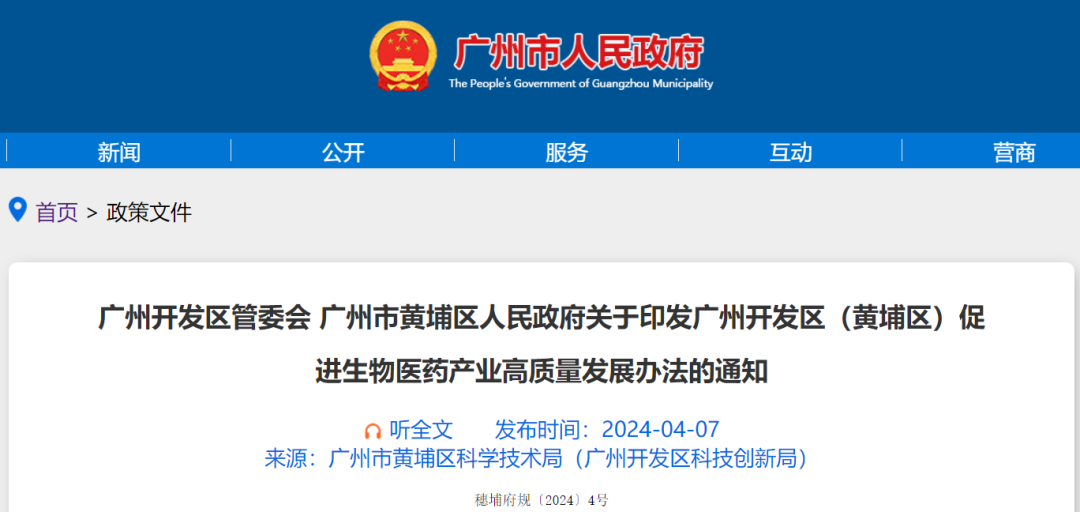
This measure integrates and optimizes Huangpu District's previous specialized policies for the biopharmaceutical industry, creating comprehensive, end-to-end support spanning the entire lifecycle and value chain of biopharmaceuticals. It features four key highlights:
First, we provide comprehensive support for innovation and R&D. We encourage clinical trials of new drugs, accelerate the development and launch of innovative medicines, and expedite the establishment of a world-class hub for biopharmaceutical R&D. For innovative drugs or improved new drugs that complete Phase I, II, and III clinical trials, companies will receive support of up to RMB 10 million, RMB 20 million, and RMB 30 million, respectively. Once a new drug obtains its drug approval certificate or registration approval, an additional subsidy of RMB 10 million will be provided. Combined with the city’s existing policies, this comprehensive support system could enable companies to secure up to approximately RMB 100 million for each new drug launch—making it the most generous incentive program of its kind nationwide.
Second, we will comprehensively build an innovation ecosystem. To reduce R&D costs for SMEs and micro-enterprises, we will attract and nurture leading Contract Research Organizations (CROs) and Contract Development and Manufacturing Organizations/Contract Manufacturing Organizations (CDMOs/CMOs). Specifically, we will provide subsidies for office space rental and service incentives to encourage CROs/CDMOs/CMOs to offer comprehensive, end-to-end services—ranging from drug screening and process development to quality research, pilot-scale production, clinical trials, and regulatory submissions—to innovative SMEs. This initiative aims to accelerate the commercialization of biopharmaceutical innovations, ultimately delivering more cutting-edge pharmaceutical and medical device products to the market.
Third, we will fully push forward innovative applications. After innovative drugs and medical devices are approved for market launch, getting them included in national health insurance and hospital formularies remains a significant hurdle for industry growth. This measure encourages medical institutions to convene their pharmacy committees within one month after the official release of the new National Reimbursement Drug List, providing support to those institutions that procure innovative medical devices or technologies—thus fostering demand-side momentum for industry development.
Fourth, we are fully committed to creating a distinctive ecosystem. We will advance the "New Provincial and Regional Collaborative Regulatory Model for Biopharmaceuticals," systematically identifying key R&D projects in our region—such as innovative drugs and cutting-edge medical devices—and actively promoting their inclusion on the Provincial Drug Administration Bureau's "Triple Innovation" service list, thereby accelerating the product approval and market launch process. Additionally, we will organize and invite representatives from the national and provincial drug regulatory agencies, along with relevant departments, universities, and industry experts, to provide proactive guidance and support throughout the review and approval stages for companies' products.
Original text follows:
Measures to Promote High-Quality Development of the Biopharmaceutical Industry in Guangzhou Development Zone (Huangpu District)
To deeply implement the spirit of the 20th National Congress of the Communist Party of China, seize the significant opportunities presented by global biomedical innovation and industrial transformation, establish a pilot zone for biomedical policy innovation, build a world-class hub for high-quality R&D and innovation, and foster a globally competitive, world-class innovative biomedical industry cluster—this policy has been formulated.
Article 1: These policy measures apply to biomedical enterprises or institutions operating within the Guangzhou Development Zone (Huangpu District) and its entrusted management areas, as well as the parks under its jurisdiction (hereinafter referred to as "this district"), provided they have sound financial systems, independent legal entity status, implement separate accounting practices, and comply with relevant regulations on credit management—unless otherwise specified.
Article 2 [Supporting Globally Outstanding Projects] For several high-potential biopharmaceutical projects led by globally renowned masters and strategic scientists, which demonstrate groundbreaking technological innovations and hold promising prospects for wide-ranging applications, the city and its districts will jointly provide comprehensive support—ranging from talent incentives, R&D and industrialization grants, equity investments, to subsidized loans—during the project’s technology development,成果转化 (成果 transfer), and commercialization phases. This support will be tailored on a case-by-case basis, in accordance with the relevant provisions outlined in the "Several Policy Measures of Guangzhou to Promote High-Quality Development of the Biopharmaceutical Industry" (Guangzhou Municipal Government Office Regulation No. 1 [2024]). The maximum total support amount for these projects will reach up to 5 billion yuan, with a support duration capped at five years. Additionally, the portion of financial resources allocated to these initiatives will be shared equally between the city and districts on a 1:1 basis. To further facilitate project implementation, dedicated service channels will be established to address issues related to land acquisition, planning approvals, regulatory reviews, and even export/import procedures for company products.
Article 3 [Supporting the Commercialization and Industrialization of National-Level Platform Innovations] We will support the implementation and construction of cutting-edge, high-end innovation projects that aim to commercialize and industrialize breakthroughs originating from national laboratories, major national scientific infrastructure facilities, and international mega-science initiatives. In accordance with the relevant provisions outlined in the "Several Policy Measures by Guangzhou to Promote High-Quality Development of the Biomedical Industry" (Guangzhou Municipal Government Office Regulation No. 1 [2024]), projects will undergo evaluation, after which the city and district governments will provide matching funding at a 1:1 ratio, up to a maximum of 30% of the project’s total investment. The maximum support for any single project will not exceed 100 million yuan. (Responsible Units: District Development and Reform Bureau, Science and Technology Bureau, and Finance Bureau)
Article 4 [Accelerating Breakthroughs in Scientific and Technological Innovation]: For innovative drugs, improved new drugs, and biosimilars that have invested more than RMB 10 million in domestic clinical trial and R&D expenses, financial support will be provided in phases—up to 40% of the actual clinical R&D costs incurred—based on the progress of their clinical development. Specifically: once Phase I, II, or III clinical trials are completed and officially recognized, enterprises will receive subsidies capped at RMB 10 million, RMB 20 million, and RMB 30 million, respectively. The maximum annual funding any single company can receive is RMB 100 million. (Responsible Units: District Science and Technology Bureau, Market Supervision Administration)
Article 5 [Enhancing Clinical Trial Capabilities] Medical institutions are encouraged to strengthen their capacity for clinical trials of new drugs. For clinical trial sites that comply with the National Good Clinical Practice (GCP) standards, a subsidy of 300,000 yuan will be provided for each additional GCP-specialized discipline, with a maximum annual support of 1.5 million yuan per institution. (Responsible Unit: District Science and Technology Bureau)
To better enhance the capacity of clinical trial institutions in our district, integrate healthcare resource networks, and support the development of innovative drugs and medical devices, medical institution branch campuses established within the district will receive support following the criteria outlined above.
Article 6 [Support for Conducting Clinical Trials] Clinical trial institutions that provide new drug clinical trial services to pharmaceutical companies in this district and comply with the National Good Clinical Practice (GCP) guidelines will, upon verification, receive support equivalent to 5% of the institution’s total annual service revenue generated from providing these trials to local pharmaceutical firms. The maximum support any single institution can receive is capped at RMB 3 million per year. (Responsible Unit: District Science and Technology Bureau)
Article 7 [Support for Drug and Medical Device Innovation Outcomes] For drugs that have obtained clinical trial approvals from the National Medical Products Administration (NMPA), a subsidy of up to RMB 500,000 will be provided per approval. For drugs that have received drug registration certificates (with different specifications considered as the same product type), a one-time grant of up to RMB 10 million will be awarded per product type. Additionally, for already-marketed drugs that have passed the bioequivalence evaluation for generic drugs or have been designated as reference preparations (again, different specifications treated as the same product type), a subsidy of RMB 1 million will be provided per product type. The maximum annual subsidy for a single enterprise is capped at RMB 20 million. (Responsible Units: District Science and Technology Bureau, Market Supervision Administration)
For products that receive Class II or Class III medical device registration certificates for the first time, a one-time subsidy of up to 1 million yuan will be provided, with a maximum annual subsidy of 10 million yuan per enterprise. (Responsible units: District Science and Technology Bureau, Market Supervision Administration)
For products in categories one, two, and three that receive a new veterinary drug registration certificate, each certificate will be granted a one-time subsidy of RMB 1 million, RMB 600,000, and RMB 400,000, respectively. The maximum annual subsidy per enterprise is capped at RMB 2 million. (Responsible units: District Science and Technology Bureau, Agriculture and Rural Affairs Bureau)
Article 8 [Support for Expanding into Overseas Markets] For new drugs that receive their first U.S. Food and Drug Administration (FDA) approval for clinical trials and are subsequently commercialized within this district, a subsidy of 300,000 yuan will be provided. The maximum annual subsidy per company is capped at 2 million yuan. Additionally, for drugs that obtain FDA approval, secure overseas marketing authorization, and begin generating sales in relevant international markets, a one-time grant of up to 1 million yuan will be awarded per product. (Responsible Unit: District Science and Technology Bureau)
Article 9 [Cultivating Prominent Traditional Chinese Medicine Products] To promote the inheritance, innovation, and development of TCM, we will accelerate the modernization and industrialization of traditional Chinese medicine. We encourage the secondary development of proprietary Chinese medicines and actively support the cultivation of leading TCM products. For proprietary TCM products with annual sales exceeding RMB 500 million and achieving year-on-year growth of 6% or more, a reward of RMB 2 million will be granted. (Responsible Unit: District Science and Technology Bureau)
Article 10 [Accelerating Technical Platform Development] Support will be provided for the establishment of biopharmaceutical animal testing platforms. Specifically, drug development safety evaluation platforms that have achieved Good Laboratory Practice (GLP) certification under the National Medical Products Administration (NMPA) will receive funding equivalent to 30% of their actual construction costs, with a maximum subsidy of up to RMB 10 million. (Responsible Units: District Science and Technology Bureau, Market Supervision Bureau)
Companies are encouraged to commission the aforementioned platforms for drug research and development. For projects incurring annual expenses exceeding 1 million yuan, a subsidy of 10% of the approved amount will be provided, with a maximum annual subsidy of 1 million yuan per company. (Responsible Unit: District Science and Technology Bureau)
Article 11 [Promoting the Cluster Development of CROs] Accelerate efforts to attract and nurture leading Contract Research Organizations (CROs). For CROs that lease self-use office space within this district and have not previously received rental subsidies from the district, a subsidy will be provided equivalent to 80% of their actual rent expenses—provided their annual revenue exceeds RMB 100 million and demonstrates year-on-year growth. The maximum subsidy per enterprise is capped at RMB 1 million per year, with support available for up to three consecutive years. (Responsible Unit: District Science and Technology Bureau)
Contract Research Organizations (CROs) with annual revenues exceeding RMB 100 million, RMB 200 million, RMB 300 million, RMB 500 million, and RMB 1 billion—and demonstrating year-on-year revenue growth—will receive subsidies of RMB 1 million, RMB 2 million, RMB 3 million, RMB 5 million, and RMB 10 million, respectively. (Responsible Unit: District Science and Technology Bureau)
Article 12 [Enhancing Industrialization Capabilities] Leading Contract Development and Manufacturing Organizations (CDMOs/CMOs) are encouraged to actively take on the production of pharmaceuticals and medical devices. For enterprises with CDMO/CMO business revenues exceeding RMB 100 million, those undertaking the manufacturing of innovative drugs, improved new drugs, biosimilars, or medical devices will receive financial support equivalent to 1% of the contractually settled amount. The maximum annual subsidy for a single company is capped at RMB 10 million. (Responsible Unit: District Investment Promotion Bureau)
Article 13 [Facilitating the Implementation of Nationally Negotiated Products] Designated medical institutions shall strictly adhere to the national basic medical insurance drug and other catalogues. For innovative drugs or medical devices listed in the National Medical Insurance Negotiation Catalogue, designated medical institutions participating in the national health insurance program are encouraged to convene their Pharmacy Affairs Committee within one month after the official release of the new edition of the National Medical Insurance Drug List, in order to incorporate these products into their drug procurement lists as needed. (Responsible Unit: District Health and Wellness Bureau)
Article 14 [Accelerating the Application of Innovative Products] Support the market expansion of innovative products, establish mechanisms for their commercial application, and develop and publish a catalog of innovative drugs and medical devices. Medical institutions are encouraged and supported to procure and use products listed in the catalog. (Responsible Unit: District Science and Technology Bureau)
For medical institutions classified as Level 2 or above, a subsidy of 200,000 yuan will be provided to each institution for every new innovative drug or medical device added to their procurement catalog. Additionally, institutions will receive a subsidy equal to 20% of the total amount spent on purchasing these innovative drugs or medical devices. The maximum annual subsidy per hospital is capped at 3 million yuan. (Responsible units: District Science and Technology Bureau, Health and Wellness Bureau)
Actively promote the adoption of innovative products in Guangzhou, fostering continuous innovation and development in the biopharmaceutical industry. Medical institutions in the district that establish branch campuses, research institutes, or research centers will receive support in line with the criteria outlined above.
Article 15 [Office Space Rental Subsidy] For newly established high-quality biopharmaceutical companies with paid-in registered capital exceeding RMB 10 million, a subsidy will be provided equal to 50% of the actual rent paid for self-used office space leased within the district. The subsidy period is three years, with a maximum annual subsidy of RMB 1 million per company. (Responsible Unit: District Science and Technology Bureau)
For major projects that involve leasing new spaces exceeding 5,000 square meters and requiring additional investments of over 100 million yuan, a subsidy will be provided at 30% of the actual rent for the newly leased area. For even larger projects—those leasing more than 10,000 square meters with additional investments surpassing 300 million yuan—a higher subsidy rate of 50% of the actual rent will be offered on the newly leased space. Each enterprise is eligible for a maximum annual subsidy of up to 5 million yuan, with the subsidy period capped at three years. (Responsible Unit: District Science and Technology Bureau)
Article 16 [Optimizing Review and Approval Services] Promote the "New Model of Provincial and Regional Collaborative Regulatory Oversight for Biopharmaceuticals," leveraging the leading role of national laboratories to accelerate the establishment of an integrated "research-and-review linkage" mechanism for innovative drugs and cutting-edge medical devices. Compile a comprehensive list of key R&D projects in the region, including innovative drugs and advanced medical devices, and actively encourage these projects to be included in the Provincial Drug Administration Bureau's "Triple Innovation" service roster, thereby expediting their market launch. Additionally, organize and invite representatives from national and provincial drug regulatory authorities, relevant government departments, universities, and industry experts to provide proactive pre- and in-process guidance and support for companies' product review and approval processes. (Responsible Units: District Science and Technology Bureau, Market Supervision Bureau)
Article 17 [Building a Shared Ecosystem] Support enterprises and institutions located on Bio Island to engage in deep, industry-academia-research-medical collaboration with universities, hospitals, research institutes, and other organizations within Guangzhou. For island-based companies or institutions that utilize laboratories and large-scale equipment from their collaborative partners, a subsidy will be provided equivalent to 30% of the actual expenses incurred for testing and analysis, with a maximum annual subsidy of RMB 300,000 per enterprise or institution. (Responsible Unit: Bio Island Management Committee)
Article 18: For the same project or matter that meets the criteria of this policy and simultaneously qualifies for other support policies within the district (including those requiring district-level matching funds or financial contributions as mandated by higher authorities), support will be provided based on the principle of applying the most favorable, non-duplicative measure—unless otherwise specified. Any tax-related expenses incurred from receiving such support or subsidies shall be borne by the enterprise or organization itself. Additionally, the establishment of new branches, name changes, or business divisions by companies already operating within the district are explicitly excluded from the scope of support under this policy. Entities benefiting from this policy must sign a corresponding commitment letter; should they subsequently breach their commitments, they will be required to repay the full amount of support received.
These policy measures shall come into effect from the date of issuance and will remain in force for a period of three years. For municipal-level policy documents already in effect under this policy, their validity will follow their original provisions; however, if these documents are subsequently revised or reformulated, the latest version shall prevail. If, upon expiration of the policy period, there are still outstanding subsidy funds that have not yet been fully disbursed, the policy will continue to apply until all payments are completed.
Reprint Notice: This article was compiled from the official website of the Guangzhou Municipal People's Government. If any infringement occurs, please contact us for removal.
Related News

Here is the title—h1 placeholder text


Copyright © Jiuzhitang Maker (Beijing) Cell Technology Co., Ltd.
Powered by: 300.cn SEO | Privacy Policy