

News
News Center
Xiong'an officially released! New area-based bio-companies and medical institutions are encouraged to apply for cutting-edge medical technology research projects aimed at conducting clinical studies involving stem cells, leveraging their own technological capabilities.
2024-02-20
On February 18, the official website of Xiong'an New Area in Hebei Province officially released the notice titled "Several Measures (Trial) to Support the Development of Modern Life Sciences and Biotechnology Industries."
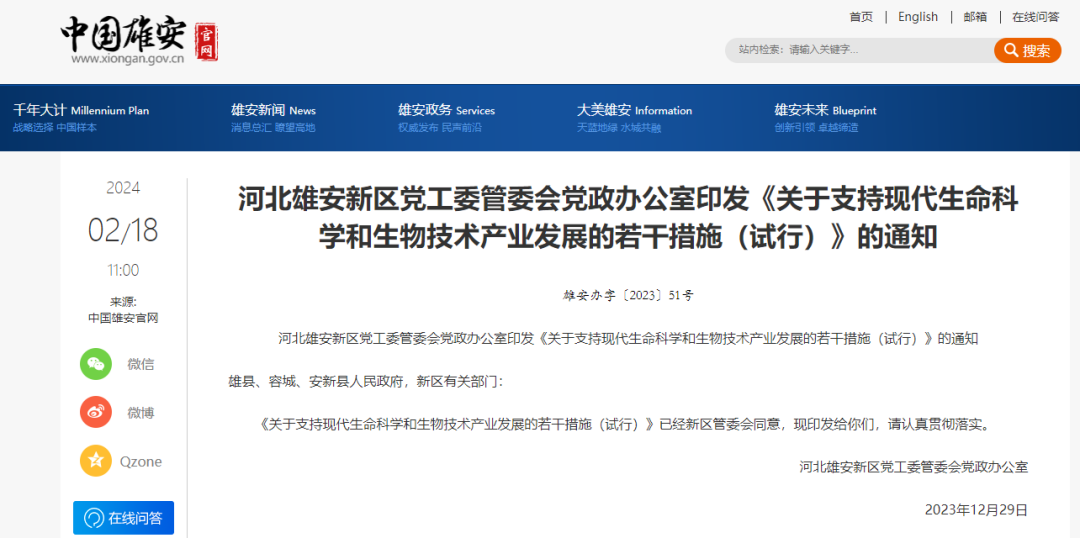
The notice clearly states:
1. Supporting the establishment and development of biomedical enterprises. We encourage large central state-owned enterprises in the biopharmaceutical sector to set up their headquarters and second- or third-tier subsidiaries, or innovative business units, in Xiong'an New Area. Strengthen the development of innovative drugs for major diseases by focusing on biologics, cell therapies, genetic engineering, and tissue engineering, while attracting and concentrating cutting-edge innovation resources to relocate or establish new R&D institutions in Xiong'an New Area. Eligible enterprises will receive priority support—such as in areas like corporate headquarters, office space, technological innovation, and talent recruitment—following the relocation policies.
2. Encourage open collaboration in the biopharmaceutical sector. Support designated medical institutions registered in Xiong'an New Area to legally and compliantly use drugs that have not yet been approved for registration in China but are essential, as they cannot be replaced by domestically available alternatives (excluding vaccines), or medical devices already approved for marketing abroad but for which no equivalent products have yet been authorized in China, thereby fostering the development of high-end healthcare services. Additionally, facilitate international innovative drug and medical device products by leveraging clinical trial data already completed overseas, combined with real-world clinical data studies and evaluations, to expedite their approval and market entry in China through a special review and approval pathway. Encourage biotech companies and medical institutions in the new district to apply for cutting-edge medical technology research projects focused on clinical stem cell studies, based on their respective technical capabilities. ; Supporting new district medical institutions, research organizations, and professional service providers in hosting international biopharmaceutical conferences.
The full text is as follows:
Several Measures to Support the Development of Modern Life Sciences and Biotechnology Industries (Trial)
To thoroughly implement the important speech delivered by General Secretary Xi Jinping during his inspection and chairing of the symposium on advancing the high-standard, high-quality construction of Xiong'an New Area, and in accordance with the "Opinions on Several Policy Measures to Support the High-Standard, High-Quality Development of Xiong'an New Area" (Guofa [2023] No. 10) and the "Several Measures to Support the High-Quality Development of the Biopharmaceutical Industry" (Ji Zheng Ban Zi [2023] No. 98), we will accelerate the promotion of high-quality development in Xiong'an New Area’s modern life sciences and biotechnology industries. Our goal is to establish the region as an innovation hub and industrial powerhouse for the growth of these cutting-edge sectors. To this end, the following measures are formulated.
1. Support the relocation and establishment of biomedical enterprises. Encourage large central state-owned enterprises in the biopharmaceutical sector to set up their headquarters and second- or third-tier subsidiaries, or even innovative business units, in the Xiong'an New Area. Focus on advancing the development of cutting-edge drugs for major diseases—such as biologics, cell therapies, genetic engineering, and tissue engineering—and attract and cluster innovative resources by relocating them to Xiong'an or establishing new R&D institutions there. Eligible companies will receive priority support under the relocation policies, covering areas like corporate headquarters, office spaces, technological innovation, and talent recruitment.
2. Encourage open collaboration in the biopharmaceutical sector. Support designated medical institutions registered in Xiong'an New Area to legally and compliantly use drugs that have not yet been approved for registration in China but are essential as substitutes for domestically available products (excluding vaccines), or medical devices already approved for marketing abroad but not yet authorized in China—particularly those with no equivalent products currently approved here—to develop high-end healthcare services. Additionally, facilitate the use of internationally innovative drug and medical device products by leveraging clinical trial data already completed overseas, combined with real-world clinical data analysis and evaluations, to expedite their approval and market entry into China through a special review and approval pathway. Furthermore, encourage biotech companies and medical institutions in the New Area to submit applications for cutting-edge medical research projects involving clinical studies of stem cells, based on their respective technical capabilities. Finally, support medical institutions, research organizations, and professional service providers in the New Area to host international biopharmaceutical conferences.
3. Encourage investment in research and innovation. Support medical institutions, research institutes, enterprises, and other entities registered and actively operating in the New Area to increase their R&D investment. For those undertaking national or Hebei Province science and technology projects aligned with Xiong'an New Area’s development priorities, up to 1:1 matching funds will be provided, with annual support capped at 20 million yuan per project. Additionally, for tech-focused enterprises and institutions benefiting from the R&D expense additional deduction policy, a 1:3 matching subsidy will be offered based on the provincial-level post-subsidy amount received in the previous year, with a maximum annual subsidy of 5 million yuan per company. Priority will also be given to supporting applications for the Ministry of Science and Technology’s Xiong’an Special Program for Technological Innovation.
4. Support the development of innovation platforms. National-level innovation hubs such as the National Medical Center, the National Center for Traditional Chinese Medicine, and the National Clinical Medical Center will receive financial support of up to 30 million yuan. Additionally, newly recognized national and provincial-level innovation platforms (including key discipline laboratories, enterprise-focused labs, technology innovation centers, enterprise technology centers, engineering research centers, and industrial design centers) will be matched with funding at a 1:1 ratio based on the actual national or provincial special funds they receive. In principle, the matching funds will not exceed 10 million yuan.
5. Accelerate the development of industrial ecosystems. Support pharmaceutical and medical device companies or projects—particularly those led by international teams, holding global patents, expected to achieve significant breakthroughs, and possessing strong international competitiveness—to establish themselves in Xiong'an New Area. For enterprises that independently build their own industrialization bases, with new fixed asset investments exceeding RMB 100 million in the same year (excluding land acquisition costs, as noted below), a financial incentive of up to 20% of the new fixed asset investment amount will be provided, capped at RMB 20 million. The subsidy period for each project will not exceed 3 years. Additionally, newly established biomedical companies in Xiong'an New Area with paid-up registered capital of RMB 100 million or more will receive an establishment subsidy of up to RMB 10 million, contingent on their overall contribution to the local economy. These funds will be disbursed over three years in proportions of 40%, 30%, and 30%, respectively.
6. Promote the development of biomedical industry parks. For newly recognized national-, provincial-, or new district-level bio-industry demonstration bases (including industrial parks, etc.), a subsidy will be provided starting from the year of recognition, covering 20% of the annual operating expenses, with an annual cap of 5 million yuan. Additionally, for companies located within these bases, financial support will be offered at 50% of the annual rent for up to three consecutive years, with each company eligible for annual funding not exceeding 5 million yuan.
7. Support the development of digital healthcare. Encourage digital health products to be first tested in qualified medical institutions within the New Area, accelerating the adoption of smart wearable devices, AI-powered diagnostic and treatment systems, and other innovative software and hardware solutions. A subsidy will be provided at 10% of the total annual procurement cost (including equipment purchase and service fees), with a maximum subsidy of up to RMB 3 million per product and no more than RMB 5 million per institution annually. Additionally, support pilot projects focused on industrial internet innovation in key sub-sectors of biomedicine, offering project units a grant equivalent to 20% of their actual investment—capping the subsidy at RMB 5 million per project. Explore the establishment of a unified internet-based healthcare service and operational platform within the New Area, aiming to optimize resource allocation, enhance service efficiency, reduce costs, and better meet the growing healthcare needs of the public.
8. Supporting the launch and industrialization of pharmaceuticals and medical devices
(1) Preclinical Research: Once an investigational innovative drug (including biologics, hereinafter the same), a biosimilar (including biologics already approved for marketing both domestically and internationally, hereinafter the same), or a Class III medical device approved for inclusion in the National Medical Device Innovation or Priority Review Pathway receives clinical trial approval, the product registration applicant will be awarded a one-time incentive of up to RMB 2 million per product. For other Class III medical devices that obtain clinical trial approval, a one-time subsidy of RMB 500,000 will be provided to the product registration applicant.
(2) Clinical Trials. After innovative drugs and biosimilars under development complete Phase I, Phase II, and Phase III clinical trials, product registration applicants will receive phased clinical trial subsidies totaling up to RMB 10 million per year. Specifically, a subsidy of RMB 2 million will be provided upon completion of Phase I, RMB 3 million after Phase II, and RMB 5 million after Phase III. Additionally, for Class III medical devices that have been approved for inclusion in the National Medical Device Innovation or Priority Review Pathway, a one-time subsidy of RMB 3 million will be awarded to the product registration applicant following completion of clinical trials. For other Class III medical devices, a one-time subsidy of RMB 1 million will be granted after clinical trials are successfully completed. The maximum annual cumulative award amount for individual legal entities—enterprises and institutions—is capped at RMB 20 million.
(3) Industrialization of New Pharmaceutical Achievements. For innovative drugs, improved drugs, and biosimilars that have received drug registration certificates and are being implemented as industrial projects within the Xiong'an New Area, financial subsidies will be provided at up to 30%, 20%, and 15% of the total project investment, respectively, with maximum funding limits of RMB 50 million, RMB 20 million, and RMB 10 million. Additionally, for newly approved traditional Chinese medicine (TCM) innovative drugs that are commercialized in the Xiong'an New Area, a subsidy of up to 20% of the total project investment—capped at RMB 10 million—will be awarded.
(4) Industrialization of medical device innovations. For projects that have successfully obtained a Class III medical device registration certificate through the innovative special review process and are subsequently implemented within the Xiong'an New Area, a funding subsidy of up to 20% of the total project investment—capped at RMB 20 million—will be provided. For other newly approved Class III and Class II medical device projects that are also established in Xiong'an New Area, a subsidy of up to 15% of the total project investment—limited to RMB 10 million—will be awarded. Additionally, eligible first-of-its-kind high-end medical devices and initial batches of advanced biomaterials will receive financial support of up to RMB 10 million and RMB 3 million, respectively. The cumulative annual support for each entity shall not exceed RMB 20 million.
(5) Support companies in applying for overseas registration and certification. For pharmaceuticals and medical devices that receive initial approval from institutions such as the U.S. Food and Drug Administration (FDA), the European Medicines Agency (EMA), the European Community (CE), Japan’s Pharmaceuticals and Medical Devices Agency (PMDA), the World Health Organization (WHO), and the International Council for Harmonisation of Technical Requirements for Pharmaceuticals for Human Use (PIC/S), thereby gaining eligibility for overseas market entry and achieving sales in relevant foreign markets, eligible projects will be selectively supported with funding covering up to 40% of their research and clinical development costs. The maximum annual funding per company under this initiative is capped at RMB 10 million. For new drugs that have successfully obtained an Investigational New Drug (IND) application approval, each drug will receive funding equivalent to 40% of its actual R&D expenditure. Additionally, for biopharmaceutical raw materials registered via the U.S. Drug Master File (DMF), the European Certificate of Suitability to the European Pharmacopoeia (CEP), or Japan’s Master File (MF), each raw material will be funded at 40% of its actual incurred costs. For pharmaceutical excipients approved by China’s National Medical Products Administration (NMPA), each excipient will also receive funding equal to 40% of its actual R&D investment. The total annual funding available per company under these programs is capped at RMB 2 million. Finally, for pharmaceutical products or active pharmaceutical ingredients (APIs) with annual export revenues exceeding USD 10 million, each individual product will receive a subsidy of RMB 500,000. However, the total funding provided to a single company under this scheme will not exceed RMB 2 million.
9. Accelerate the introduction of public service platforms. Speed up efforts to cultivate, attract, and establish contract research organization (CRO) services, contract development and manufacturing organization (CDMO) services, contract manufacturing organization (CMO) services, and contract sales organization (CSO) platforms within the new district. These platforms will receive funding equivalent to 20% of the total project investment as approved after evaluation, with a maximum subsidy cap of 50 million yuan.
10. Encourage the development of the specialized medical food industry. Promote enterprises in obtaining national registration for health foods and special medical-purpose formula foods, and identify companies that demonstrate both the willingness and capability to pursue certification for producing special medical-purpose formula foods. Focus on addressing the key challenges businesses face in registering their product formulas, providing targeted support to help companies secure these critical regulatory approvals. Additionally, newly approved health foods and special medical-purpose formula foods—once they begin production and generate revenue in the Xiong'an New Area—will receive a reward equivalent to 5% of the product’s annual sales revenue. The maximum reward per company will be capped at 10 million yuan annually, with this incentive program continuing for three consecutive years.
11. Promote clinical application and research of pharmaceuticals. Support medical institutions in the New Area to establish clinical research information platforms and clinical trial recruitment platforms. Qualified medical facilities are encouraged to actively participate in drug and medical device clinical trials. Notably, beds exclusively used for clinical trials will not be counted toward a facility’s total bed capacity, and no performance metrics—such as bed utilization rates, turnover rates, or efficiency targets—will apply to these specialized beds. Additionally, innovative drugs developed by registered pharmaceutical companies in Xiong'an New Area that successfully complete Phase I–III clinical trials within China and receive market approval will be incentivized: New Area medical institutions can directly adopt these drugs on a "batch-by-batch approval, immediate implementation" basis, earning a reward of up to 3% of the actual product cost. The maximum annual reward per institution is capped at 5 million yuan, and this incentive will not factor into the institution’s overall drug or consumable spending ratios. Furthermore, medical facilities accredited under Good Clinical Practice (GCP) standards and providing clinical trial services to relevant companies will receive funding from the New Area: Institutions delivering 5, 15, or 30 or more clinical trial service projects annually will be awarded grants of up to 1 million yuan, 2 million yuan, or 3 million yuan, respectively, with the highest award amount available to the leading institution in the region.
12. Building a High-Performance, Open, and Innovation-Driven Cluster for Biopharmaceuticals. Leveraging the free trade pilot zone as a platform, we will accelerate the implementation of cutting-edge biopharmaceutical technologies, innovative policies, and major projects. Within the free trade zone, we aim to establish a premier open innovation hub for biopharmaceuticals, including piloting integrated regulatory measures for natural bezoar imports to boost the healthy development of traditional Chinese medicine. Additionally, we will prioritize the establishment of a gene data center within the free trade zone. Furthermore, we will give top-tier support to companies operating in emerging areas like novel biotherapies and cross-border e-commerce retail drug imports, actively pursuing national pilot programs while providing complementary policy incentives.
13. Building a highland for talent in the biopharmaceutical industry. Support new district medical institutions and key enterprises in attracting innovative resources, focusing on cutting-edge technologies and industry development trends. We will introduce a group of high-caliber talents and their teams, offering them tailored policy benefits—including support for innovation and entrepreneurship, settlement assistance, housing, healthcare, school enrollment for their children, and competitive salaries through special positions. Specific details will align with the district’s established policies for talent recruitment.
14. Support will be provided on a case-by-case basis. Enterprises and institutions that have made significant contributions to the development of the biomedical industry in the Xiong'an New Area, facilitated product launches, or played a guiding and catalytic role in technology transfer and commercialization—and major biomedical projects that demonstrably boost the local economy—will receive support through an "issue-by-issue" approach.
This policy will support initiatives by adhering to the principle of "applying the highest, most favorable, and non-duplicative" approach when overlapping with policies already implemented in the New Area or when multiple preferential measures apply to the same matter. Additionally, the total amount of incentives provided shall not exceed the entity's actual contribution to the New Area's local fiscal revenue for that year. Entities receiving financial support must repay the funds if they voluntarily relocate out of the New Area within five years.
This measure takes effect from the date of its issuance and will remain in force for two years.
Reprint Notice: This article is reprinted from the official website of China Xiong'an. If any infringement occurs, please contact us for removal.
Related News

Here is the title—h1 placeholder text


Copyright © Jiuzhitang Maker (Beijing) Cell Technology Co., Ltd.
Powered by: 300.cn SEO | Privacy Policy