

News
News Center
Zhejiang issues document: Leveraging the Zhejiang Free Trade Zone to explore and advance clinical research in cutting-edge biomedical fields such as stem cell and gene therapy.
2022-06-28
On June 16, the General Office of the Zhejiang Provincial People's Government issued the "Action Plan for Promoting High-Quality Development of the Biopharmaceutical Industry (2022–2024)." The notice outlined: Leveraging the China (Zhejiang) Pilot Free Trade Zone (hereinafter referred to as the Zhejiang FTZ), we will explore and advance clinical research in cutting-edge biomedical fields such as immune cells, stem cells, and gene therapy.
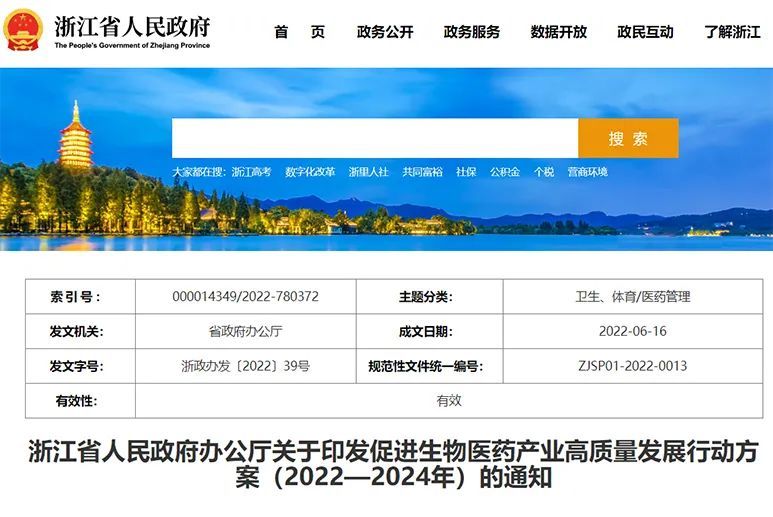
Action Plan for Promoting High-Quality Development of the Biopharmaceutical Industry
(2022–2024)
To accelerate the development of a leading hub for life sciences and health innovation, and to promote high-quality growth in the biopharmaceutical industry, this action plan has been formulated based on our province's specific conditions.
I. General Requirements
(1) Guiding Principles. Guided by digital transformation and aligned with global trends in life sciences and health technology, we will drive the comprehensive development of the biopharmaceutical industry chain, accelerate the establishment of a world-class innovation hub for life and health, and provide critical support for faithfully implementing the "88 Strategy," striving to build an "Important Window," and fostering high-quality development as a demonstration zone for common prosperity.
(II) Main Objectives. By 2024, we will accelerate the development of an industrial spatial layout featuring "one core, two belts, and two circles," aiming to cultivate and establish two biopharmaceutical industry clusters each worth over 100 billion yuan and three more valued at around 50 billion yuan. This will drive the total output value of the biopharmaceutical industry to approximately 450 billion yuan, with R&D expenditures by large-scale biopharmaceutical manufacturing enterprises accounting for 5.5% of their operating revenues. Ultimately, we will essentially build a new ecosystem centered on "Industrial Brain + Future Factory," positioning ourselves as the nation's leading biopharmaceutical manufacturing hub.
II. Key Areas and Spatial Layout
(1) Promote breakthrough developments in biopharmaceuticals. Leveraging Hangzhou's role as a hub for innovation and strategic leadership, we will support the development of innovative pharmaceuticals in cities like Hangzhou and Wenzhou—including antibody drugs, nucleic acid therapies, and recombinant protein medications. Additionally, we’ll assist Hangzhou, Ningbo, Huzhou, Jiaxing, and other regions in accelerating their efforts to establish and expand cutting-edge vaccine platforms, such as next-generation COVID-19 vaccines and critical bioproducts that are currently in high demand. Building on the China (Zhejiang) Pilot Free Trade Zone (referred to as Zhejiang FTZ), we will explore and facilitate clinical research in pioneering biomedical fields like immune cell therapy, stem cell technology, and gene-based treatments. Furthermore, we’ll encourage Ningbo, Wenzhou, Zhoushan, Taizhou, and other regions to cultivate vibrant marine-based pharmaceutical ecosystems, fostering the growth of bio-product industries anchored in marine biological resources.
(II) Promote the large-scale development of high-end medical devices. Support the strategic development of medical device products and molecular diagnostic products in key areas such as next-generation medical imaging, in vitro diagnostics, intelligent rehabilitation, cancer radiotherapy, wearable monitoring devices, and traditional Chinese medicine diagnostics, alongside high-end implantable/interventional products, biodegradable materials, and biomedical materials like those used for human tissue and organ repair and regeneration. Additionally, support the growth of combined pharmaceutical-device products.
(III) Promote the high-end development of chemical drugs. Support Shaoxing, Jinhua, Taizhou, and other regions in leveraging their traditional industrial strengths by focusing on the development of innovative chemical drugs with novel targets and mechanisms, as well as improved new drugs that offer clear clinical value. Additionally, prioritize advancements in cutting-edge drug delivery systems, along with specialized APIs and pharmaceutical intermediates that are in high demand, boast high added value, and address critical market gaps. Together, these efforts will help elevate the production of premium pharmaceutical excipients and establish internationally recognized centers for chemical drug manufacturing.
(4) Promote the inheritance, innovation, and development of modern Chinese medicine. Leverage the advantages of the 26 mountainous counties to build a regional ecological pharmaceutical industry cluster. Guided by clinical value, strengthen research and development of traditional Chinese medicine compound formulations based on classic prescriptions, as well as TCM preparations developed by medical institutions. Additionally, promote the secondary development of renowned and high-quality proprietary Chinese medicines. Accelerate innovation in processed Chinese medicinal materials and Chinese herbal extracts, and encourage the development and application of innovative products such as granulated TCM formulas and TCM-derived derivatives.
(5) Advance the deployment of new business models and formats in the biopharmaceutical sector. Focusing on cities such as Hangzhou, Ningbo, and Taizhou, while fostering collaboration with regions like Wenzhou and Jiaxing, this initiative will explore the application of next-generation information technologies across key areas—including drug development, diagnostic assistance, health management, and disease screening. It aims to drive innovation in R&D, manufacturing, and precision medicine, while also encouraging the growth of specialized outsourcing services like Contract Research Organizations (CROs) and Contract Development and Manufacturing Organizations (CDMOs). Together, these efforts will help create a new "Internet + Healthcare" ecosystem, strengthen research and development in smart medical technologies such as wearable remote diagnostics, and promote the establishment of robust internet-based service platforms.
III. Key Tasks
(1) Implement the Enterprise Cultivation Program.
1. Strengthen and scale up leading enterprises. Deeply advance the "Eagle Action" and "Phoenix Action," increasing policy support in areas such as collaborative innovation across industrial chains, technological upgrades, and cutting-edge scientific research. By 2024, we aim to have cumulatively nurtured 6 leading enterprises with annual output value exceeding 10 billion yuan, while also adding 5 new "Eagle" companies and 20 newly listed (or publicly traded) enterprises. (Responsible units: Provincial Department of Industry and Information Technology, Provincial Local Financial Regulatory Bureau. The entity listed first is the lead unit, as noted below. Governments of all cities, counties (cities, districts) serve as the primary responsible parties and will not be listed separately.)
2. Cultivating "Specialized, Fine, and New" SMEs. We will establish and refine a tiered nurturing mechanism for "specialized, fine, and new" SMEs, while also promoting the development of innovation platforms such as incubators and accelerators. By 2024, the biopharmaceutical sector will have cumulatively nurtured 6 manufacturing Single Champion enterprises, 300 provincial-level "specialized, fine, and new" SMEs, and 30 "hidden champion" companies. (Responsible Units: Provincial Department of Industry and Information Technology, Provincial Department of Science and Technology, Provincial Administration for Market Regulation)
(II) Implement the Industrial Chain Enhancement Project.
1. Accelerate efforts to attract large, high-quality projects. Encourage key cities and counties to fully leverage newly available, reclaimed, and revitalized industrial land to expedite the attraction, development, and cultivation of major projects, as well as the establishment of comprehensive industry chains. Aim to attract more than 10 projects worth over 1 billion yuan each year, and fast-track the implementation of several landmark manufacturing initiatives in the biopharmaceutical sector. (Responsible Units: Provincial Department of Commerce, Provincial Development and Reform Commission, Provincial Department of Industry and Information Technology)
2. Promote collaborative development across the industrial chain. Deeply implement the "Chain Leader + Chain Master" collaborative working mechanism, dynamically nurturing more than 5 leading enterprises within the industrial chain. Annually organize and carry out over 5 collaborative innovation projects and more than 10 projects focused on transforming production and manufacturing processes. Strengthen and refine the vaccine industry chain by accelerating the introduction and deployment of cutting-edge vaccine technology platforms, driving innovation in areas such as recombinant vaccines, multivalent combination vaccines, and novel adjuvants. Additionally, support the construction of vaccine production facilities meeting Level-3 biosafety standards to expedite the commercialization process. Meanwhile, consolidate and enhance the competitive edge in active pharmaceutical ingredient (API) manufacturing, encouraging integrated development of APIs and finished dosage forms in regions like Shaoxing, Jinhua, and Taizhou. (Responsible Units: Provincial Department of Industry and Information Technology, Provincial Development and Reform Commission, Provincial Department of Science and Technology, Provincial Health Commission, Provincial Drug Administration Bureau)
2. Innovate industry safety regulatory approaches. Accelerate the automation upgrades of high-risk process units—such as nitration, chlorination, and fluorination systems—as well as their supporting equipment. Encourage the development of green, intelligent, and compact production equipment and processes, including tubular and microchannel technologies. Support pilot initiatives in Taizhou and other regions to explore innovative, streamlined safety approval and regulatory frameworks for biopharmaceutical contract manufacturing organizations (CMOs) and custom R&D/production projects. Implement comprehensive, end-to-end drug safety oversight, and expedite the deployment of the "smart监管 black box"—a cutting-edge tool for intelligent drug safety monitoring and management. (Responsible Units: Provincial Drug Administration, Provincial Development and Reform Commission, Provincial Health Commission)
4. Drive the digital transformation and upgrading of industries. Develop an industrial ecosystem featuring "Industry Brain + Future Factory," establishing Industry Brains for sectors such as biopharmaceuticals and traditional Chinese medicine, while exploring market-oriented operational models. By 2024, the province will add 5 new Future Factories and 30 smart factories (digitalized workshops) in the biopharmaceutical sector, build 10 provincial-level industrial internet platforms, and achieve an average annual growth rate of 20% in industry-wide investment in technological upgrades. (Responsible Unit: Provincial Department of Industry and Information Technology)
(III) Implement the Innovation and R&D Capability Enhancement Project.
1. Promote the development of major innovation platforms. Strengthen and expand the Institute of Medical Research, Hangzhou (under preparation) of the Chinese Academy of Sciences, and accelerate the construction of provincial laboratories such as those in Xihu, Liangzhu, and Oujiang. Support the transformation of the Xihu Laboratory into a national-level laboratory. Back the establishment of high-level biosafety labs at institutions like Westlake University and Hangzhou Medical College, and strive to establish two National Medical Centers. Additionally, aim to secure the placement of key national scientific and technological infrastructure projects. Encourage local areas to build bio-sample banks, gene banks, and other facilities, while also supporting the development of China Gene Pharmaceutical Valley. (Responsible Units: Provincial Development and Reform Commission, Provincial Department of Science and Technology, Provincial Health Commission, Provincial Drug Administration)
2. Intensify efforts to tackle critical core technologies. Focus on advancing cutting-edge science and addressing major industrial challenges in key areas such as biomedicine, while driving innovation and breakthroughs in both original and essential common technologies. Continuously implement the "Peak, Vanguard, Leading Goose, and Navigator" R&D initiatives, with at least 50 projects scheduled each year. By 2024, aim to achieve a total of 30 landmark, game-changing scientific and technological breakthroughs. (Responsible Unit: Provincial Department of Science and Technology)
3. Accelerate the commercialization of innovation outcomes. Strive to bring key projects from the National Key R&D Program and achievements from the national major science and technology project on "Major New Drug Development" to fruition within our province. Aim to secure approval for 8 additional innovative drugs and 20 innovative medical devices ready for market launch. Support the establishment of provincial-level product transformation centers for pharmaceutical marketing authorization holders and medical device registrants. Additionally, advance the development of a provincial-level intellectual property alliance for the biopharmaceutical industry and create a dedicated biopharmaceutical patent pool. (Responsible Units: Provincial Department of Science and Technology, Provincial Development and Reform Commission, Provincial Department of Industry and Information Technology, Provincial Health Commission, Provincial Market Supervision Administration, Provincial Drug Administration)
(IV) Implement the Clinical Service Capacity Enhancement Project.
1. Enhance the research and innovation capabilities of healthcare institutions. By 2024, establish 8 to 10 domestically leading, research-oriented hospitals, set up 3 to 5 clinical research and training centers within healthcare facilities, and refine mechanisms that link these centers with technology transfer, commercialization, and incentive-based revenue-sharing models. Additionally, apply for designation as a National Health Technology Promotion Demonstration Base, develop shared platforms for resources such as electronic medical records, imaging data, biological samples, and clinical research datasets, and promote the lawful, secure, and orderly open access to public data. (Responsible Units: Provincial Health Commission, Provincial Department of Science and Technology, Provincial Big Data Bureau, Provincial Drug Administration)
2. Strengthen the provision of clinical research resources. Beds allocated for clinical research will not be counted toward the hospital’s total authorized bed capacity, nor will they be included in medical performance evaluation metrics such as bed utilization rates, turnover efficiency, or overall bed productivity. The number of clinical research beds may reach up to 10% of the hospital’s total authorized bed capacity. Clinical research will also be incorporated as a key component into the hospital’s accreditation process. Additionally, we will explore and promote the establishment of regional ethics committees, dedicated research teams, and standardized infrastructure for drug clinical trials, while developing robust systems for clinical trial quality management and ethical review. (Responsible Units: Provincial Health Commission, Provincial Department of Human Resources and Social Security, Provincial Drug Administration)
(5) Implement the project to deepen reforms in the regulatory field.
1. Innovate the review and approval mechanisms. Advance the implementation of the medical device registration (and filing) system, and optimize and refine the post-market drug change management framework. By the end of 2022, aim to reduce the average technical review timeline for Class II medical device initial registrations, change registrations, and renewal registrations in the province to 60 working days; by 2024, strive to further shorten this timeframe to 40 working days. Strengthen the development of the pharmaceutical technology review team and support collaborative efforts among prefecture-level cities to jointly build and share inspector teams. (Responsible Unit: Provincial Drug Administration)
2. Innovate industry safety regulatory approaches. Accelerate the automation upgrades of high-risk process units—such as nitration, chlorination, and fluorination systems—as well as their supporting equipment. Encourage the development of green, intelligent, and compact production equipment and processes, including tubular and microchannel technologies. Support pilot initiatives in Taizhou and other regions to explore innovative, streamlined safety approval and regulatory frameworks for biopharmaceutical contract manufacturing organizations (CMOs) and custom R&D/production projects. Implement comprehensive, end-to-end drug safety oversight, and expedite the deployment of the "smart监管 black box"—a cutting-edge tool for intelligent drug safety monitoring and management. (Responsible Units: Provincial Department of Emergency Management, Provincial Drug Administration Bureau)
3. Deepen regional collaboration in the Yangtze River Delta. Encourage National Drug Marketing Authorization Holders and Medical Device Registrants to engage in contract manufacturing through our province’s platform, and explore a mutually beneficial "flying-land" model. Additionally, study the establishment of cross-regional regulatory cooperation mechanisms and a collaborative framework for mutual recognition and trust in drug and medical device inspections across the Yangtze River Delta. Finally, promote the mutual acceptance of ethical review results from multi-center clinical research conducted in the Yangtze River Delta region. (Responsible Units: Provincial Drug Administration, Provincial Health Commission)
4. Launch pilot programs to facilitate customs clearance. Enhance the streamlined regulatory framework for importing special supplies used in biopharmaceutical R&D, and support the trial implementation of new quarantine measures for imported biological materials in Hangzhou City. Back the development of an integrated customs clearance platform for specialized biological products within the Hangzhou Comprehensive Bonded Zone. Strengthen inspection capabilities and service platforms at pharmaceutical import and export ports, and encourage qualified prefecture-level cities to apply for designation as ports capable of handling imported pharmaceuticals. (Responsible Units: Provincial Department of Commerce, Provincial Drug Administration, Hangzhou Customs, Ningbo Customs)
4. Strengthen Integrated Policy Support
(1) Increase the intensity of fiscal policy support. Implement the policy of additional deductions for R&D expenses, launch a major science and technology special project focused on life sciences and health, and encourage companies developing innovative drugs (Category 1), improved new drugs (Category 2), and cutting-edge medical devices that have entered the special review process to actively apply for provincial key R&D projects, industry-chain collaborative innovation initiatives, and production model transformation programs. These projects will be prioritized for approval under equal conditions, with provincial financial support provided as per regulations. Additionally, cities and counties with sufficient resources are encouraged to step up their efforts in supporting the R&D breakthroughs and industrialization of innovative drugs and medical devices. (Responsible Units: Provincial Department of Industry and Information Technology, Provincial Department of Science and Technology, Provincial Department of Finance, Provincial Tax Bureau, Provincial Drug Administration)
(II) Strengthen policy support for promoting and scaling up innovative products. Dynamically adjust the eligibility criteria for innovative drugs, medical devices, and consumables, optimize the listing process on the provincial medical device procurement platform, and accelerate the timely launch and commercialization of groundbreaking products. Additionally, explore pilot programs for purchasing services that leverage AI-powered diagnostic systems. Finally, support the adoption and promotion of high-quality "Made in Zhejiang" products and first-of-its-kind medical equipment solutions. (Responsible Units: Provincial Department of Industry and Information Technology, Provincial Development and Reform Commission, Provincial Department of Finance, Provincial Health Commission, Provincial Healthcare Security Bureau)
(III) Strengthen efforts to ensure land and environmental resources. Coordinate the land-use needs of the biopharmaceutical industry and support the adoption of flexible land supply models, such as lease-then-transfer or a combination of leasing and transfer arrangements. Promote the integration of environmental impact assessments (EIAs) for both industrial park planning and individual project developments within biopharmaceutical industrial parks. For eligible projects, implement streamlined reforms as prescribed—such as lowering EIA levels, introducing EIA commitment-based filing processes, and simplifying EIA preparation requirements. On the basis that regional environmental quality meets relevant standards, actively seek coordination through provincial-level pollutant discharge reserves to secure total emission quotas for major industrial projects, in accordance with applicable regulations. Under the premise of aligning with industry-specific functional guidelines and ensuring the intended use of the project’s primary industry sector, pilot programs in Zhejiang Free Trade Zone will allow assignees to independently determine the proportion of land allocated for specific industrial purposes. (Responsible Units: Provincial Development and Reform Commission, Provincial Department of Natural Resources, Provincial Department of Ecology and Environment, Provincial Department of Commerce)
(4) Strengthen financial support. Fully leverage the leveraging effect of the provincial industry fund, and encourage government-guided funds and industrial investment funds to channel investments into the biopharmaceutical sector. Innovatively introduce financial support mechanisms such as financing leases and intellectual property-backed loans, and encourage insurance institutions to enhance their related insurance products and services. (Responsible Units: Provincial Department of Economy and Information Technology, Provincial Department of Finance, Provincial Administration for Market Regulation, Provincial Local Financial Regulatory Bureau, Zhejiang Bureau of Banking and Insurance Regulation)
(5) Strengthen support for talent policies. Support high-level talent in the biopharmaceutical sector to apply for major provincial talent programs such as the "Kunpeng Action" Initiative and the Provincial Overseas Talent Attraction Program, with at least 20% of selected candidates coming from the overseas talent pool. Establish a talent database specifically for the biopharmaceutical industry, and encourage the inclusion of urgently needed professionals into the province’s list of scarce talents. Those who meet the criteria outlined in our province’s streamlined review process for high-level, innovative talent may directly apply for senior professional titles. (Responsible Units: Provincial Party Committee Talent Office, Provincial Department of Industry and Information Technology, Provincial Department of Science and Technology, Provincial Department of Finance, Provincial Department of Human Resources and Social Security)
5. Organization and Implementation
(1) Strengthen organizational leadership. Under the Provincial Industrial Transformation and Upgrade Leading Group, a dedicated task force has been established to promote the development of the biopharmaceutical industry and enhance overall coordination. All regions and departments must fulfill their responsibilities, refine working mechanisms, and strengthen policy updates. (Responsible Units: Relevant Member Units of the Provincial Industrial Transformation and Upgrade Leading Group)
(II) Strengthen evaluation and incentives. Establish a statistical system for the biopharmaceutical industry, develop evaluation methods, and create an industry development index. Provide support—through policies related to industry, technology, clinical applications, and resource allocation—to cities and counties that demonstrate outstanding performance in these areas. (Responsible Units: Relevant Member Units of the Provincial Industrial Transformation and Upgrade Leading Group)
(III) Foster a positive environment. Fully leverage the role of industry associations by establishing expert advisory committees and industry development centers specifically focused on the biopharmaceutical sector. Additionally, organize and host a Biopharmaceutical Industry Summit, as well as launch an innovation and entrepreneurship competition. (Responsible Units: Relevant Member Units of the Provincial Industrial Transformation and Upgrade Leading Group)
Related News

Here is the title—h1 placeholder text


Copyright © Jiuzhitang Maker (Beijing) Cell Technology Co., Ltd.
Powered by: 300.cn SEO | Privacy Policy