

News
News Center
The Ministry of Science and Technology has released the 2022 Project Application Guidelines for nine key special projects under the National Key R&D Program, including "Stem Cell Research and Organ Regeneration."
2022-05-05
Professional agencies will review pre-proposals and conduct the first round of evaluations. To ensure fair competition, if the number of applicant teams for a specific, non-targeted guideline area does not exceed the planned number of projects to be supported, that particular guideline will not proceed to the next stage of project review and approval—and instead, the agency will revisit and reissue the guideline at a later date. Meanwhile, professional agencies will carry out a formal review and initiate the first-round evaluation based on the submitted proposals. Notably, project leaders are not required to present their proposals during this initial review phase. Based on the experts' assessments, 3 to 4 times the number of projects intended for funding will be shortlisted for the subsequent defense review. For applications that do not advance to the defense review, the agencies will promptly provide feedback on the evaluation results to both the submitting organizations and the project leaders.
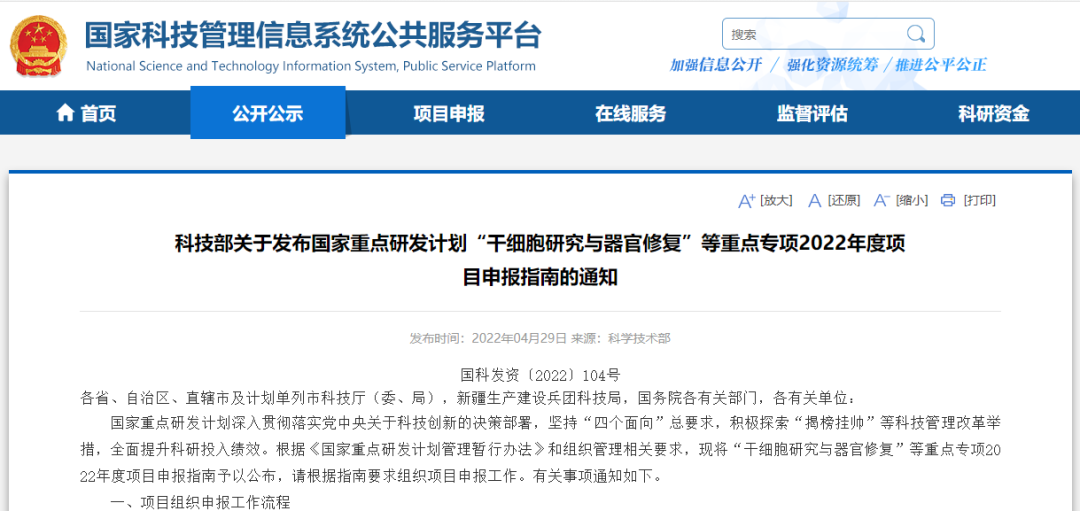
Notice from the Ministry of Science and Technology on the Release of the 2022 Project Application Guidelines for Key Special Projects under the National Key R&D Program, Including "Stem Cell Research and Organ Regeneration"
Published on: April 29, 2022 | Source: Ministry of Science and Technology
National Science and Technology Development Document No. [2022] 104
To the Science and Technology Departments (Commissions/Bureaus) of all provinces, autonomous regions, municipalities directly under the central government, and cities separately listed in the planning system; to the Science and Technology Bureau of the Xinjiang Production and Construction Corps; to relevant departments of the State Council; and to all concerned organizations:
The National Key R&D Program is deeply implementing the CPC Central Committee's strategic plans for scientific and technological innovation, adhering to the overarching principle of "Four Orientations," and actively exploring innovative science and technology management reforms such as the "Challenge-Based Funding" initiative, all aimed at comprehensively enhancing the efficiency of research investment. In accordance with the *Provisional Measures for the Management of the National Key R&D Program* and relevant organizational guidelines, we are now releasing the 2022 Project Application Guidelines for key special projects, including "Stem Cell Research and Organ Repair." Please organize your project applications according to the guidelines provided. Details are outlined in the following notice.
I. Project Organization and Application Workflow
1. Applicant organizations should submit their proposals as projects, aligned with the research areas outlined in the guidelines. Each project may include sub-projects or tasks. Projects must be submitted as a complete package, ensuring that they address all evaluation criteria specified for the relevant guideline area. Each project will have one principal investigator, and each task within the project will also have its own lead researcher. Notably, the project’s principal investigator may simultaneously serve as the lead for one of the tasks.
2. Integrate leading innovation teams and actively recruit female researchers to participate in project development, focusing on the guidelines and tasks at hand. Strengthen coordination among various activities, including foundational research, development of common key technologies, and demonstration of exemplary applications. Pool resources and collaborate across disciplines to tackle challenges collectively. Encourage capable female researchers to take the lead as project or task leaders, assuming prominent roles in driving these initiatives forward.
3. The application process for National Key R&D Program projects consists of two stages: preliminary submission and formal submission, with the specific workflow outlined below.
——Complete the pre-proposal form. Project applicants should, in accordance with the relevant guidelines and requirements, log into the National Science and Technology Management Information System Public Service Platform (http://service.most.gov.cn, hereafter referred to as the "National Science & Technology Management System") to prepare and submit a pre-proposal of approximately 3,000 words. The pre-proposal should provide a detailed explanation of the project’s objectives and key performance indicators, along with a concise overview of the innovative concepts, technical approach, and existing research foundation. Note that there must be at least 50 days between the guideline release date and the deadline for accepting pre-proposals.
The pre-proposal should include relevant agreements and commitments. The lead applicant organization must sign a joint application agreement with all participating entities, clearly specifying the date of signature. Additionally, the lead applicant organization, project sub-award recipients, the project leader, and the sub-project leaders are required to submit letters of integrity commitment. Both the lead applicant organization and all participating units must adhere to the requirements outlined in documents such as "Several Opinions on Further Strengthening Research Integrity" and "Opinions on Further Promoting the Spirit of Scientists while Enhancing Professional Conduct and Academic Atmosphere," ensuring rigorous review and verification of all submitted materials to prevent exaggeration, inaccuracies, or even outright falsification.
The pre-proposal must be recommended by the relevant organizations. Each recommending entity should strengthen its review and quality control of the submitted project materials, ensuring that recommended projects are uniformly reported through the National Science and Technology Management System on time.
Professional agencies will review pre-proposals and conduct the first round of evaluations. To ensure fair competition, if the number of applicant teams for a specific, non-targeted guideline area does not exceed the planned number of projects to be supported, that particular guideline will not proceed to the next stage of project review and approval—and instead, the agency will revisit and reissue the guideline at a later date. Meanwhile, professional agencies will carry out a formal review and initiate the first-round evaluation based on the submitted proposals. Notably, project leaders are not required to present their proposals during this initial review phase. Based on the experts' assessments, 3 to 4 times the number of projects intended for funding will be shortlisted for the subsequent答辩评审 (defense review). For applications that do not advance to the defense review, the agencies will promptly provide feedback on the evaluation results to both the submitting organizations and the project leaders.
——Complete the official application form. For project applications that have passed the first-round review and directly advanced to the defense review, please fill out and submit the official project application form via the National Science and Technology Management System. The official application form will be accepted for 30 days.
Professional organizations will receive and formally review the submitted proposals, then organize a defense and evaluation process. These organizations will conduct a formal review of the proposals that advance to the defense stage and subsequently arrange for the project leaders to present their cases via online video conferencing. Based on the expert panel’s evaluations, the most promising projects will be selected for funding. For guideline areas supporting 1 or 2 projects, only one project will typically receive funding. However, if the top two-ranked proposals demonstrate comparable evaluations but feature distinctly different technical approaches, both could be approved simultaneously. In such cases, a dynamic adjustment mechanism will be implemented, allowing for ongoing assessment at key milestones throughout the project lifecycle. The final decision on how to proceed with support—whether to continue funding one or both projects—will be made based on these periodic evaluations.
II. Recommending Organizations for Application Nominations
1. Relevant science and technology departments and bureaus under the State Council;
2. Science and Technology Authorities of provinces, autonomous regions, municipalities directly under the central government, cities separately listed in the planning system, and the Xinjiang Production and Construction Corps;
3. Industry association established through the transformation of the original industrial sector;
4. Industry-Technology Innovation Strategic Alliances that have been included in the Ministry of Science and Technology’s pilot program and received an A-level evaluation, as well as industry pilot alliances for innovative development in the science and technology service sector, jointly organized by the Ministry of Science and Technology and the Ministry of Finance;
5. Projects led by Hong Kong and Macao research institutions will be recommended separately by the Hong Kong Innovation and Technology Commission and the Macao Science and Technology Development Fund, as required.
Each recommending organization should make recommendations within the scope of its own functions and business areas, and shall be responsible for the authenticity of the projects it recommends. The list of recommending organizations will be publicly released on the National Science and Technology Management System.
III. Eligibility Requirements for Application
1. The leading applicant and participating organizations must be research institutions, universities, enterprises, and other entities registered within mainland China (hereinafter referred to as "Mainland Units"), or Hong Kong and Macao research institutions identified through consultations between the Mainland-Hong Kong and Mainland-Macao Science and Technology Cooperation Committees (list available in Appendix 10). Mainland Units must possess independent legal entity status, have been registered prior to June 30, 2021, demonstrate robust scientific research and development capabilities and infrastructure, and adhere to standardized operational and management practices. Government agencies are prohibited from serving as either the lead applicant or participating organization in this initiative.
The leading applicant organization, participating organizations, and team members all have a strong record of integrity, with no records of serious scientific misconduct currently under penalty enforcement or entries on any relevant public-sector credit "blacklists."
The applying organization can submit only one application for each project through a single recommending entity; multiple submissions or duplicate applications are not permitted.
2. The project (research) leader must hold a senior professional title or possess a doctoral degree, be born on or after January 1, 1962, and dedicate at least 6 months per year to the project. Applicants from Hong Kong and Macao should demonstrate patriotism toward both Hong Kong and Macao, as well as a commitment to national unity.
3. In principle, the project (or research topic) leader should be the researcher who originated the core scientific and technological ideas behind the project and is actually overseeing its execution. Civil servants from central and local government agencies at all levels, as well as public officials from the Hong Kong and Macao Special Administrative Regions (including those involved in managing science and technology programs), are not eligible to apply for projects (or research topics).
4. The principal investigator of a project (or research topic) is limited to applying for only one project (or topic). Individuals serving as principal investigators for ongoing projects under National Key Science and Technology Major Projects, the National Key R&D Program, or the Innovation 2030—Major Projects are prohibited from leading or participating in the application process for new projects (or topics). However, topic leaders may still participate in applying for other projects (or topics).
The project (task) leader and core members may not be leading or participating in more than two ongoing projects—specifically, National Key Science and Technology Projects, National Key R&D Programs, or major initiatives under the Innovation 2030 Framework. Additionally, leaders and core members currently involved in these ongoing projects are prohibited from withdrawing from their current roles to pursue new project applications. Once they leave the original project’s research team, they should, in principle, refrain from either leading or joining new applications for National Key R&D Programs within the original project’s remaining execution period.
Research projects (including tasks or sub-projects) that are ongoing as of December 31, 2022, and whose project task books remain active—including those with approved extensions—are exempt from the limitation.
5. Experts who have participated in the development of key special implementation plans or this year's project guidelines are, in principle, ineligible to apply for projects (research topics) under that same key special initiative.
6. Foreign scientists employed by mainland Chinese institutions, as well as scientists from Hong Kong, Macao, and Taiwan, may serve as project (subject) leaders. Full-time appointees must provide valid documentation of full-time employment issued by their mainland employer, while part-time appointees must submit valid employment letters from both the employing institution in their home region and the mainland-based institution—these documents should be included together as part of the pre-proposal materials.
7. Once a project application is accepted, the applicant organization and the principal investigator cannot be changed in principle.
8. For detailed application requirements, please refer to the respective application guidelines; any special provisions will be followed accordingly.
Before formally submitting project proposals, each applicant organization can use the National Science and Technology Management System to check the status of ongoing national key science and technology projects, key projects under the National Key R&D Program, and major initiatives under the Innovation 2030 program—specifically, any tasks or sub-projects currently in progress—helping to avoid duplicate submissions.
IV. Initiatives for Project Management Reform
1. Regarding the Young Scientist Program: To create more opportunities for young researchers to lead and implement major national R&D initiatives aligned with strategic goals, the Key R&D Program has established the Young Scientist Program. Depending on the specific field and program focus, this initiative may take various forms, such as setting up dedicated Young Scientist Projects or establishing separate Young Scientist Sub-projects within broader programs. Notably, the Young Scientist Program does not involve individual sub-projects, and budget evaluations are generally waived. This approach encourages young scientists to boldly explore innovative, even disruptive, new methods and pathways—empowering them to better contribute to the achievement of the program’s overarching objectives.
2. Regarding the collaboration between ministries and provinces: Certain specialized tasks will be implemented through a coordinated approach involving both national-level strategic initiatives and significant regional industrial development needs. Departments and local authorities will jointly identify key requirements, pool resources collaboratively, and manage projects in tandem. Local governments will introduce tailored policies to effectively adopt and integrate project outcomes, ensuring that major scientific and technological achievements are systematically advanced and successfully translated into practical applications throughout the project’s implementation process.
3. Regarding Technology Readiness Level (TRL) Management: For task areas with clearly defined technology systems and quantifiable evaluation metrics, the "14th Five-Year" Key R&D Program will explore the implementation of TRL management. The application guidelines will specify the required TRL levels, and these metrics will be integrated into subsequent review, project approval, and performance assessment processes. Milestone evaluation points will be scientifically established to closely monitor project progress and manage risks, ensuring high-quality outcomes throughout the initiative.
V. Specific Application Procedures
1. Online Submission: All applicant organizations are requested to complete the online submission through the National Science and Technology Management System as required. The submitted proposals will serve as the basis for subsequent formal reviews and project evaluations by the specialized agencies. Please upload all required supporting documents as electronic scans. If certain materials cannot be provided temporarily due to pandemic-related disruptions, please submit a scanned copy of an explanatory statement issued by your affiliated institution; the specialized agencies may, depending on the situation, request you to provide the missing documents at a later date.
The online submission period for the project applicants to complete and submit their pre-proposals is from 8:00 a.m. on May 20, 2022, to 4:00 p.m. on June 20, 2022. The project applications advancing to the defense and review stage should be formally submitted by the applicant organizations via the National Science and Technology Management System, following the specified requirements. Detailed timelines and relevant guidelines will be announced separately.
2. Organization Recommendations. Please ensure that each recommending organization confirms the recommended projects item by item through the National Science and Technology Management System by 4:00 PM on June 23, 2022, and upload an electronic scanned copy of the recommendation letter, duly stamped with the official seal of the recommending organization.
3. Technical support phone number and email:
010-58882999 (trunk line), program@istic.ac.cn
4. Business Inquiry Phone:
(1) "Stem Cell Research and Organ Repair" Key Special Project Hotline: 010-88225199, 88225123
(2) Key Project Hotline for "Biomacromolecules and the Microbiome": 010-68104344
(3) Key Special Consultation Hotline for "Matter-State Regulation": 010-68104388
(4) Key Project Consultation Hotline for "Catalysis Science": 010-68104776
(5) Key Project Hotline for "Synthetic Biology": 010-88225176, 010-88225178
(6) Key Special Consultation Hotline for "Developmental Programming and Metabolic Regulation": 010-68104388
(7) Key Project Hotline for "Earth System and Global Change": 010-68104432
(8) Key Project Hotline for Gravitational Wave Detection: 010-68104435
(9) Key Project Hotline for "Mathematics and Applied Research": 010-68104460
Please log in to the system and check the application guidelines under the "Public Announcement - Application Guide (2022)" menu.
Ministry of Science and Technology
April 28, 2022
Related News

Here is the title—h1 placeholder text


Copyright © Jiuzhitang Maker (Beijing) Cell Technology Co., Ltd.
Powered by: 300.cn SEO | Privacy Policy