

News
News Center
Beijing issues document: Conducting the initial review of clinical research institution and project filings for stem cells and somatic cells in 2022
2022-04-26
Refine the specialized management approach and systems for scientific research in capital health development under the new circumstances. Complete project approvals for 2022 and fully launch 494 research initiatives. Continuously strengthen the construction of Clinical Research Quality Promotion Centers, leveraging the second batch of 36 Beijing-based centers that have already been accredited to implement a three-tiered quality control system—including self-assessments by project teams, institutional reviews, and third-party audits. Expand and augment the project review and audit teams, refine quality control processes, and enhance the overall quality of project implementation. Additionally, evaluate research outcomes through acceptance checks, performance assessments, outcome tracking, and analysis of current trends in technology transfer/commercialization, while also assessing the overall effectiveness of the studies. Carry out the initial review of registration applications for clinical research institutions and projects involving stem cells and somatic cells, while strengthening policy advisory services and pre-application guidance.
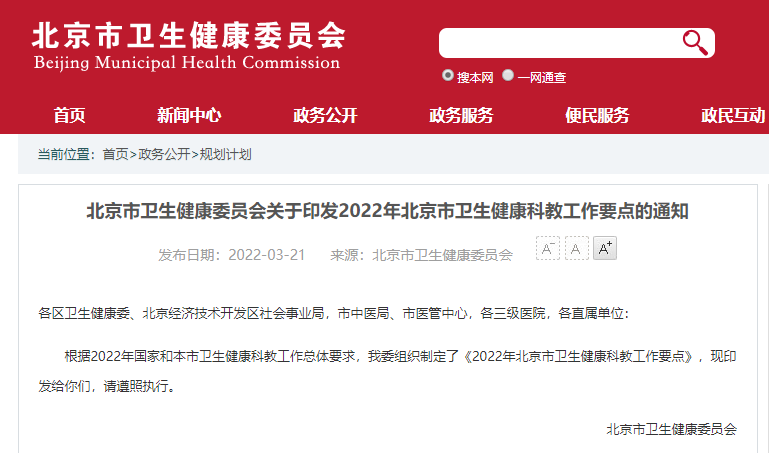
The full text is as follows.
Key Priorities for Beijing's Health, Wellness, and Science Education in 2022
In 2022, Beijing's health, science, and education efforts were thoroughly implemented in line with the strategic plans for building the Beijing International Science and Technology Innovation Center and the "Two Zones." Guided by national and municipal health, science, and education priorities, these initiatives focused on capacity-building as the main driver and quality enhancement as the core objective. They aimed to comprehensively advance health-related scientific innovation, accelerate innovative development in medical education, and strengthen the biosecurity framework. By fostering both groundbreaking innovation and tangible results, these efforts continuously propelled high-quality growth in the capital’s health sector, providing robust scientific and talent support for its sustained development.
1. Effectively drive the COVID-19 prevention and control research projects to yield tangible results.
Conducting an evaluation of the research outcomes from collaborative public health projects. This includes assessing the effectiveness of joint initiatives such as emergency COVID-19 testing, respiratory infectious disease surveillance and early warning systems, molecular tracing efforts, development of protective and disinfection products, intelligent bio-safety monitoring in laboratories, the 5G-based emergency medical information platform, emergency blood supply strategies for sudden public health events, and integrated preparedness and response frameworks for both routine and crisis scenarios. The evaluation will also involve summarizing key findings, analyzing results, and forecasting potential applications for these innovative projects.
II. Fully Promote Innovation in Health and Wellness Science and Technology
(1) Strengthening Clinical Research Capacity Building
Launch the third batch of demonstration projects for research-oriented wards, supporting Capital Medical University in developing a research-focused hospital. Refine the evaluation indicator system for research-oriented wards, conduct comprehensive assessments of their development, and formulate reform plans tailored to both research hospitals and individual research wards. Focusing on specific diseases as pilot initiatives, establish local standards for clinical research data elements and gradually roll out standardized contract templates for select disease areas, thereby enhancing the efficiency and quality of clinical research services. Additionally, strengthen efforts to attract enterprises to these research-oriented wards, actively enabling them to play a unique and vital role in boosting the capital’s pharmaceutical and healthcare industries.
(II) Enhance the Development of a System for Commercializing Scientific and Technological Achievements in Medical and Healthcare Institutions
Deeply implement the "Several Measures to Unblock Bottlenecks in the Commercialization of Scientific and Technological Achievements from Universities, Institutes, and Medical Institutions in Beijing," strengthening working mechanisms, refining the institutional framework, and actively organizing a series of initiatives focused on delivering policies, services, and matchmaking opportunities. Expand the pilot scope of reforms aimed at granting researchers ownership or long-term usage rights over their institutionally-owned scientific and technological achievements. Adopt a multi-pronged approach to support clinical healthcare professionals in advancing technology-transfer-focused research projects. Additionally, launch the construction of the second batch of collaborative innovation centers integrating medicine, research, and industry, and kick off activities to promote 2022’s scientific and technological achievements as well as suitable technologies.
(III) Implement the Capital Health Development Research Special Program
Refine the specialized management approach and systems for scientific research in capital health development under the new circumstances. Complete project approvals for 2022 and fully launch 494 research initiatives. Continuously strengthen the construction of Clinical Research Quality Promotion Centers, relying on the second batch of 36 Beijing-based centers that have already been accredited to implement a three-tiered quality control system—including self-assessments by project teams, institutional reviews, and third-party audits. Expand and augment the project review and audit teams, refine quality control processes, and enhance the overall quality of project implementation. Additionally, review research outcomes by conducting acceptance checks, performance evaluations, outcome tracking, and analyzing current trends in成果转化 (translation: technology transfer/commercialization), while also assessing the overall effectiveness of the studies.
(4) Strengthen the development of industry-specific science and technology governance capabilities.
Strengthen capacity-building for ethical review in human biomedical research, further promote mutual recognition of ethics reviews, explore mutual acceptance of ethics review outcomes among Beijing, Tianjin, and Hebei, initiate assessments of ethics committee capabilities, and investigate the establishment of a regional ethics committee framework. Carry out the initial review of registration applications for clinical research institutions and projects involving stem cells and somatic cells, while strengthening policy advisory services and pre-application guidance. To implement the requirements outlined in national and Beijing municipal documents aimed at strengthening research integrity, we will enhance the research integrity management system and standardize research practices. Additionally, we will launch an audit of clinical research projects, conducting comprehensive evaluations and oversight of investigator-initiated clinical studies to ensure their proper and compliant execution.
3. Accelerate Innovation and Development in Medical Education
(1) Accelerate efforts to enhance the quality and efficiency of standardized residency training.
Focusing on implementing the "two equal treatments" policy for standardized residency training, we will strengthen policy communication and guidance, address issues proactively to ensure effective implementation, and make progress tracking a core indicator in the evaluation of residency training bases. At the same time, we will coordinate and align the training needs of residents and professional master's students, strictly manage the scale of training programs, and firmly prohibit enrollment beyond capacity limits.
Strengthen the management of training centers, ensure compliance with national quality standards for training facilities, and refine and enhance the criteria for accrediting and evaluating these centers. Continuously conduct dynamic assessments of training sites, placing a strong emphasis on monitoring and improving the management and quality of residency training programs. Advance and optimize the development of performance evaluation metrics for residency training centers, incorporating key areas such as "equal treatment" policies, effective management of training funds, and recruitment strategies for in-demand specialties into the assessment framework. Establish a robust faculty-training system centered on the competency of supervising physicians, while further enriching the content of public courses offered within residency programs. Promote proven quality improvement initiatives, including teaching outpatient clinics, dedicated teaching beds, and tiered surgical training programs. Support the establishment of collaborative training networks, continue implementing comprehensive faculty development plans, and roll out innovative quality enhancement projects—such as joint training models between centers, mechanisms for managing resident attrition, and leadership/role-model initiatives spearheaded by leading specialty training hubs.
Reform and improve the systems for process assessment, annual evaluations, and graduation assessments; accelerate the pilot program for unified process assessments; gradually enhance the standardization of process evaluations. Building on the foundation of objective, structured graduation assessments, explore diverse assessment approaches and implement a phased, competency-based modular evaluation system as a pilot initiative. Additionally, establish an arbitration mechanism for clinical practice competency assessments to further enhance the objectivity of the evaluation process.
(II) Steadily advance the standardized training program for specialist physicians
We are developing standardized training programs and supporting measures for specialist physicians. Graduation assessments will be conducted for the first cohort of neonatal perinatal medicine and neurosurgery specialists who have completed their initial training phases. Additionally, the integrated residency-specialty training program for medical and surgical oncology will be revised to enhance its structure, ensuring a curriculum that closely aligns with clinical practice. Based on the national specialty catalog, we will refine training frameworks for specialties such as endocrinology, gastroenterology, critical care medicine, orthopedics, urologic surgery, obstetrics and gynecology, ultrasound medicine, and diagnostic radiology. We will also advance the development of specialized training programs in fields like general surgery, rheumatology and immunology, and oral and maxillofacial surgery, while simultaneously researching and establishing rigorous standards for training facilities.
(III) Strengthening the Development of Grassroots Health Personnel
Implementing the spirit of the "Beijing Municipal Implementation Plan on Reforming and Improving the Training and Incentive Mechanisms for General Practitioners," we will vigorously promote grassroots health workforce development, with a strong focus on building a robust team of general practitioners. This includes in-depth training programs such as assistant general practitioner and general practitioner faculty training, general practitioner career-transition courses, mandatory continuing education modules for community health technicians, on-the-job training for rural doctors, cultivation of key physicians at district-level hospitals, targeted order-based training initiatives for rural and township doctors, and comprehensive clinical residency programs for community-based medical professionals—among other diverse training initiatives designed to strengthen primary healthcare capacity.
(IV) Standardize Continuing Medical Education Management
To implement the national requirements for continuing medical education management, we will strengthen local governance responsibilities, revise and refine our management systems, and enhance the standardization of continuing medical education administration. We will also align with the National Health Commission’s initiative to reduce administrative burdens at the grassroots level by exploring tailored measures specific to Beijing—particularly in areas such as remote continuing education management and the methods used to award continuing education credits. Additionally, we will participate in the national "Verifiable Self-Study Model" pilot project for continuing medical education, testing innovative approaches to verifiable self-learning within the Beijing region. Furthermore, we will leverage "Internet + Continuing Medical Education" by upgrading and modernizing Beijing’s ICME (Information System for Continuing Medical Education), optimizing its functionalities for credit management, program administration, and personnel tracking. We’ll integrate enhanced learning tools into the system, transforming it into a comprehensive information platform that supports training, education, learning record-keeping, and competency assessment for healthcare professionals across Beijing. To ensure relevance, adaptability, and cutting-edge quality, we will roll out online training and assessments covering essential topics like infectious disease prevention and control, ensuring that continuing medical education remains highly targeted and effective. Finally, we will establish a specialized expert team dedicated to advancing high-quality continuing medical education programs. Gradually, we’ll introduce flagship initiatives that set new benchmarks in the field. At the same time, we’ll adopt a balanced approach to managing continuing education—combining regulatory oversight with flexible implementation strategies. This includes intensifying routine monitoring activities, such as rigorous project supervision and meticulous credit verification, to continuously elevate the overall quality of education. Lastly, we’ll invest in strengthening the leadership cadre responsible for managing these efforts, offering specialized training programs, fostering knowledge-sharing opportunities, and promoting collaborative learning practices to further enhance the effectiveness of continuing medical education administration.
(5) Explore the implementation of integrated training programs for hospital pharmacists and clinical pharmacists
Pilot programs will establish an integrated training model for hospital pharmacists and clinical pharmacists, refine the training curriculum and collaborative management framework for training facilities, and strengthen efforts to build a robust faculty team and develop a comprehensive course structure.
(6) Continue to strengthen training and development of public health professionals.
Strengthen the foundational work of integrating medical and public health services, refine training standards, expand training resources, and enhance information system development. Broaden pathways for cultivating master’s and doctoral-level public health professionals. Revise and improve the public health physician training program, conduct accreditation of collaborative public health and clinical training sites in accordance with national standards, and bolster the development of the teaching faculty.
4. Ensuring Laboratory Biosafety
Deepen our city's biosecurity risk monitoring and early warning mechanism, dynamically adjusting the list of laboratories designated to handle key source-related pathogenic microorganisms, while implementing precise control measures. Clearly define emergency drill scenarios and organize these labs to conduct drills, on-site training sessions, and guidance activities, thereby enhancing their capacity to respond effectively to emergencies. Further refine inspection and supervision protocols, along with corresponding operational requirements, and encourage key laboratories handling source-related pathogens to carry out self-assessments and corrective actions, complemented by district-level oversight and city-level unannounced inspections. Finally, systematically follow up on inspection findings through summary evaluations and "look-back" reviews. Additionally, rigorously manage administrative approvals for the transportation and experimental activities involving highly pathogenic microbial strains or samples, strengthening biosecurity risk prevention in human infectious disease laboratories to ensure overall lab safety.
Reprint Notice: This article is reprinted from the official website of the Beijing Health Commission. If there is any infringement, please contact us for removal.
Related News

Here is the title—h1 placeholder text


Copyright © Jiuzhitang Maker (Beijing) Cell Technology Co., Ltd.
Powered by: 300.cn SEO | Privacy Policy