

News
News Center
Big news! Two national ministries jointly issued a document: easing market access restrictions in Shenzhen's pharmaceutical sector, and supporting the development of innovative medical products and technologies such as stem-cell therapies and immunotherapies.
2022-01-26
In accordance with the requirements outlined in the "Opinions of the CPC Central Committee and the State Council on Supporting Shenzhen's Development as a Pilot Demonstration Zone for Socialism with Chinese Characteristics," the "Implementation Plan for the Comprehensive Reform Pilot Program in Shenzhen as a Pilot Demonstration Zone for Socialism with Chinese Characteristics (2020–2025)," and the "Action Plan for Building a High-Standard Market System," and to further strengthen Shenzhen's efforts in establishing itself as a pioneering示范区 of socialism with Chinese characteristics, accelerate the advancement of the comprehensive reform pilot program, continuously promote the easing of market access restrictions, and foster a business environment that is market-oriented, rule-of-law-based, and internationally competitive—thereby driving and leading the Guangdong-Hong Kong-Macao Greater Bay Area to deepen reform and opening-up at an even higher starting point, on a more sophisticated level, and toward loftier goals—the Central Party Committee and the State Council have approved this initiative.
China's pilot zone for socialism with Chinese characteristics eases restrictions
Opinions on Several Special Measures for Market Access
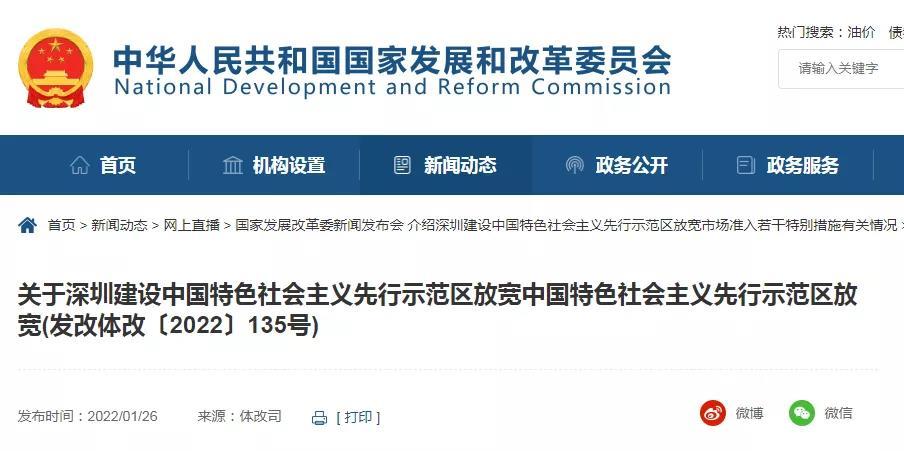
NDRC Document No. 135 of 2022
In accordance with the requirements outlined in the "Opinions of the CPC Central Committee and the State Council on Supporting Shenzhen's Development as a Pilot Demonstration Zone for Socialism with Chinese Characteristics," the "Implementation Plan for the Comprehensive Reform Pilot Program in Shenzhen as a Pilot Demonstration Zone for Socialism with Chinese Characteristics (2020–2025)," and the "Action Plan for Building a High-Standard Market System," and to further bolster Shenzhen's efforts in establishing itself as a pioneering示范区 of socialism with Chinese characteristics, accelerate the advancement of the comprehensive reform pilot program, continuously promote the easing of market access restrictions, and foster a business environment that is market-oriented, rule-of-law-based, and internationally competitive—thereby driving and leading the Guangdong-Hong Kong-Macao Greater Bay Area to deepen reform and opening-up at an even higher starting point, on a more sophisticated level, and toward loftier goals—the Central Party Committee and the State Council have approved this initiative. Six key areas and 24 special measures have been proposed, including support for cutting-edge medical products such as stem cell therapy, immunotherapy, and gene therapy, as well as the development of related technologies.
III. Innovating Market Access Mechanisms in the Pharma and Healthcare Sector
(10) Relaxing market access restrictions for pharmaceuticals and medical devices. Medical device registration inspection reports issued by third-party testing organizations accredited jointly by the CNAS and the National Medical Products Administration are now accepted. We support the wider adoption of real-world data in clinical evaluations spanning the entire lifecycle of pharmaceuticals and medical devices based in Shenzhen—covering pre-market approval and registration for new drugs and devices, post-approval updates to product labeling, as well as safety studies and proactive monitoring after market launch. This initiative will prioritize clinical evaluations in areas such as treatments for clinically urgent needs, rare diseases, AI-driven medical algorithms, precision medicine, and traditional Chinese medicine, thereby accelerating the time-to-market for innovative products while ensuring timely identification and management of risks associated with already approved products. Additionally, we aim to expedite the commercialization and clinical application of AI-based medical algorithms, enhancing their integration into healthcare practices. (Organized jointly by the National Medical Products Administration, the National Health Commission, the State Administration for Market Regulation, and other entities, in collaboration with Shenzhen.)
(11) Pilot program to launch online sales of prescription drugs. The establishment of the Shenzhen Electronic Prescription Center—providing third-party information services to prescription drug retailers—will allow internet-based sales of all domestically approved prescription medications, except for those explicitly banned by the state. These drugs can now be sold online through the electronic prescription center without requiring additional approval. The Shenzhen Electronic Prescription Center will seamlessly integrate with internet-based hospitals, prescription systems used by Shenzhen’s medical institutions, various prescription drug sales platforms, Guangdong Province’s national medical insurance information platform, payment and settlement organizations, and commercial insurance providers. This integration will enable "one-stop online services" for unified collection of prescription-related data, streamlined processes for purchasing prescription drugs, robust security authentication, and efficient medical insurance settlements. Additionally, the center will explore the use of digital RMB for transaction settlements. Shenzhen’s electronic prescription center and relevant local authorities are tasked with developing detailed implementation plans, strengthening management of high-risk medications, and ensuring accountability in critical areas such as cybersecurity, information security, and personal data protection. Leveraging cutting-edge technologies like blockchain and quantum computing, the center will facilitate integrated online-offline supervision, enable full-chain traceability of drug distribution, and guarantee secure data storage. Furthermore, the Shenzhen Electronic Prescription Center will achieve seamless information sharing and mutual recognition with other pilot centers, including the one already approved in Hainan. (Organized and implemented by Shenzhen City in collaboration with the National Development and Reform Commission, the National Health Commission, the National Medical Products Administration, the National Healthcare Security Administration, the China Banking and Insurance Regulatory Commission, and the National Administration of Traditional Chinese Medicine, among other entities)
(12) Optimize approval and access services for human genetic resources. Enhancing Shenzhen's capacity to review and approve human genetic resources, while exploring the establishment of a dedicated management platform for such approvals. Supporting the research and development of innovative medical products and technologies such as stem cell therapy, immunotherapy, and gene therapy, Optimize the approval procedures for human genetic resource activities involving international collaboration in clinical trials, and implement risk-based classification and tiered management for research samples such as human tissues and blood entering or leaving the country, as well as laboratory reagents. While ensuring biosafety, provide streamlined customs clearance for low-risk, high-priority items, while meticulously maintaining comprehensive records throughout all stages—including usage, tracking of distribution, and proper disposal after use. (Organized and implemented jointly by the Ministry of Science and Technology, the General Administration of Customs, Shenzhen City, along with the National Medical Products Administration, the National Health Commission, and other relevant agencies)
(13) Relaxing restrictions on the qualifications and business access of medical institutions. Shenzhen will delegate approval authority for medical practice applications submitted by Hong Kong and Macao service providers, further streamlining the licensing process for wholly-owned and joint-venture medical institutions from these regions. Additionally, professionals with exceptional clinical experience or high peer recognition in overseas healthcare fields will be encouraged to practice in Shenzhen according to established regulations. Finally, efforts will be made to develop a hospital accreditation and evaluation framework aligned with international standards. Support will be provided for designated medical institutions opening in Shenzhen to use urgently needed clinical drugs already approved in Hong Kong and Macao, as well as cutting-edge medical devices that have been procured and used in public hospitals in Hong Kong and Macao—and are recognized for their advanced clinical applications—while also exploring the possibility of launching international telemedicine consultations. Establish a regional ethics center in accordance with international standards for pharmaceutical research, providing guidance on ethical review processes for clinical trial institutions. The center will also accept commissions from institutions lacking the necessary ethical review capabilities to conduct ethical reviews of clinical trial protocols. Additionally, we encourage healthcare institutions to collaborate with Contract Research Organizations (CROs) to enhance their technical expertise and quality management in medical clinical trials. Furthermore, we will optimize and refine the approval and filing procedures for traditional Chinese medicine (TCM) preparations within healthcare facilities, supporting pilot programs for TCM clinical trials and post-marketing evaluations. We also encourage the development of modern, research-oriented TCM hospitals. Moreover, we will support qualified private hospitals in establishing standardized residency training bases. Finally, we will scientifically formulate plans for the allocation of large-scale medical equipment, refining the evaluation criteria for such equipment. In particular, we will fully consider the equipment needs of privately-run healthcare institutions when determining the overall number of devices allocated, thereby fostering the growth and development of private healthcare providers. (The National Health Commission, the Ministry of Human Resources and Social Security, the National Medical Products Administration, the State Administration of Traditional Chinese Medicine, the General Administration of Customs, and other relevant departments will collaborate with Shenzhen to implement this initiative according to their respective responsibilities.)
Reprint Notice: This article is reprinted from the official website of the National Development and Reform Commission. If any infringement occurs, please contact us for removal.
Related News

Here is the title—h1 placeholder text


Copyright © Jiuzhitang Maker (Beijing) Cell Technology Co., Ltd.
Powered by: 300.cn SEO | Privacy Policy