

News
News Center
Centennial Jiuzhitang: Pioneering Global Regenerative Medicine and Embracing China's Stem-Cell Pharmaceutical Era
来源:China Securities Journal - CS.com
2018-09-21

Li Zhenguo, Chairman of Jiuzhitang, delivers a speech.
A major breakthrough has been reported in China's stem cell therapy field.
On September 14, Jiuzhitang, a century-old Chinese medicine enterprise, announced the establishment of the Jiuzhitang Yonghe Qihang Fund and signed an investment agreement with Stemedica Cell Technologies, a U.S. company based in San Diego’s Biotech Valley—home to one of the world’s leading biopharmaceutical hubs—with over a decade of experience in stem cell research, development, manufacturing, and marketing. Under the agreement, Jiuzhitang Maker (Beijing) Cell Technology Co. will introduce cutting-edge stem cell production technologies and a state-of-the-art preparation platform from a globally renowned stem cell firm. Over the next 3 to 5 years, the company plans to build a commercial-grade stem cell production facility at the Daxing Biomedical Industry Base in Beijing, adhering to both U.S. and EU cGMP standards.
Industry insiders believe this move marks Jiuzhitang's official entry into the research, clinical development, and industrialization of stem-cell therapies, signaling that China's era of stem-cell-based pharmaceuticals is set to accelerate.
Hundreds of attendees, including 2004 Nobel laureate Professor Aaron Ciechanover, international expert in clinical stem cell research Dr. Joseph Maroon, renowned U.S. pediatric neurosurgery chief Professor Michael Levy, Stemedica’s Chief Medical Officer Dr. Alex Kharazi, Professor Zhang Yanan from Beijing Tiantan Hospital affiliated with Capital Medical University, Professor Tian Ye from the First Affiliated Hospital of Harbin Medical University, as well as Professor Yuan Baozhu, Director of the Cell Resource Storage and Research Center at the China National Institute for Food and Drug Control, jointly witnessed the launch ceremony marking Jiuzhitang’s entry into the stem-cell pharmaceutical sector.
From stem cell research to stem cell-based pharmaceuticals
Increasingly, clinical cases are demonstrating that stem cell technology is poised to revolutionize the future of human medicine. At the Global Stem Cell Industry Development Summit held that day, experts from institutions such as the School of Medicine at UC San Diego in California and Beijing Tiantan Hospital affiliated with Capital Medical University shared compelling case studies showcasing the application of stem cells in areas like stroke treatment, neurology, and cardiology. Data reveals that nearly 6,000 stem cell clinical trials are currently registered worldwide—up significantly from just 800 a decade ago. As groundbreaking advances continue in basic research and clinical applications accelerate, stem cell technology is rapidly unlocking vast market opportunities. By 2020, the global stem cell market is projected to reach $400 billion, while China’s stem cell market alone could soar to 120 billion RMB. It is precisely for this reason that countries around the world are now positioning stem cell research as a strategic emerging industry critical to enhancing their international competitiveness in the realm of human health.
The stem cell industry consists of three key components: stem cell collection and storage, stem cell-based drug development and research, and clinical treatment and application. "Our goal is to develop stem cell-based pharmaceuticals," says Gao Yansong, CEO of Jiuzhitang Maker. He notes that China currently has over 140 stem cell-related companies, with the vast majority focused on collection, storage, and research into stem cell drug production. Meanwhile, advancing clinical applications remains a critical area where greater efforts are needed. Globally, 13 stem cell therapies have already been approved, yet China still lags behind in this space. Domestically, stem cell applications primarily fall into two categories: clinical trials and ongoing clinical research. Although health authorities mandate that stem cell technologies used for clinical treatments must undergo rigorous approval processes, unauthorized stem cell therapy programs continue to proliferate widely. This chaotic situation is significantly hindering the healthy growth of the stem cell industry.
To address the chaos, at the end of 2011, the Ministry of Health (now the National Health Commission) and the State Food and Drug Administration issued a ban mandating that China cease using any unapproved stem cells in treatments and clinical trials by July 1, 2012—and also halt the acceptance of new applications for stem cell-based clinical projects. In August 2015, the National Health and Family Planning Commission (now the National Health Commission), together with the State Food and Drug Administration, jointly released the "Provisional Measures for the Administration of Clinical Research on Stem Cells," China's first regulatory document specifically tailored to stem cell–based clinical research, sparking a fresh wave of industry enthusiasm.
On October 25, 2016, the Central Committee of the Communist Party of China and the State Council jointly issued the "Healthy China 2030" Planning Outline, vigorously promoting pharmaceutical innovation and industrial transformation in China. Among these efforts, regenerative medicine—led by stem cell technology—is emerging as a key direction for the future of medical advancement. Stem cell technology has been continuously highlighted as a research priority, featured for multiple consecutive years in various national and regional science and technology development plans and specialized guidelines.
"Developing and applying stem cells requires massive financial investment, and the entry of major corporations will undoubtedly accelerate this process while also driving the refinement of stem cell quality standards," analyzed Yuan Baozhu, Director of the Cell Resource Storage Research Center at the Institute of Biological Products Testing, China National Institute for Food and Drug Control. She added that every step of the stem cell preparation—from manufacturing and in vitro testing to in vivo animal studies, clinical research involving human implantation, and ultimately clinical treatment—must involve rigorous research and quality control measures to ensure the cells meet high standards in terms of cell quality, safety, and biological efficacy."
Yuan Baozhu highlighted key challenges such as large-scale stem cell preparation and standardized storage—issues that Jiuzhitang Maker is dedicated to addressing. "We’ve introduced Stemedica’s globally advanced stem cell production technology and manufacturing platform, enabling the world’s leading capability for scalable stem cell expansion and overcoming critical technical hurdles in turning stem cells into viable pharmaceutical products," said Gao Yansong, CEO of Jiuzhitang Maker.
Launching Clinical Trials: Accelerating the Path to Market for Stem Cell Therapies
U.S.-based Stemedica, located in San Diego—the epicenter of the U.S. biotechnology and pharmaceutical industry, is the first U.S. company approved to conduct clinical research using stem cells for Alzheimer’s disease treatment. It is also one of only a handful of U.S. biotech firms certified by the FDA to carry out stem-cell drug trials, and among the very few companies worldwide capable of producing both human bone marrow mesenchymal stem cells and human neural stem cells.

Dr. Aaron Ciechanover, 2004 Nobel Laureate, delivers a speech
Turning stem cells into pharmaceutical products is the strategic development path chosen by Jiuzhitang for its stem cell-based product initiatives. Stem cell drugs represent some of the most complex medications in human history, posing significant technical challenges that scientists worldwide are working tirelessly to overcome. As scientific research continues to advance and technology evolves, countries around the globe are gaining deeper insights into cell-based therapies, while regulatory frameworks and approval pathways are steadily improving. In recent years, China has accelerated its healthcare system reforms, introducing a growing number of policies aimed at encouraging innovation in drug development. The CFDA has already released a series of guiding principles specifically tailored to stem cell technologies, and it has once again begun accepting applications for clinical trials involving stem cells—effectively opening the door for stem cell-based medicines to enter the market.
As U.S.-based technology is steadily transferred, Jiuzhitang is building a state-of-the-art production facility in Daxing—fully designed and constructed to meet both U.S. and EU cGMP standards. Once operational, this site will enable the company to produce 900,000 consistent, highly active therapeutic-grade stem cells from just one donated bone marrow sample, achieving world-leading scalability in stem cell manufacturing and addressing the critical technical challenges that have long hindered the development of stem-cell-based therapies. Leveraging Stemedica Corporation’s existing advancements while continuously innovating, Jiuzhitang Maker plans to advance clinical trials across key therapeutic areas, including neurology, cardiovascular and cerebrovascular diseases, endocrinology, and orthopedics. Currently, the company is finalizing documentation and preparing for the regulatory process, with an anticipated submission to the CFDA within the year.
Meanwhile, Jiuzhitang Maker has also signed cooperation agreements with Mexico’s Novastem Cell Technology Company and Kazakhstan’s ALTACO Cell Technology Company, respectively, to jointly establish an international stem cell research and development platform.
As Li Zhenguo, Chairman of Jiuzhitang Co., Ltd., stated, the company aims to leverage its strong position in the traditional Chinese medicine industry while tapping into the global expertise of stem-cell technology. By combining China’s time-honored traditional medicine with cutting-edge stem-cell biotechnology, Jiuzhitang aspires to forge a pioneering path of innovation for China’s century-old pharmaceutical enterprises. Meanwhile, Jiuzhitang Maker’s deep collaboration with the U.S.-based Stemedica Company marks a significant milestone as a leading Chinese traditional medicine enterprise takes an important step toward advancing pharmaceutical innovation.
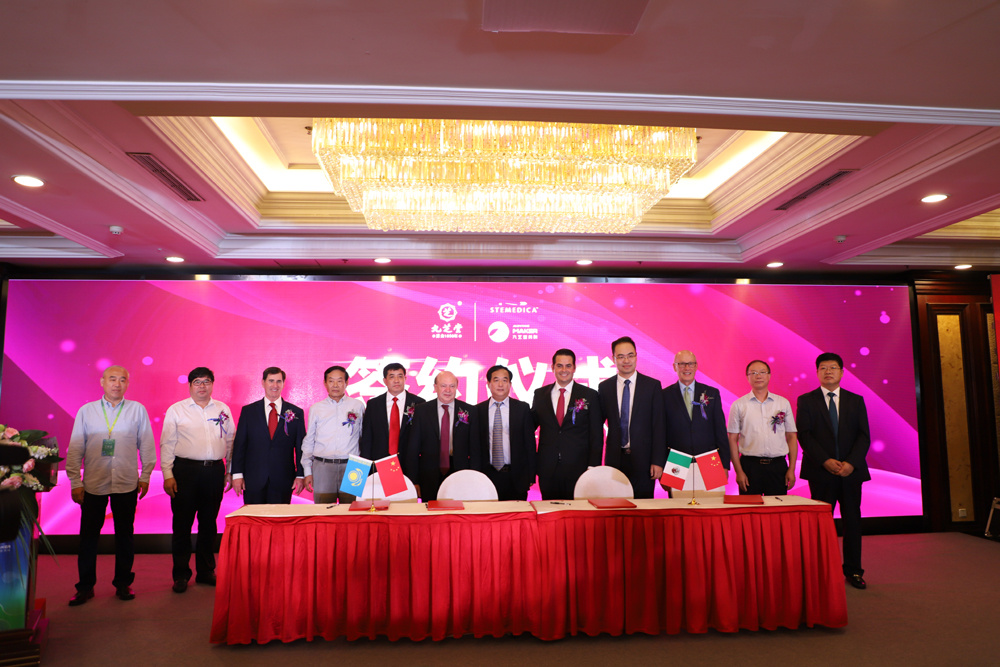
The signing ceremony venue
As a pioneer in the development of stem-cell-based pharmaceuticals in China, Jiu Zhi Tang remains steadfast in its commitment to becoming a global leader in regenerative medicine. The company will continue proactively building an international network for research, development, production, and application, playing an active role in enhancing the competitiveness of China’s stem-cell-based drug industry and driving forward the growth of the country’s regenerative medicine sector. (Text by Zhong Hua)
Related News

Here is the title—h1 placeholder text


Copyright © Jiuzhitang Maker (Beijing) Cell Technology Co., Ltd.
Powered by: 300.cn SEO | Privacy Policy