

News
News Center
Medical and research institutions within Shenzhen's Qianhai-Shekou Free Trade Zone can carry out research and translational applications of cutting-edge technologies such as stem cells and immune cells, in accordance with relevant regulations.
来源:Shenzhen People's Congress Website
2020-09-04
On September 1, China's first legislation specifically tailored for a free trade zone— the "Shenzhen Special Economic Zone Qianhai-Shekou Free Trade Pilot Zone Regulations" (hereafter referred to as the "Free Trade Zone Regulations")—along with the revised "Shenzhen Special Economic Zone Qianhai Shenzhen-Hong Kong Modern Service Industry Cooperation Zone Regulations" (hereafter referred to as the "Cooperation Zone Regulations"), were officially released and will both take effect on October 1.
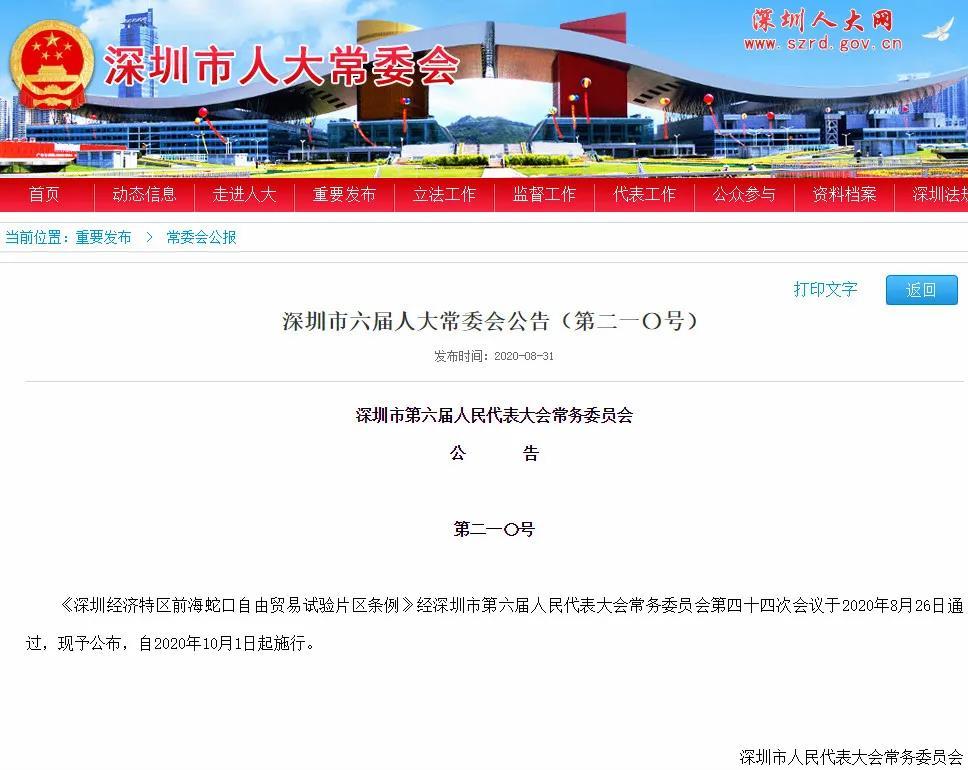
The full text is as follows
Regulations of the Qianhai-Shekou Free Trade Pilot Zone in Shenzhen Economic Special Zone
Table of Contents
Chapter 1 General Provisions
Chapter 2: Management System
Chapter 3: Investment Liberalization
Chapter 4: Trade Liberalization
Chapter 5: Financial Openness and Innovation
Chapter 6: Regulation and Services
Chapter 7: The Rule of Law Environment
Chapter 8: Supplementary Provisions
Chapter 1 General Provisions
Article 1: To advance the construction and development of the Shenzhen Qianhai-Shekou Area of the China (Guangdong) Pilot Free Trade Zone, continuously enhance the level of trade and investment liberalization and facilitation, establish a institutional framework aligned with an open economy, and drive the development of the Guangdong-Hong Kong-Macao Greater Bay Area as well as Shenzhen’s role as a pioneering demonstration zone for socialism with Chinese characteristics, this regulation is formulated based on the fundamental principles outlined in the "Outline of the Development Plan for the Guangdong-Hong Kong-Macao Greater Bay Area," the "Regulations on the China (Guangdong) Pilot Free Trade Zone," and relevant laws and administrative regulations.
Article 2: This regulation applies to the Shenzhen Qianhai-Shekou Area of the China (Guangdong) Pilot Free Trade Zone, established with the approval of the State Council, as well as to the areas expanded with State Council approval (hereinafter referred to as the Free Trade Zones).
Article 3: The free trade zone shall center on institutional integration and innovation, fostering a business environment that is market-oriented, rule-of-law based, and internationally competitive. It will establish a new open economic framework, drive deeper cooperation between Guangdong, Hong Kong, and Macao, and strive to become a premier new high ground for reform and opening-up in the new era—characterized by convenient investment and trade, prominent radiation and driving capabilities, safe and efficient regulation, and an even stronger rule-of-law environment—as well as a world-class, high-level free trade pilot zone with significant international influence.
Article 4: The construction and development of the free trade zone shall adhere to the principles of expanding openness, fostering innovation, and promoting free trade.
Chapter 2: Management System
Article 5: The free trade zone shall establish a management system characterized by clear accountability, inter-departmental collaboration, efficient operations, and openness and transparency, all in line with the principles of open innovation, streamlined administration with empowered authorities, integrated regulation and oversight, and enhanced service delivery.
Article 6: The Free Trade Zone Management Committee (hereinafter referred to as the Committee) is an agency dispatched by the Municipal People's Government and is responsible for performing the following duties:
(1) Coordinately advance development, reform, and institutional innovation within the free trade zone, and formulate, draft, and implement development plans and policy measures for the zone.
(II) Responsible for administrative management and public services related to investment, trade, finance, talent, technology, and other areas within the free trade zone;
(III) Responsible for specific tasks such as free trade zone planning and urban development, while coordinating the overall promotion of industrial layout within the zone and overseeing the attraction, construction, and management of major investment projects.
(4) Coordinate the administrative management work of departments such as taxation, financial regulation, customs, and maritime affairs within the free trade zone;
(5) Organize and implement credit management and regulatory information-sharing initiatives;
(6) Perform duties related to national security reviews and antitrust reviews in accordance with the law;
(7) Perform other duties assigned by the State Council, the People's Government of Guangdong Province, and the Municipal People's Government.
With approval from the city's organizational and staffing department, the management committee may establish working departments with administrative functions to carry out relevant responsibilities externally.
The division of responsibilities for the expanded area of the free trade zone, approved by the State Council, will be separately stipulated by the municipal people's government.
Article 7: The Municipal People's Government may delegate municipal-level administrative powers required for the development of the free trade zone to the Management Committee, while providing guidance, coordination, and oversight over the exercise of these delegated authorities.
Article 8: The Municipal People's Government shall comprehensively study the free trade zone policies and development plans, decide on major issues related to the development of the free trade zone, guide pilot reform initiatives, and coordinate affairs pertaining to the free trade zone with the central government, Guangdong Province, and Hong Kong and Macao.
Relevant departments of the Municipal People's Government and the governments of the respective jurisdictions shall, within their respective areas of responsibility, legally assume the administrative management duties for the free trade zone area.
Article 9: The Shenzhen Qianhai Local Financial Regulatory Bureau exercises municipal-level local financial regulatory powers within the free trade zone, performing corresponding duties such as administrative licensing, administrative penalties, administrative enforcement, and administrative inspections. It is also responsible for overall coordination, statistical analysis, and investigative work in the field of local financial management within the free trade zone, and may formulate pioneering regulatory systems tailored to the specific needs of the area.
Shenzhen's Qianhai Local Financial Regulatory Bureau can launch a pilot program for comprehensive financial supervision, supported by cooperative and coordinated regulation, to explore the establishment of a cross-border financial innovation regulatory zone.
Article 10: The comprehensive administrative enforcement agency of the free trade zone exercises administrative penalty, administrative enforcement, and administrative inspection powers in management areas including commerce, intellectual property, market supervision, transportation, ecological environment protection, water resources, labor inspection, culture (encompassing press, publishing, radio, film, and television, as well as copyright), urban management, natural resources, and workplace safety.
Article 11: The integrity supervision agency of the Free Trade Zone, authorized by the Shenzhen Supervisory Commission, shall perform its supervisory duties over activities related to the development, construction, operation, and management of the Free Trade Zone.
Article 12: Departments such as taxation, financial regulation, customs, and maritime affairs shall, within their respective areas of responsibility, provide legal support for the development of the free trade zone.
Establish a coordination mechanism for financial supervision in the free trade zone, involving the national financial regulatory authority's Shenzhen-based office, the municipal local financial regulatory authority, and the Shenzhen Qianhai Local Financial Supervision and Administration Bureau.
Article 13: Establish a social governance system jointly built, governed, and shared by the government, the market, and society; encourage various social organizations to participate in the governance of the free trade zone in accordance with the law.
Article 14: Drawing on the industry management mechanisms of Hong Kong and Macao, we will promote alignment with their industry standards and regulatory frameworks. We will also leverage the roles of industry associations and chambers of commerce in setting technical standards and guiding industry development, while strengthening self-regulatory management within the free trade zone's industries.
Encourage international industry and standards organizations to establish their headquarters within the free trade zone, eliminate the prerequisite approval from the business supervisory authority when applying for establishment and registration, streamline the registration process, allow them to recruit members globally, and enable them to operate under regulations aligned with those outlined in the Shenzhen Special Economic Zone Industry Association Ordinance.
Chapter 3: Investment Liberalization
Article 15: Except for areas subject to national access management—such as those involving national security, social stability, ecological conservation redlines, and significant public interests—explore establishing institutional arrangements that fully liberalize investment access.
Article 16: Implement the pre-establishment national treatment for foreign investment, adopt a negative list management system, and uphold the principle of non-interference unless violations occur. Additionally, explore pilot policies and measures to encourage foreign investment.
Gradually easing or removing market access restrictions for foreign investors in sectors such as finance, logistics, information services, technology services, cultural services, professional services, and healthcare—including requirements related to qualifications, equity ownership ratios, and business scope.
Article 17: Implement the series of agreements under the Closer Economic Partnership Arrangement between the Mainland and Hong Kong and Macao, explore removing entry restrictions for investments made by Hong Kong and Macao enterprises within the free trade zones, promote the implementation of a negative list management system for cross-border trade in services with Hong Kong and Macao, and foster full liberalization of service trade between the mainland and these two regions.
Article 18: Promote the concentration of key industries in the free trade zone; support major projects in sectors such as finance, logistics, information services, technology services, scientific and technological innovation, and cultural creativity to establish a presence within the free trade zone; and encourage private capital to participate systematically in the development of industries like education, healthcare, and elderly care services in the free trade zone.
Encourage domestic and foreign investors to establish multi-format headquarters within the free trade zone; support multinational corporate headquarters and international organization offices in setting up shop in the free trade zone.
Relevant policies supporting key industries and the headquarters economy will be formulated separately by the Management Committee.
Article 19: Eligible Hong Kong and Macao business entities may, after registering in the free trade zone, legally engage in relevant business activities. Specific measures will be formulated separately by the Municipal People's Government.
Chapter 4: Trade Liberalization
Article 20: Explore implementing an open, transparent, efficient, and convenient regulatory model for the import and export of goods.
Implement a streamlined customs clearance model for goods in special regulatory zones, introducing trade facilitation and liberalization measures—primarily focused on security-based supervision—for goods entering or leaving the physical perimeter of these zones from overseas.
Implement digital customs supervision, leveraging advanced technologies such as IoT and artificial intelligence to enhance the efficiency of clearance and regulatory processes.
Simplify cargo import and export clearance procedures, enabling all regulatory authorities to conduct a single on-site inspection, submit one declaration, perform one inspection, and authorize release in a single visit.
Article 21: Expand the cross-border trade-specific features of the International Trade Single Window, and promote its integration into service trade sectors such as technology trade, service outsourcing, and maintenance services.
Building a digital and smart port, leveraging IT infrastructure to advance one-stop international trade services in the free trade zone, and accelerating the development of customs clearance infrastructure that is globally competitive.
Article 22: Innovate cross-border tax regulation facilitation measures, promote the implementation of export tax rebates from ports of departure, tax refunds for overseas travelers upon departure, and duty-free policies for the import and sale of exhibits at trade shows. Additionally, explore tax policies that align with the growth of overseas equity investments and offshore trade activities.
Article 23: Promote the facilitation of foreign exchange receipts and payments, as well as settlement, for cross-border merchandise trade, service trade, and new forms of international trade. Optimize the review process for trade-related foreign exchange documents; allow trade-related foreign exchange earnings to bypass the verification account altogether; and eliminate the registration procedures for special remittance return transactions.
Article 24: Import goods, products, and services within the free trade zone will be managed via a list-based system. Products and services listed can adhere to internationally recognized standards. The list of product and service standards will be formulated separately by the Management Committee.
Article 25: Establish a new international trade center, promote the development of trade in services, explore ways to improve the service trade statistics system, and set up a service trade monitoring mechanism. Additionally, foster offshore trade by innovating offshore trade-related foreign exchange services and strengthening the offshore trade settlement framework.
Article 26: Promote coordinated development between special customs supervision zones and their surrounding areas, and foster the emergence and growth of new business models such as bonded R&D, bonded financial leasing, bonded exhibition trading, and bonded testing and repair services.
Encourage enterprises to engage in cross-border science and technology R&D innovation activities, and support overseas research institutions in Shenzhen's Qianhai Comprehensive Bonded Area to benefit from Qianhai's cross-border equipment bonded policies.
Promote the development of cross-border e-commerce international distribution platforms equipped with overseas warehouse capabilities; and support eligible enterprises in expanding high-value-added industries such as global cultural and artistic exhibitions, auctions, and trade.
Article 27: Support the free trade zone area in collaborating with ports along the Belt and Road, expanding information sharing with pilot ports along the route, achieving data interconnectivity, and promoting mutual recognition of regulatory enforcement practices.
Article 28: Establish an international high-end shipping service center and implement the "China Qianhai" ship registry system for international vessel registration. Enterprises legally established within the free trade zone will be permitted to register all their vessels internationally in Shenzhen, with no restrictions on the foreign ownership ratio of these enterprises. Additionally, foreign crew members will be allowed to serve as senior officers on vessels registered under this international system in Shenzhen, and all crew members will be exempt from obtaining employment permits.
Implement quality management for ship registration, gradually easing statutory inspections and age restrictions for vessels registered under the "China Qianhai" flag. Approved foreign survey companies will also be permitted to conduct classification and statutory inspections of ships registered under the "China Qianhai" flag.
Under the premise of effective regulation and controllable risks, domestically manufactured ships registered at the "China Qianhai" ship registry for international transport will be treated in accordance with export management regulations.
Pilot international bunkering operations with bonded liquefied natural gas for ships operating in the free trade zone. Establishments of offshore bonded fuel oil supply warehouses will be permitted. The use of RMB for pricing and settlement of bonded fuels is encouraged.
Article 29: Establish a yacht entry-exit credit management system and eliminate the customs guarantee deposit requirement for yachts engaging in independent travel. Explore implementing a negative list system for navigation waters accessible to Hong Kong and Macao yachts, allowing free navigation in waters not listed as restricted. Promote innovative cross-border clearance models for Hong Kong and Macao residents traveling by yacht, and investigate establishing a filing system for yacht-supplied materials to facilitate the liberalization of customs clearance for both yacht tourists and onboard supplies. Additionally, consider introducing a visa-free transit policy for foreign visitors entering via cruise ship homeports, support the establishment of international transfer zones at passenger terminals, streamline immigration procedures, and extend port clearance service hours.
Article 30: Drawing on the internationally recognized rules governing free trade zones and free trade ports, Shenzhen's Qianhai Comprehensive Bonded Area will be developed into a new type of comprehensive bonded zone characterized by complete functionality, efficient operations, sound rule of law, and strong international competitiveness.
Article 31: Build a green and eco-friendly free trade zone, adopt internationally recognized environmental protection and energy management system standards, promote low-carbon certification for export products, and establish a green supply chain.
Chapter 5: Financial Openness and Innovation
Article 32: Enhance the level of financial sector opening-up, support pilot implementation of national financial reform and innovation policies within the free trade zone, and establish a national demonstration window for opening up the financial industry to the outside world.
Article 33: Explore establishing a unified domestic and foreign currency banking account system based on free trade accounts, develop a multifunctional free trade account framework, and facilitate cross-border trade, investment, and financing settlements.
Article 34: Support the free trade zone in establishing a pilot zone for cross-border RMB business innovation, and encourage eligible enterprises to engage in cross-border financial activities as per regulations. Enterprises are encouraged to use RMB as the primary currency for settling large-scale cross-border trade and investment transactions, thereby expanding both the scope and scale of RMB’s cross-border usage and enhancing channels for the return of offshore RMB funds. Additionally, we will support and collaborate with Hong Kong in developing its offshore RMB center, fostering the establishment of unified domestic and foreign currency pooling accounts that integrate functions for managing, allocating, and consolidating funds in both currencies. This will enable two-way macroprudential management of cross-border capital flows within the pool, allowing funds held in the main account to be used for foreign exchange settlement and sale, as well as related hedging derivative transactions. Importantly, the currency of funds transferred out of the pool must remain consistent, and the use of pooled funds will be governed by a negative list approach. Furthermore, we will actively work to establish and refine the Cross-Border Wealth Management Connect mechanism, positioning the free trade zone as a premier hub for cross-border wealth management. Finally, while optimizing and upgrading existing trading platforms, the free trade zone is encouraged to explore opportunities that permit non-residents to participate in trading activities and conduct fund settlements in accordance with applicable regulations.
Article 35: Support banking financial institutions in issuing cross-border loans—denominated in any currency—to institutions and projects in Hong Kong and Macao, under the macroprudential framework. Additionally, support securities trading institutions in establishing a Greater Bay Area bond platform, fostering an international bond market that attracts both domestic and overseas investors.
Article 36: Explore and advance the free flow of capital into and out of the free trade zone, as well as its free convertibility. Guided by the principles of integrated planning, support for the real economy, controllable risks, and phased implementation, steadily promote capital account convertibility.
Article 37: Enterprises may freely utilize funds raised from overseas for business activities both within the free trade zone and abroad. Eligible financial institutions can independently allocate overseas-raised funds, as well as income generated from providing cross-border services, toward investment activities inside the free trade zone and overseas. We will support the high-quality development of the factoring industry within the free trade zone and encourage exploration of international factoring operations. Additionally, we will back free trade zone-based financing leasing companies in conducting operational leasing businesses that allow them to collect rental payments in foreign currencies, fostering innovation in business models and driving the clustered growth of the financing leasing sector.
Article 38: Deepen financial technology cooperation with Hong Kong and Macao, establish platforms for fintech collaboration, and promote the implementation of technological achievements such as artificial intelligence, big data, and cloud computing in the financial sector within the free trade zone.
Promote the cross-border use of RMB and facilitate foreign exchange management; explore new mechanisms for cross-border trade finance and international payment clearing; support coordinated cooperation with financial regulators in Hong Kong and Macao to build a next-generation cross-border payment system, while enhancing monitoring and analysis of cross-border fund flows.
Support green finance cooperation with Hong Kong and Macao, establish a mutual recognition mechanism for green projects, develop Shenzhen-Hong Kong-Macao green bond standards aligned with international practices, and encourage financial institutions and enterprises in the free trade zones to issue green bonds and other green financial products in Hong Kong and Macao.
Article 39: Promote cross-border financial product transactions in sectors such as banking, securities, and insurance between the free trade zone and Hong Kong and Macao, explore a single-passport system, and establish mechanisms for mutual recognition of products, seamless capital flows, and interconnected markets.
Article 40: Support eligible Hong Kong and Macao insurance institutions in establishing operational entities within the free trade zone; also, encourage Hong Kong and Macao insurers to set up after-sales service centers in the free trade zone.
Support banking and financial institutions in the free trade zone to provide cross-border fund exchange services—such as claims processing, policy renewal, and policy surrender—to mainland residents who have already purchased insurance products from Hong Kong and Macao. Additionally, support financial institutions in the insurance sector to collaborate with their international counterparts in developing cross-border medical insurance products.
Article 41: Support the diversified development of innovative financial business models, and encourage qualified international financial headquarters, fund management centers, as well as national-level financial headquarters, business operation hubs, and major financial projects to establish themselves in the free trade zone.
Support the establishment of the International Ocean Development Bank in the free trade zone, vigorously promote marine finance, and contribute to Shenzhen's development as a global ocean-centric city.
Chapter 6: Regulation and Services
Article 42: The free trade zone should innovate its regulatory approaches, shifting from ex-ante approval to ongoing and post-event supervision, and establish a diversified, comprehensive oversight mechanism that integrates administrative regulation, industry self-regulation, and social oversight.
Article 43: The Management Committee may, based on development needs, propose a list of municipal and district-level administrative approval authorities to be exercised. After obtaining approval from the competent authority through the prescribed legal procedures, these powers will be implemented.
Article 44: Tax administration-related services within the free trade zone will be handled in a specialized and centralized manner, gradually reducing or eliminating upfront verification processes. Instead, a "process-first, verify-later" approach will be implemented, separating the processing stage from the verification process altogether.
Article 45: Establish a system for compiling a list of urgently needed talent in the free trade zone, regularly publishing a roster of high-demand positions to broaden international recruitment channels. Additionally, create an international talent public service platform that centrally handles services such as subsidies and incentives, housing support, education and healthcare, immigration procedures, and residency permit processing.
Article 46: Support the free trade zone in launching a pilot program for talent immigration, simplifying procedures for foreign professionals regarding employment, entry/exit, and residence permits within the zone. Additionally, encourage foreign technical talents in the free trade zone to apply for permanent residency in China.
Article 47: Professional talents holding foreign professional qualifications in fields such as finance, taxation, construction, planning, accounting, law, design, patent agency, and tour guiding may legally provide services within the free trade zone. Their overseas work experience will be recognized as equivalent to domestic work experience. Specific implementation measures will be formulated jointly by the Management Committee and relevant industry authorities. With the exception of professions involving national sovereignty and security, foreign nationals will be permitted to apply for and take part in China’s national professional qualification exams within the free trade zone.
Article 48: Support the free trade zone in exploring innovations in international internet services, promoting cross-border data flows, and advancing information infrastructure development, thereby fostering a globally competitive ICT environment.
Article 49: Support the development of credit services such as enterprise credit reporting, credit rating, credit guarantee, and credit consulting; encourage credit service institutions to legally leverage database information to develop innovative credit products.
Article 50: Medicines and medical devices urgently needed for clinical use in healthcare institutions within the free trade zone—specifically those already approved for marketing in Hong Kong and Macao but not yet registered for use on the mainland—may be used at designated healthcare facilities in the free trade zone. Detailed management measures will be formulated by the Municipal People’s Government. Physicians and nurses from Hong Kong and Macao, after completing the necessary registration procedures, will be permitted to practice at multiple locations within the free trade zone. The validity period of their practice registration in the free trade zone must align with the employment agreement they have signed with the healthcare institution.
Article 51: Medical and research institutions within the free trade zone may, based on their own technical capabilities and in accordance with relevant regulations, carry out research and translational applications of cutting-edge technologies such as stem cells, immune cells, gene therapy, monoclonal antibody drugs, and tissue engineering.
Article 52: The free trade zone should strengthen coordinated development with other regions, collaboratively pursue institutional innovations in areas such as investment, trade, and finance, align policy support measures, and enhance cross-regional collaborative pilot programs and experience-sharing initiatives.
Chapter 7: The Rule of Law Environment
Article 53: Support the free trade zone in comprehensively enhancing its rule-of-law development, guided by the principles of being a pioneer in trials, promoting coordinated efforts, and leading with the rule of law. Use the rule of law to clearly define the boundaries between government and market, fostering a world-class, internationally recognized business environment that is stable, fair, transparent, and predictable.
Article 54: If regulations enacted by the Shenzhen Municipal People's Congress and its Standing Committee contain provisions that no longer align with the development needs of the free trade zone, the Shenzhen Municipal People's Government may submit a proposal to the Standing Committee of the Municipal People's Congress to temporarily adjust or suspend the application of such provisions within the free trade zone. Similarly, if regulations issued by the Shenzhen Municipal People's Government include provisions that no longer meet the developmental requirements of the free trade zone, the Management Committee may recommend to the Municipal People's Government that these provisions be temporarily adjusted or suspended within the free trade zone.
Article 55: Establish a system for assessing the rule-of-law environment in the free trade zone. The Management Committee may entrust third parties to conduct comprehensive and specialized assessments of the rule-of-law environment in the free trade zone, and the assessment results will be publicly disclosed.
Article 56: Support the establishment of specialized international commercial dispute resolution bodies within the free trade zone, and exercise judicial jurisdiction over international commercial transactions—such as cross-border and offshore deals—related to the zone, in accordance with the law. Additionally, explore the possibility of hearing international commercial cases that lack a direct connection but for which the parties have explicitly agreed on jurisdiction.
Article 57: Offshore transaction dispute parties shall, in accordance with the law, be guaranteed the right to freely choose between applying foreign law or internationally recognized commercial rules and practices—provided that such choice does not contravene China’s fundamental legal principles or undermine national sovereignty, security, and public interests.
Encourage the parties to mutually agree on selecting a specialized international commercial dispute resolution body within the free trade zone for jurisdiction.
Article 58: Judicial authorities in the free trade zone are encouraged to hire qualified legal professionals from Hong Kong and Macao to participate in handling foreign-related cases, in accordance with relevant regulations. Additionally, expert judges and prosecutors who are well-versed in international trade rules as well as financial, intellectual property, and international commercial law principles will be selected.
Article 59: Free trade zone arbitration institutions are encouraged to draw on international commercial arbitration practices, refine arbitration rules tailored to the unique characteristics of the free trade zone, and establish the Guangdong-Hong Kong-Macao Greater Bay Area as a global hub for international arbitration. Commercial mediation organizations are also encouraged to engage in dispute resolution across international commercial, maritime, investment, intellectual property, and other fields, fostering a diversified dispute-resolution framework that seamlessly integrates mediation, arbitration, and litigation.
Article 60: Innovate the intellectual property protection mechanisms within the free trade zone, establishing an integrated IP management and enforcement system that aligns with international standards. Strengthen the IP rights protection framework and develop diversified dispute-resolution mechanisms, creating a demonstration zone for robust IP protection efforts. Additionally, enhance the overseas IP rights protection infrastructure, foster specialized IP service providers, and support the growth of platforms dedicated to resolving IP disputes abroad.
Article 61: Hong Kong legal practitioners and Macao practicing lawyers who meet the eligibility criteria and have obtained mainland practice qualifications by passing the Guangdong-Hong Kong-Macao Greater Bay Area Lawyers Qualification Examination may, in accordance with regulations, engage in legal services within the free trade zones.
Chapter 8 Supplementary Provisions
Article 62: The Municipal People's Government may formulate specific implementation measures in accordance with these Regulations.
Article 63: These Regulations shall come into effect on October 1, 2020.
Related News

Here is the title—h1 placeholder text


Copyright © Jiuzhitang Maker (Beijing) Cell Technology Co., Ltd.
Powered by: 300.cn SEO | Privacy Policy